
China Index Research Institute: Renewal of industrial and commercial land in first-tier cities to achieve multiple breakthroughs and rents to usher in new opportunities?
The Zhitong Finance App learned that the China Index Research Institute said that the gradual improvement of industrial and commercial land renewal policies has created conditions for commercial rent conversion projects to extend the operating period and expand asset exit methods. In the short term, project implementation still depends on location conditions, transformation costs, leasing requirements, and renewal and exit arrangements. The development of the industry is more likely to be dominated by the implementation of high-quality projects. As subsequent projects advance, the bridging effects of relevant policies between land renewal, renovation and operation, and asset securitization will be further demonstrated, and the market is also expected to gradually develop replicable practical experiences.
The China Index Research Institute pointed out that in recent years, stock non-residential properties such as commercial offices and industrial parks in some key cities have faced problems such as slow removal, declining occupancy rates, or rent pressure. At the same time, some existing properties located in convenient transportation, industrial population agglomeration areas, and well-equipped surrounding areas still have renovation and operation value. For such assets, conversion to rental housing not only helps improve the efficiency of the use of inefficient properties, but also supplements the supply of rental housing in key regions.
After years of practice, commercial leasing has accumulated some experience in the transformation of building functions, project renovation, and mortgage certification, etc., but the length of land use is still an important factor affecting the long-term operation and capitalization exit of the project. Some of the commercial land in stock has a short period of time remaining. Even if the renovation is completed, the project may face problems such as insufficient operating periods, limited asset valuation, and difficulties in matching the life of public REITs.
Therefore, the value of industrial and commercial land renewal policies is not only to extend the period of land use, but also to supplement the period conditions required for long-term operation and capital withdrawal for commercial leasing projects. Since 2026, cities such as Shanghai and Guangzhou have successively promoted the construction of industrial and commercial land renewal systems, but different cities have different ways to solve the problem. Whether commercial rent conversion can move from case to case to large-scale still depends on whether conditions such as land, renovation, operation, and financial withdrawal can be established simultaneously.
01. Renewal of industrial and commercial land and conversion of building functions to provide institutional conditions for commercial leasing
In 2026, the central level will further refine the institutional arrangements for stock revitalization and land use renewal.
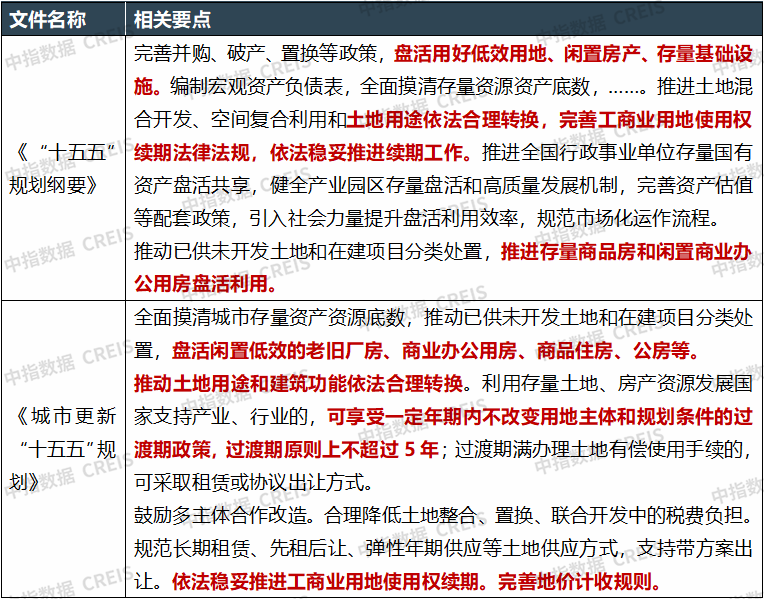
In March, the “Outline of the “15th Five-Year Plan” proposed “improving laws and regulations on the renewal of industrial and commercial land use rights, and steadily advancing the renewal process in accordance with the law”, and made arrangements to revitalize inefficient land use and idle real estate, and promote the rational conversion of land use in accordance with the law.
In May, the “Fifteenth Five-Year Plan” for Urban Renewal was further proposed to steadily promote the renewal of industrial and commercial land use rights in accordance with the law and improve land price calculation rules. It also emphasized that it will promote the rational conversion of land use and building functions in accordance with the law.
The two documents separately put forward work requirements in areas such as inventory asset revitalization, land use conversion, industrial and commercial land renewal, and land price calculation, providing direction for the local authorities to further improve relevant policies.
Table: Content related to industrial and commercial renewal management in the “15th Five-Year Plan” programmatic document
Source: Comprehensive compilation by the China Index Research Institute
Non-residential properties such as commercial offices and industrial parks in first-tier cities are large, and some vacant projects have renovation and utilization value in terms of location, transportation, facilities, and construction conditions. At the same time, first-tier cities have high population and industrial concentration, and demand for rental housing is relatively stable, providing a good market foundation for “non-residential to rent”. In recent years, various regions have successively explored functional transformation of non-residential buildings and renovation of rental housing, but due to factors such as land management systems, industrial structure, and urban renewal progress, policy tools and reform priorities are different.
The Shanghai policy mix is most closely linked to the complete life cycle of commercial leasing projects: the commercial building functional compatibility policy mainly addresses compliance issues during the renovation phase of the project, while the industrial and commercial land renewal policy provides long-term support for the long-term operation of the project and the exit of REITs.
In June 2024, the “Shanghai Action Plan to Promote the Renewal and Upgrading of Commercial Buildings (2024-2027)” was released, proposing to promote 40-50 commercial building renewal and renovation projects over three years.
In July 2025, the “Implementation Opinions on Promoting the Renewal and Upgrading of Commercial Buildings in Shanghai” were issued to allow existing inefficient commercial buildings to be compatible with rental housing functions for up to 15 years on the premise that the subject, property certificate nature, and main structure remain the same.
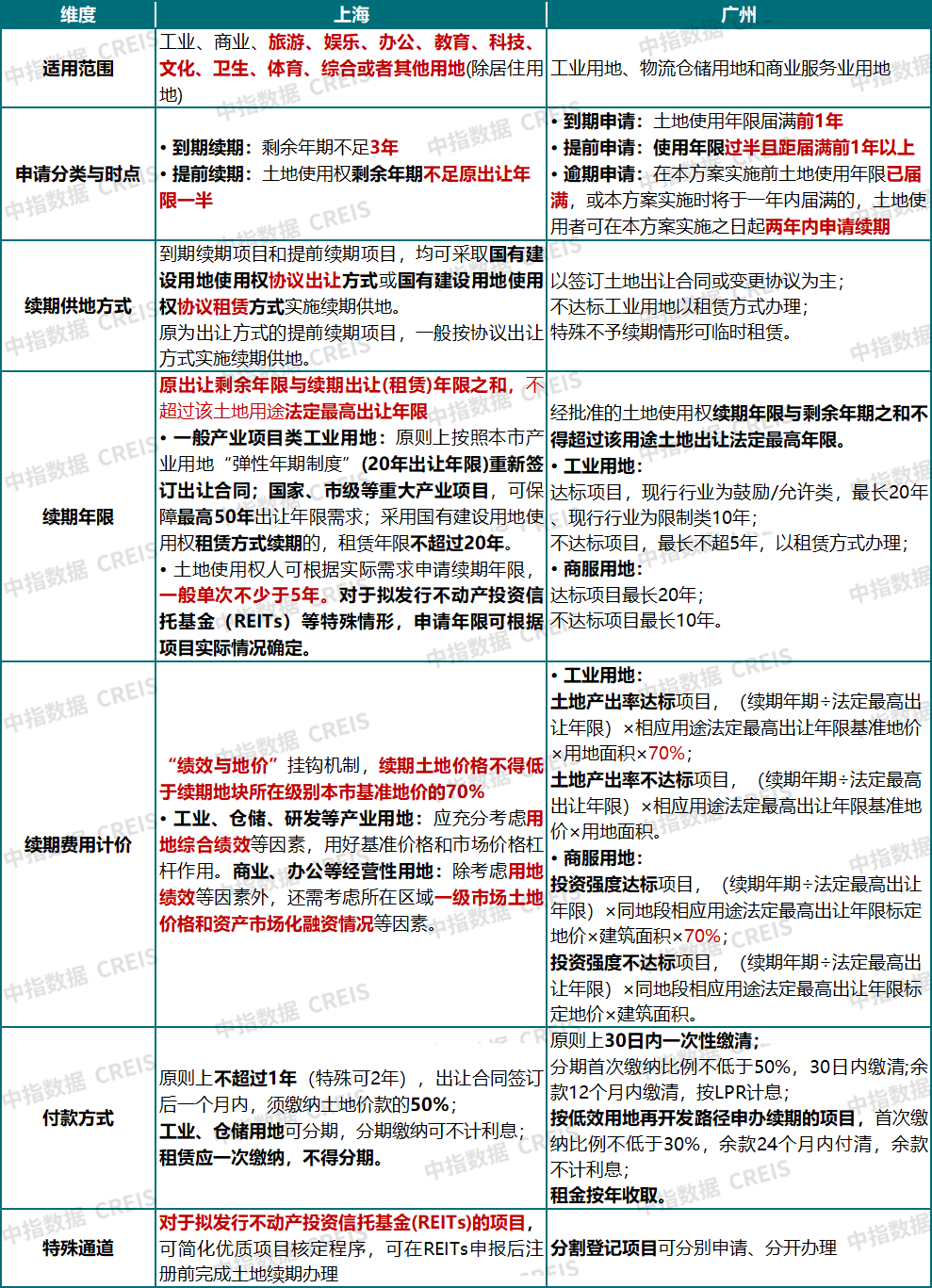
The “Guiding Opinions on Renewal of Land Use Rights for Industrial and Commercial Projects in Shanghai (Trial)” was issued in July 2026. The scope of application covers all types of non-residential land, establishes the principle of “renewal as the norm, no renewal is the exception, and should be continued”, and a green channel is set up for projects to be declared for REITs: the renewal period can be determined according to the actual situation of the project, and the renewal land price shall not be less than 70% of the base land price.
Guangzhou's policy focuses on the rules of the entire industrial and commercial land renewal process. In April 2026, the Guangzhou Municipal Bureau of Regulation and Administration issued the “Guiding Opinions on Further Promoting the Reform of Market-based Allocation of Industrial and Commercial Land”, which complements the “Guangzhou Pilot Plan for the Administration of Renewal Management of Industrial and Commercial Land Use Rights”, which sets out complete and detailed rules on applicant subjects, processing procedures, renewal periods, and settlement of concession funds. At present, the renewal of land use rights for Guangzhou International Textile City has been implemented.
Currently, Shenzhen is mainly revitalizing non-residential buildings through functional transformation. In March 2026, the Shenzhen Municipal Bureau of Regulation and Self-Regulation and the Housing and Construction Bureau issued the “Implementation Measures for Functional Transformation of Existing Non-residential Buildings in Shenzhen”, which allows non-residential buildings such as commercial, office, factory buildings, R&D buildings, warehouses, etc., to change the function of the building without changing the nature of the original land, land age, land use subjects and approved planning license documents; the functional conversion project is valid for 5 years, and projects included in the positive list are exempt from paying supplementary land prices during the 5-year transition period.
Currently, Beijing supports stock transformation more through urban renewal incentives, and the renewal of industrial and commercial land is still in the policy exploration stage. In January 2026, the “Beijing Urban Renewal Policy Incentive Toolbox (1.0 version)” made it clear that non-residential renovation guaranteed housing can apply for municipal construction scale index support. Projects that meet the requirements increase the structural floor height below 2.4 meters without calculation. At the same time, it was proposed to “actively carry out a pilot project to renew existing industrial and commercial land use rights”, and future industrial and commercial land renewal management policies will be studied and formulated.
Table: Comparison of key points of industrial and commercial land use rights renewal policies in Shanghai and Guangzhou
Source: Comprehensive compilation by the China Index Research Institute
02. Shanghai Real Estate Jiangyue Road project provider's leasing asset securitization sample. The effects of the renewal policy are yet to be verified by subsequent projects
Policies such as renewal of industrial and commercial land and functional conversion of non-residential buildings provide new institutional conditions for long-term operation and asset withdrawal of commercial leasing projects. However, the relevant renewal policy has yet to be introduced. Currently, no new projects have completed the complete process of “land renewal - functional transformation - leasing operation - asset securitization” in accordance with the new policy.
The Jiangyue Road project described below is a typical example of commercial leasing and asset securitization, but its renovation and REITs issuance policy were renewed earlier than 2026, and the remaining period of land was long when the project issued REITs, which is different from the current situation where some commercial projects have a short remaining period of time.
Typical case: Shanghai Real Estate Jiangyue Road Project
(1) Basic situation of the project
The Jiangyue Road project consists of three buildings and is located at No. 55, No. 91 and No. 125, Nanjiangzhou Road, Pujin Street, Minhang District, Shanghai. The Pujiang World Expo Home, which belongs to the project, is a resettlement community for residents who were relocated to the 2010 Shanghai World Expo. The original plan of the project was a community office facility. The nature of the land was supporting commercial housing, the building function was office, and the construction area was about 5,7560 square meters. It was completed in 2015.
The property rights unit for the project is an investment company under the Shanghai Real Estate Group, and the operating unit is Chengfang Company under the Shanghai Real Estate Group. The ownership is clear.
Three years after completion, the project has been vacant for a long time due to changes in the surrounding office market environment and cost factors, and there is a strong desire for renovation.
The project is close to Jiangyue Road Station of Metro Line 8, has complete supporting facilities such as primary and secondary schools, commerce, etc., and is close to Pujiang Hi-Tech Park in Caohejing Development Zone. Rental demand is strong.
(2) Project transformation
Application for renovation: In 2017, Shanghai issued the “Guiding Opinions on Planning Land for the Transformation of Commercial Office Cleanup and Rectification Projects in the City (Trial)” to encourage the transformation of commercial projects included in the clean-up list to rental housing. The real estate investment company applied for the transformation of the project into rental housing after a comprehensive evaluation, and obtained approval from the Minhang District Government in 2018.
Land contract changes: In 2018, the Minhang District Planning and Land Administration signed a supplementary land concession contract with the project party, making it clear that the nature of the construction was changed from an office building to a rental housing.
Renovation costs: In the renovation and upgrading of the project, the real estate investment company invested about 18 million yuan in infrastructure renovation, and the city company invested about 110 million yuan in renovation costs, for a total renovation investment of about 130 million yuan.
Title certificate change: In 2021, the project completed the title change at the Minhang District Planning and Natural Resources Bureau, and the nature of the building was updated to rental housing.
Project Guarantee: In September 2022, the Minhang District Affordable Rental Housing Leading Group issued a certificate to officially confirm that the project is affordable rental housing.
(3) Project operation
In May 2019, the renovation was completed and put into operation as rental housing. The first and second floors of the project are commercial facilities, with an area of 4,825 square meters; the 3-20 floors are rental housing, with an area of 52,734 square meters. The main unit area is 28-58 square meters, about 1,080 units.
In 2020-2022, the annual revenue of the project was 44.52 million yuan, 53.32 million yuan and 47.51 million yuan respectively; in 2022, due to the epidemic, there was a phased decline. Currently, the average annual revenue remains above 50 million yuan, and the occupancy rate is about 94%.
The project originally required about 20 years of operation to recoup costs. After conversion to rental housing, the capital recovery period was shortened by about 10 years.
(4) REITs distribution
On March 21, 2025, Huitianfu Shanghai Real Estate Rental Housing REIT was approved by the China Securities Regulatory Commission, and the fund contract came into effect; on March 31, REITs were officially issued and listed.
The fund has existed for 65 years and raised a total of 1,362 billion yuan; the public subscription ratio has reached 494 times, and the market attention is high.
The assessed asset value of the Jiangyue Road project is 875 million yuan.
Source: Minhang Construction Commission, comprehensive compilation by the China Index Research Institute
Although the Jiangyue Road project has favorable conditions such as a state-owned platform background and a long remaining period of land, the process of transforming from a stock commercial office to rental housing, completing the certification of guaranteed housing, and achieving exit from public REITs still provides a complete practical sample for similar projects. Project experience shows that whether commercial leasing projects can achieve asset securitization, in addition to compliance with renovation procedures, also depends on various conditions such as property rights relationships, location and leasing requirements, transformation costs, operating performance, and remaining years of land. For projects with a short remaining period of land, whether the renewal policy can be used to supplement the period required for long-term operation and capital withdrawal in the future still needs to be further verified in conjunction with subsequent projects.
Furthermore, in terms of exit methods, public REITs are not the only option for commercial leasing projects. In June 2026, a special real estate asset support plan for CICC-Borin long-term rental apartments was issued. The ground level assets are serviced apartments converted from office buildings and commercial complexes, reflecting the application potential of inter-agency REITs in the field of market-based rental housing. Compared with public rental housing REITs, inter-agency REITs low-level projects have greater autonomy in rent pricing, customer base selection, and operation methods, and are more suitable for projects with good location, strong operational capacity, and desire to maintain market-based rent levels. However, there are differences in the scope of investors, product liquidity, and financing costs from public REITs, and whether assets can be reasonably priced still depends on the stability of the project's cash flow and market recognition.
03. Policy conditions are gradually being improved, and commercial leasing changes still need to establish a project-based investment judgment framework
The improvement of industrial and commercial land renewal policies has provided new possibilities for commercial leasing projects to extend the operating period and improve asset exit conditions, but the policy does not replace the economic calculation of the project itself. For enterprises, whether the project has investment value still needs to be comprehensively judged based on renovation conditions, land duration, leasing requirements, operating income, and exit methods.
First, priority is given to screening stock assets with a foundation for transformation and rental needs. The project should focus on conditions such as transportation accessibility, introduction of surrounding industries and population, living facilities, and building structures. Commercial and industrial parks that are close to rail transit stations, industrial parks, or employment concentration areas, and where conditions such as high buildings, fire, lighting, electricity, water supply and drainage are suitable for renovation, are more likely to form stable rental demand, and the cost of transformation is relatively low. In addition to location conditions, it is also necessary to check the project's property rights relationship, mortgage seizure, planned use, and historical procedures in advance to avoid making the renovation more difficult due to ownership or compliance issues.
Second, land renewal is used as a precondition for project investment estimation. The remaining years of land directly affect the sustainable operation time of the project, asset valuation, and capitalization exit. Before the project is renovated, the enterprise shall clarify the nature of the land, the remaining period, the applicable conditions for renewal, the renewal period, and the land price calculation method, and determine the feasibility of renewal based on urban policies. Shanghai has proposed that the renewal period for the REITs to be issued can be determined according to the facts, and Guangzhou has further refined the renewal process and land price rules. The project conditions and cost constraints corresponding to different policy paths are different, and the possibility of renewal cannot be directly equated with the renewal result.
Third, calculate the long-term benefits of the project by combining transformation costs and operating income. The revenue calculation for commercial leasing projects should not only look at the rent level after the renovation, but should also consider factors such as transformation investment costs, renovation cycle, operation and management expenses, rental rate, rent control requirements, and supporting commercial income. For projects to be included in the guaranteed housing system, it is also necessary to consider the impact of rent standards and operating requirements on income levels. Only when transformation investment, operating cash flow, and capital recovery cycle are basically matched can the project have a foundation for further progress.
Fourth, choose the appropriate exit method according to the project attributes. Projects that meet the requirements of guaranteed housing certification, have stable operating cash flow, and can meet long-term holding requirements can focus on bonded housing public REITs. For projects with a good location, a high degree of product marketization, and the desire to preserve the right to set rent independently, exit methods such as inter-agency REITs can be studied. Inter-agency REITs differ from public REITs in terms of investor scope, product liquidity, and financing costs. Whether a project can achieve reasonable pricing depends more on asset quality, operating performance, and cash flow stability.
Overall, the industrial and commercial land renewal policy has improved long-term expectations for commercial leasing projects, but large-scale implementation of the project still depends on whether multiple conditions can be established at the same time. In the future, enterprises should establish a project screening and investment decision mechanism from the four aspects of “whether it can be reformed, whether it can be continued, whether it can be rented, and whether it can be withdrawn”, calculate different cities and different property types separately, and give priority to promoting projects with clear policy conditions, controllable transformation costs, stable rental demand, and a clear exit path.