
There is no hope that the energy market will return to stability until 2027: Seven major market signals warn that the global energy market will continue to be tight
The Zhitong Finance App notes that global energy traders are sending a consistent signal about 2027: they do not expect the global energy market to calm down in the short term.
Since the future of energy production and flow in the Middle East and Russia is still uncertain, traders do not expect the energy system to return to the stable and predictable state it was before the Russian-Ukrainian conflict.
From tanker term rental rates and refining profit margins to diesel, gas, and electricity futures, the energy market is pricing a future where the geopolitical situation continues to be tense, supply chains are still weak, and supply of key refined oil products continues to be scarce.
The pain of shipping
The clearest signal comes from the route connecting the world's largest oil producing region to its largest energy consumer market.
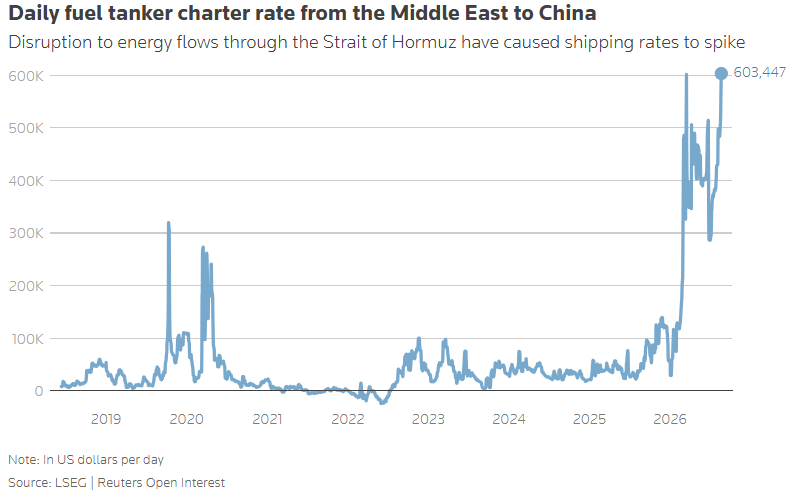
Daily oil tanker charter rates from the Middle East to China
According to data from the London Stock Exchange Group (LSEG), the daily charter rate for tankers sailing from the Middle East to China has surpassed 600,000 US dollars for the second time in history. This is due to the threat of a new round of “severe economic attack” on Iran by the US, which has raised concerns in the market that the situation around the Persian Gulf is once again tense.
Such high rates reflect not only the demand for ships, but also the risks and costs associated with transporting fuel through key maritime arteries.
The strong performance of the freight market shows that traders expect the risk of transportation disruptions in the Persian Gulf region to remain a normal feature of global energy trade after entering next year.
The situation in the refined oil market is tense
The same signal is clearly visible in the refined oil market.
European diesel futures are expected to be traded about 35% higher than the 2024-2025 average by 2027; while the current trading price of US heating oil futures, which is the benchmark for diesel, is about 42% higher than the 2024-2025 average.
The reason these signals are noteworthy is their high degree of consistency.
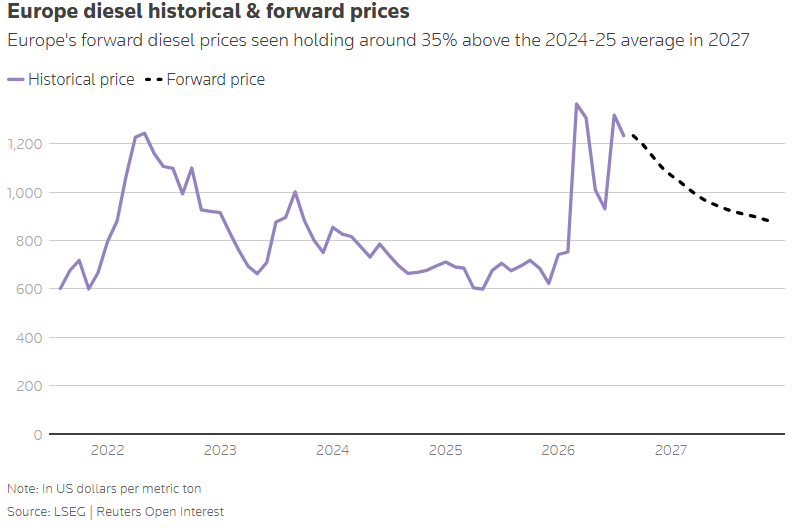
European diesel history and future prices
Europe and North America have different refining systems, different fuel regulatory policies, and different supply chains.
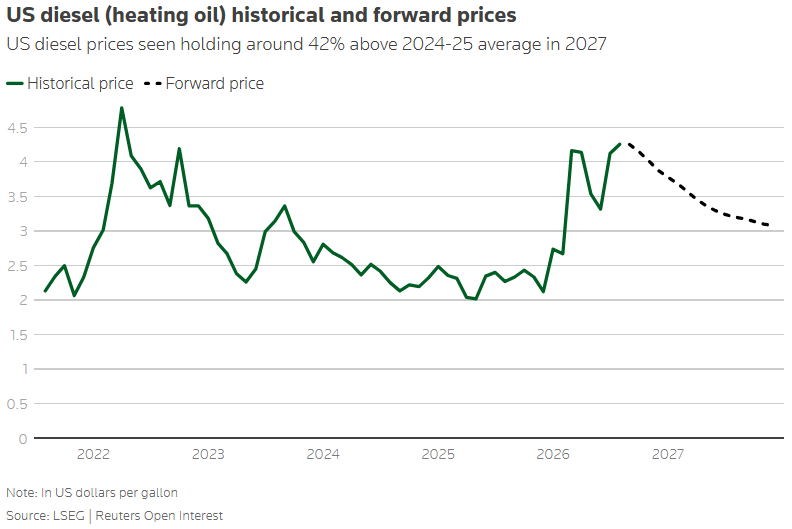
Historical and forward prices for US diesel
However, both markets factored in the price the tight supply of diesel in the coming year. This indicates that traders believe intermediate fractionates are facing a wider shortage rather than a local regional imbalance.
The Asian refining market further confirmed this view.
As the core oil trading hub in Asia, Singapore's refining profit margins for diesel and aviation kerosene are hovering near historic highs.
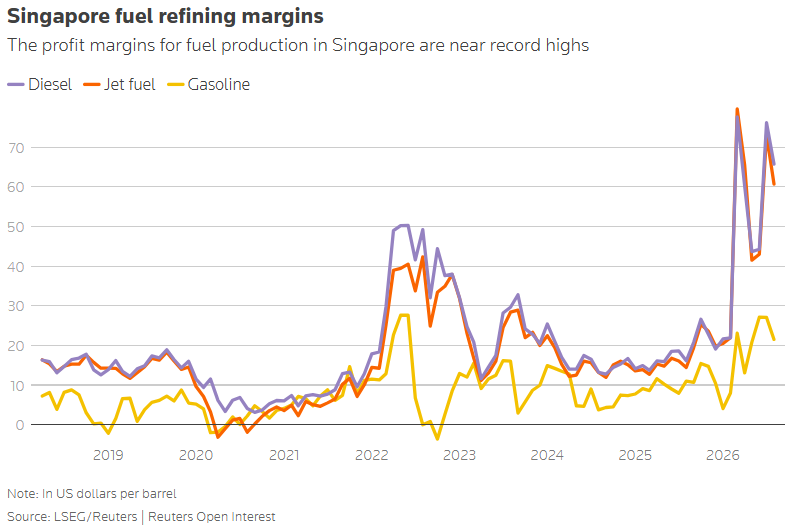
Singapore Fuel Refining Profit Margin
Refining profit margins represent the premium that refiners get for converting crude oil into usable fuel. High profit margins often mean that demand for refined oil products exceeds existing processing capacity.
In other words, the market is not signaling an impending shortage of crude oil.
They indicate that consumers will face a continued shortage of refined oil products that are actually used by consumers and that also support the operation of the global economy.
This distinction is critical.
In recent years, the global petroleum industry has expanded crude oil production capacity.
However, it has been proven that replacing refining capacity is much more difficult and much more expensive. A wave of refinery failures in Europe and North America reduced backup capacity, making the refined oil market more vulnerable in the face of disruptions in trade flows.
Europe's electricity woes
The European energy market also points to a similar conclusion.
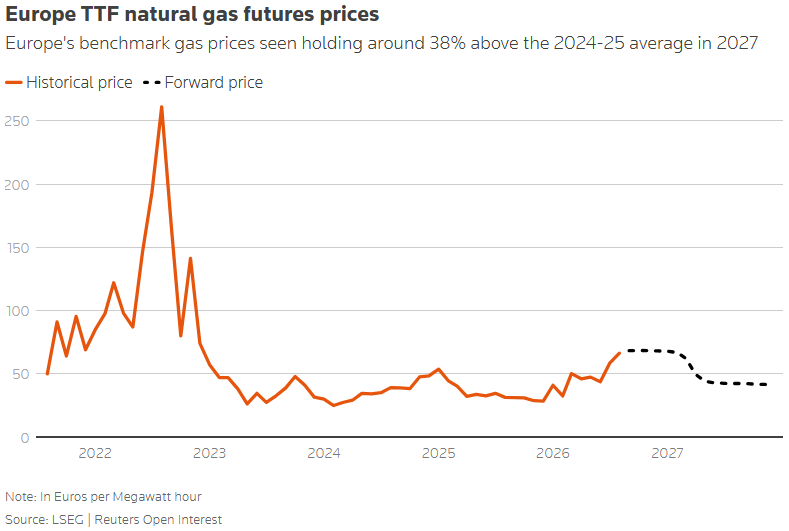
European TTF natural gas futures price
Benchmark TTF gas futures are expected to trade for the period up to 2027 to about 38% higher than the 2024-2025 average, while German forward electricity prices are nearly 70% higher than the average for that period.
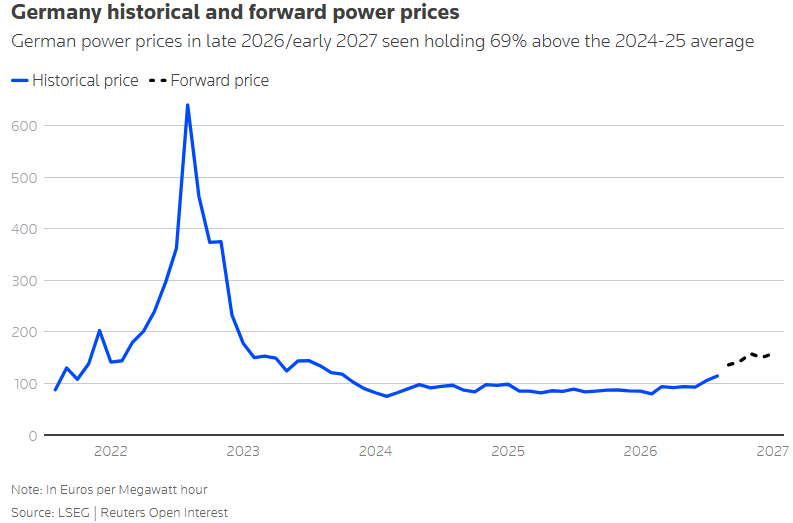
Historical and future electricity prices in Germany
Neither of these markets reached the extreme highs when the Russian-Ukrainian conflict triggered the energy crisis.
But neither will pricing return to pre-crisis conditions.
Traders seem to believe that Europe will continue to pay a high premium for energy security as it competes for imported gas supplies and strives to balance increasingly dependent renewable energy power generation systems.
US natural gas stands alone
The only exception in the context of a general tightening of major energy markets is US natural gas.
The price of Henry Hub (Henry Hub) futures until 2027 is only slightly above the recent average, reflecting the market's confidence that the US is capable of producing large amounts of natural gas even as liquefied natural gas (LNG) exports continue to grow.
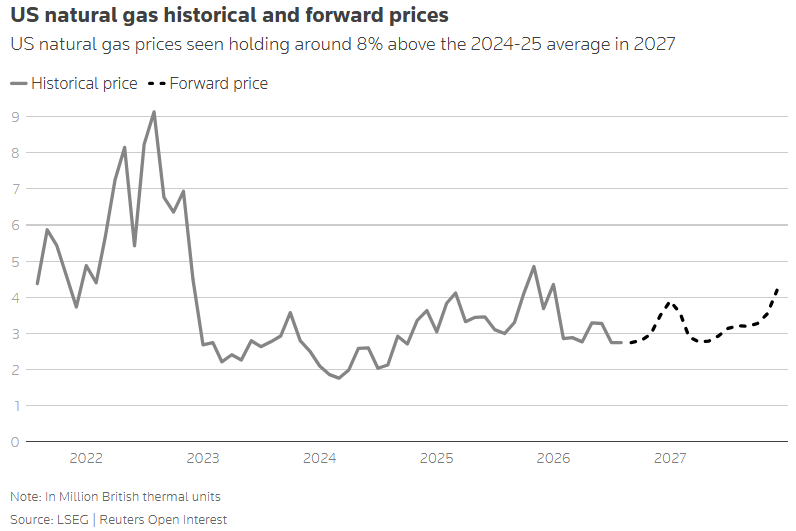
US natural gas history and future prices
However, instead of breaking this overall signal, US gas highlights an increasingly important differentiation in the global energy market.
North America is still one of the few regions that enjoy abundant domestic fuel supplies. Europe is still heavily dependent on imports. Asia, on the other hand, still faces the risk of double disruptions in shipping and oil refining.
Summarize
Taken together, these seven markets tell a logically consistent story.
Traders are neither pricing another 2022 energy shock, nor are they betting on a rapid return to the era of energy abundance.
Instead, they are betting that geopolitical tensions around the Middle East, limited refining capacity, high transportation costs, and ongoing competition for fuel supplies will keep the energy market tight until 2027.
In other words, while the global energy system appears capable of producing enough crude oil and gas, the market is worried about whether these products can be refined, transported, and delivered at a low enough price to meet demand.