
VIX Futures sounded the alarm in advance! The November US midterm elections are expected to be a window of high volatility for US stocks
The Zhitong Finance App learned that although Nvidia (NVDA.US)'s upcoming earnings report and Federal Reserve Chairman Kevin Walsh's speech at Jackson Hall are the main events investors are concerned about this week, traders in the stock derivatives market have begun preparing for a potential increase in volatility before and after the November US midterm elections.
Volatility traders who closely monitor the futures market linked to the Chicago Board Options Exchange (Cboe) Volatility Index (VIX) pointed out that the market is experiencing increasingly strong demand and hopes to prevent possible fluctuations in the S&P 500 index before and after the election through hedging. VIX futures, which expire in September, are currently trading at around 17.4, but the October contract rose to 19, and the November contract rose further to 19.7.
Matthew Thompson, co-portfolio manager at Little Harbor Advisors, said in an interview: “The US election is coming soon, and you are already entering a time window where the election will have an impact on VIX.” “You can already see this bulge in the VIX futures term structure.”
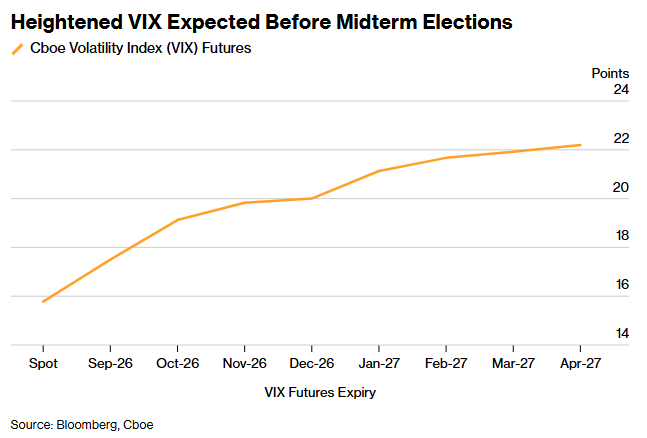
VIX is expected to rise further before the midterm elections
It's no surprise that traders are starting to prepare for stock market fluctuations before and after the election, because historically, political uncertainty in midterm election years has often led to increased market volatility. According to a study conducted by analysts at Cboe Global Markets Inc., since 1945, the actual volatility in the midterm election year was 80% higher than the previous year, with an average increase of 3.5 volatility points. In years where the same party controlled both the White House and Congress, the volatility increased by an average of 6 percentage points. According to Cboe data, the performance of the S&P 500 index in midterm election years was also often weak, with an average return of 4% and a median of only 1%.
This year's situation is probably more important than usual, because the planned construction of artificial intelligence (AI) data centers within the US is triggering an increasingly strong backlash from voters, and related spending plans are one of the important forces driving up the stock market this year.
Also, the focus is not just on the election of members of the National Assembly. The Bank of America strategist team led by Michael Hartnett is particularly concerned about the re-election of Texas Governor Greg Abbott. They warned that if the Democratic Party takes control of the Senate and the position of governor of Texas, then the stock market may fall by more than 10% next year, reaching the standard of “correction” in the normal sense of the word.
Cboe's main exchange recently introduced daily rights for the S&P 500 index, which expire on election day and the next day, enabling traders and strategists to begin monitoring fluctuations in the market's expectations of the election results. Currently, the pricing of these options shows that on November 4 — the day after the election — the implied single-day fluctuation in the S&P 500 index will be around 1.4%. Mandy Xu, head of market intelligence for derivatives at Cboe, said: “Now that these options are on the market, you will begin to see more and more election-specific deals.”
Furthermore, the market is still speculating that US President Trump and Treasury Secretary Bezent may try to keep the stock market performing strongly until the election. Brent Kochuba, co-founder of data provider SpotGamma, said: “It can be assumed that Trump and Bezent will push this thing to continue.” He added that as long as Federal Reserve Chairman Walsh sends a signal that he supports the Treasury Secretary's efforts to stabilize the bond market, it will be enough to signal risk appetite to investors. He said, “Don't fight against Bezent and Trump.”
Of course, there may be other reasons for the rise in VIX futures in October, including a seasonal upward trend in US stock market volatility during the fall months. Brent Kochuba said, “It is clear that there is a bulge, but there is also a seasonal element in the VIX term structure.”
In any case, despite this “bulge” in the VIX curve, options traders pointed out that now is a good time to buy cheap stock market fluctuation protection. The VIX Spot Index closed at 15.8 on Monday, far below its historical average of 19.4. “Insurance is really cheap right now,” Brent Kochuba said. “If you own stocks and want to hedge, now is the time to hold options.”