
A Key Leap in the Edge AI Era: Huaxida (00901) “AI Home” Strategy and Value Revaluation Logic
When computing power density breaks through cost thresholds, and when privacy compliance becomes just what digital life requires, edge AI is ushering in a historic inflection point from a “technical concept” to “large-scale commercial use.” In this wave of global industrial restructuring, the home scene is becoming one of the important implementation scenarios for edge AI due to its rigid requirements for real-time, privacy, and scene collaboration.
However, the smart home industry has long been stuck in the silos of “single point intelligence” and lacks a system-level brain that can integrate multiple protocols, across brands, and all scenarios. In this critical window, whoever can build an ecological barrier for “cloud-edge-end” collaboration can have a say in defining the next generation of home intelligence. With its unique operator channel barriers and the first-mover advantage of the Google ecosystem, Huaxida (00901) has taken the “1+2+X” strategy as a fulcrum to become a “home AI ecosystem builder”. Recently, Huaxida was selected by Hang Seng Index Co., Ltd. and will be included as a component stock of the Hang Seng Composite Index. It will take effect from September 7, 2026, marking a key step in the company's capital market construction.
According to the interim results announcement issued by Huaxida on August 20, 2026, the company achieved revenue of RMB 2,095 billion in the first half of the year, up 36.3% year on year; profit for the period was RMB 181 million, up 75.9% year on year; and gross margin increased 3.5 percentage points year on year to 21.1% year on year. Among them, digital video equipment revenue was RMB 1,734 billion, up 40.5% year on year, accounting for 82.7% of total revenue; overseas revenue was RMB 1,947 billion, accounting for 92.9%. As the world's leading overall AI home solution provider, during the reporting period, Huaxida continued to increase investment in R&D, focusing on key areas such as home AI smart devices cedar, edge computing, smart terminals and underlying storage collaboration, promoting the deep integration of home solutions between the cloud and the home edge, and building a complete technical architecture and commercialization implementation path.
Edge AI commercialization has reached an inflection point and the home scene has become the core landing position
Driven in both directions by technology iteration and market demand, edge AI is accelerating its entry into a large-scale commercial cycle. The formation of this inflection point stems from the concentrated maturity of the three driving forces of computing power costs, privacy compliance, and real-time response.
AI chips increase the computing power density and reduce costs, making the local computing power of 1-5 TOPS integrated into home terminals economical, and can support local operation of high-frequency tasks such as speech recognition and image analysis. Because of the special nature of the home scenario, the implementation of pure cloud AI applications has faced multiple challenges, and edge AI achieves an optimal balance of experience and security through local processing of home data and integration with cloud AI's flagship intelligent experience. The rigid demand for millisecond response in applications such as security alarms and fall detection also makes edge-side real-time decision-making capabilities irreplaceable infrastructure.
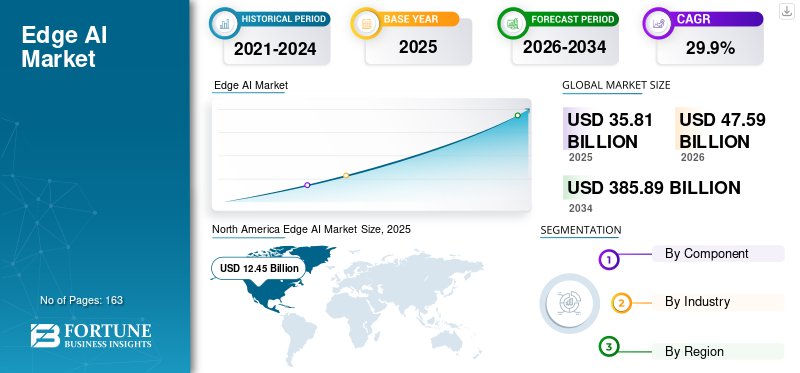
In terms of market space, edge AI tracks are growing significantly at a high rate. According to Fortune Business Insights (Fortune Business Insights) data, the global edge AI market will reach US$35.81 billion in 2025, and is expected to rise to US$385.89 billion (equivalent to RMB 26,17.1 billion) in 2034, with a compound growth rate of 29.9% from 2026 to 2034, far exceeding the growth rate of the cloud computing market. Capital and technical resources are being tilted intelligently towards the end side. The industrial chain has a three-tier structure. Edge AI solutions for smart homes are one of the application directions worth paying attention to because they can solve the “multi-device, multi-brand, multi-protocol” collaboration problem.
Currently, smart homes are moving from “single-point intelligence” to “scene collaboration”, and the data island model controlled by an independent app has become an important bottleneck limiting the upgrading of experiences. The core of the next phase is to build a home AI hub with a closed loop of perception, decision making, and execution. It must meet the four major conditions of localized operation, multi-protocol compatibility, cross-brand interoperability, and native AI. Huaxida's “AI Home” strategy accurately anchors this strategic gap and reshapes the smart ecological value chain of the home through the integration of edge AI and intelligent connectivity.
“AI Home 1+2+X” architecture: cloud-edge-end collaboration to build an ecological moat
Huaxida's strategic upgrade is essentially based on its global leading position in the field of Android TV terminals, completing the value transition from “software and hardware product solutions” to “AI home overall solutions.” The core support for this transformation lies in its two scarce assets: one is the B2B2C channel network covering more than 80 countries and regions around the world and serving more than 300 operators and retail brand customers as of June 30, 2026, reaching hundreds of millions of home users and building the foundation for large-scale commercialization; the second is the deep binding with the Google ecosystem, which lays out Google's TV ecosystem and AI ecosystem in advance, providing a technological pioneering advantage for its AI strategy.
According to the Zhitong Finance App, Huaxida's “AI Home 1+2+X” architecture is a system-level solution with “cloud-edge-end” collaboration capabilities. Its core value is to form an ecological moat through technology integration, rather than a single product innovation.
“1” is the home AI smart device Cedar. As a self-developed “family brain”, as of June 2026, Cedar has been further equipped with the Gemini 3.5 model to continuously improve capabilities such as visual perception, active service, identification, and personalized memory. Its cloud-side deployment architecture reduced some of its capabilities to terminals such as AI smart TV boxes to support network self-operation and maintenance and local offline AI customer service; during the reporting period, Cedar has completed R&D and is in the customer testing and commercialization stage. Cedar's strategic significance is that it has been upgraded from an interactive portal to a “decision center” for the family scene.
“2” represents the two major bases of intelligent connectivity and edge AI. The intelligent connection layer is centered on the Wi-Fi 8 AI optical fiber gateway. The product not only integrates tri-band Wi-Fi 8 and 10G optical fiber access, but also has a built-in AI NPU, which can achieve intelligent traffic scheduling, Wi-Fi sensing wireless sensing, and local AI inference collaboration. At the software level, AI fiber gateways, combined with Prplos' remote management and application lifecycle management capabilities, can support operators to carry out large-scale device management and continuous function upgrades, making them programmable edge computing nodes.
It is worth emphasizing that in addition to gateway products, Huaxida's AI smart TV box is also one of the important carriers of the home edge computing power system. Huaxida took the lead in building an AI smart TV box with computing power into an AI home hub for operators, and further integrated smart devices with home network equipment, showing remarkable phased results at MWC 2026. In the future, the company will continue to deploy edge AI devices such as home computing power centers to improve the home edge computing power system. It can be said that Huaxida's AI smart TV box has evolved from a traditional streaming terminal to a home edge computing node that integrates local computing power, runs Cedar smart devices, and collaborates with devices throughout the house.
“X” is an ever-expanding terminal ecosystem matrix, which has expanded from streaming media boxes to smart projectors, cameras, home service robots, and smart glasses. These terminals use Cedar to deeply collaborate with home central devices to achieve scenario-based linkage. When an abnormal event is recognized by a camera or other sensing device, the AI Home system can make judgments based on the home context and link compatible devices to complete reminders and responses, thus forming a closed loop of the scene from perception, decision making to execution
From hardware box faucets to home AI hub operations: open ecological connectors and value revaluation logic
More importantly, Huaxida's product innovation path essentially completes value reshaping from “functional terminals” to “AI hubs”. The Wi-Fi 8 AI optical fiber gateway has evolved into the core node of home edge computing power. It has three characteristics: built-in computing power (integrated AI NPU, decision time delay in milliseconds), enhanced perception (Wi-Fi Sensing enables insensitive monitoring), and programmability (supports dynamic application deployment based on PrPLoS), enabling the gateway to upgrade from a network-connected device to an operating platform that continuously adds value.
The parallel AI smart TV box, which relies on its wide range of home coverage and high-frequency user interaction characteristics, is a carrier for CEDAR agents — it can not only act as an independent AI customer service and scene automation engine, but also form computing power collaboration with the gateway to achieve dynamic collaboration and load balancing for edge-side tasks. Cedar is expanding from a single device capability to a cross-device AI service layer, providing value-added services such as network self-operation and maintenance, local offline AI customer service, and scenario automation, and driving the transformation of the operation and maintenance model from “manually-driven” to “AI-driven”.
Huaxida's strategic wisdom is that it does not pursue a closed ecosystem, but rather becomes a “connector” to the mainstream ecosystem through a “double entry” strategy. On the one hand, it is compatible with the Matter protocol, which enables Cedar to control cross-brand Matter certification devices, open up intelligent hardware from different ecosystems and brands, and achieve device interconnection and collaboration; on the other hand, it is deeply integrated into Google's business ecosystem and capability ecosystem to provide customers with “last mile” delivery and provide users with unique scenario definitions. This “double entry” strategy has enabled Huaxida to occupy an irreplaceable position in the family scene.
Conclusions
The reason why Huaxida's strategic implementation is extremely scarce is that it simultaneously gathers three core elements that are extremely difficult to achieve in the home-edge AI circuit: first, B2B2C channel barriers that serve more than 300 operator and retail brand customers, building a moat for large-scale monetization; second, comprehensive cooperation with Google's ecosystem to establish the core ecological position of the user scenario; third, “1+2+X” system-level architecture capabilities, which have achieved qualitative transformation from single product stacking to intelligent collaboration throughout the house.
At the critical tipping point of edge AI from concept to implementation, Huaxida uses the Cedar smart device and edge computing power base to transform the home scenario into an operable and value-added digital asset. Understanding this restructuring of business logic from “selling terminals” to “selling scenarios” is the underlying logic for judging the investment value and value revaluation space after listing.