
One billion dollars have escaped! Korea's chip-leveraged ETF shows its first monthly net outflow, retail investors are speeding up their switch to the US stock index to take safe haven
The Zhitong Finance App learned that leveraged ETFs linked to Korean chip giants such as Samsung Electronics (SSNLF.US) and SK Hynix (SKHY.US) are experiencing large-scale capital outflows as investors' enthusiasm for artificial intelligence (AI) trading gradually declines, and regulators have introduced measures to curb overheated demand. Meanwhile, against the backdrop of the intensification of KOSPI shocks, individual investors in South Korea are clearly turning to relatively stable US stock index ETFs in order to avoid risk.
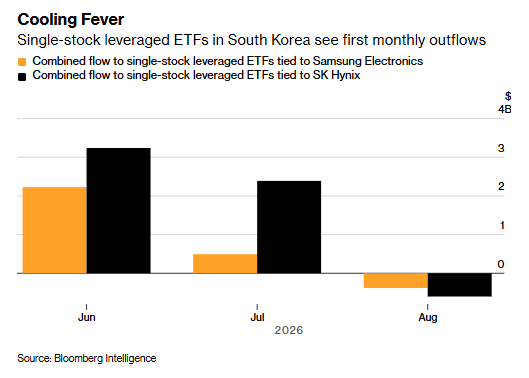
According to compiled data, since August, leveraged ETFs tracking Samsung Electronics had a cumulative net outflow of 381 million US dollars, while leveraged ETFs tracking SK Hynix had a net outflow of 601 million US dollars, a total outflow of nearly 1 billion US dollars. This is also the first time since the launch of this type of product at the end of May this year that there has been a net monthly outflow.
The above leveraged ETF aims to track double the daily stock price fluctuations of Samsung Electronics and SK Hynix, and to quickly attract a large amount of capital to chase the AI chip market since its launch. However, such products are also alleged to have amplified market fluctuations. In particular, during the global AI sector pullback in July, Korea's KOSPI Index once experienced a historic 22% sell-off, and market fluctuations increased markedly.
Since then, South Korea's regulators have strengthened controls on leveraged ETFs, including increasing the minimum deposit requirements for new investors, and requiring new investors to complete a five-day simulated transaction before they can officially participate. The tightening of regulations combined with the cooling of AI trading sentiment has further increased the pressure on the outflow of funds from leveraged products.
KOSPI fell sharply, and retail investors poured into US stock index ETFs
South Korea's domestic stock market continues to fluctuate, further driving investors to switch to overseas assets. According to data released by ETF Check on August 25, among the ETFs listed in South Korea on August 24, nine of the top ten products had net inflows invested in US assets, and the capital flow was concentrated in ETFs that track major US stock indices such as the S&P 500 and NASDAQ.
Specifically, the TIGER US NASDAQ 100 ETF had a net inflow of 50.2 billion won in a single day, which was the highest of all ETFs listed in Korea; KODEX's US NASDAQ 100 ETF had a net inflow of 49.6 billion won; TIGER's US S&P 500 ETF had a net inflow of 31.6 billion won; and KODEX's US S&P 500 ETF had a net inflow of 29.9 billion won. Furthermore, the TIGER US Philadelphia Semiconductor NASDAQ ETF, which invests in the US Philadelphia Semiconductor Index, had a net inflow of 29.6 billion won, and the ACE US Big Tech TOP7 Plus ETF, which focuses on major US technology stocks, had a net inflow of 19.1 billion won.
Analysts pointed out that this trend is closely related to the sharp decline in the South Korean stock market. On August 24, the KOSPI index fell 3.12%, and Samsung Electronics and SK Hynix, the two major stocks in the Korean stock market, plummeted 8.7% and 3.41% respectively. In the face of large fluctuations in the domestic stock market, investors clearly prefer to spread risk through US stock index ETFs.
However, judging from the flow of capital over the past week, the choices of individual investors and institutional investors in South Korea are quite different. According to ETF Check data, the Korean-listed ETF with the most net purchases by Korean retail investors in the past week was the TIGER US S&P 500 ETF, with a net purchase amount of 1982 billion won; KODEX's net purchases of the US S&P 500 ETF were 106.2 billion won, and the KODEX US NASDAQ 100 ETF had net purchases of 102.7 billion won, all ranking among the top net purchases of retail investors.
In contrast, the highest net purchases by institutional investors during the same period were KODEX 200 target week covering bullish options ETFs, with net purchases of 78 billion won; followed by KODEX SK Hynix Single Stock Leveraged ETF, with net purchases of 61.4 billion won; and KODEX 200 ETF net purchases of 53.3 billion won. Institutional funding is still mainly concentrated on Korean domestic indices and related strategic products.
People in the financial investment industry pointed out that against the backdrop of unstable trends in the Korean stock market, investment sentiment that has already shrunk has prompted retail investors to seek safer investment choices. The source said, “Retail investors will enter the market when KOSPI falls in the first half of the year, but unless KOSPI shows a continuous upward trend in the future, it is unlikely that retail investors' attitudes will change.”