
Is NIKE (NKE) Fairly Valued After Its 74% Five Year Slide?
NIKE stock is coming off a steep multi year slide, with the share price down about 73.7% over 5 years, while current valuation checks paint a mixed picture that includes a fairly valued intrinsic estimate and an undervalued signal on earnings multiples.
- The roughly 73.7% share price decline over 5 years suggests investors have sharply reset expectations for NIKE.
- Recent coverage of NIKE's turnaround efforts and wholesale reset may support a case for earnings and cash flow improvement, while ongoing competitive pressure and questions around brand momentum can still weigh on what investors are willing to pay.
- NIKE scores 2 out of 6 on Simply Wall St's broader valuation checks, which implies the stock does not screen as a clear bargain overall even though some measures look attractive, see 2/6 here.
The issue now is whether NIKE's current US$40.76 share price already reflects a fair intrinsic value, or if the reset in expectations has gone too far.
Find out why NIKE's -47.1% return over the last year is lagging behind its peers.
Is NIKE Fairly Priced on Cash Flow?
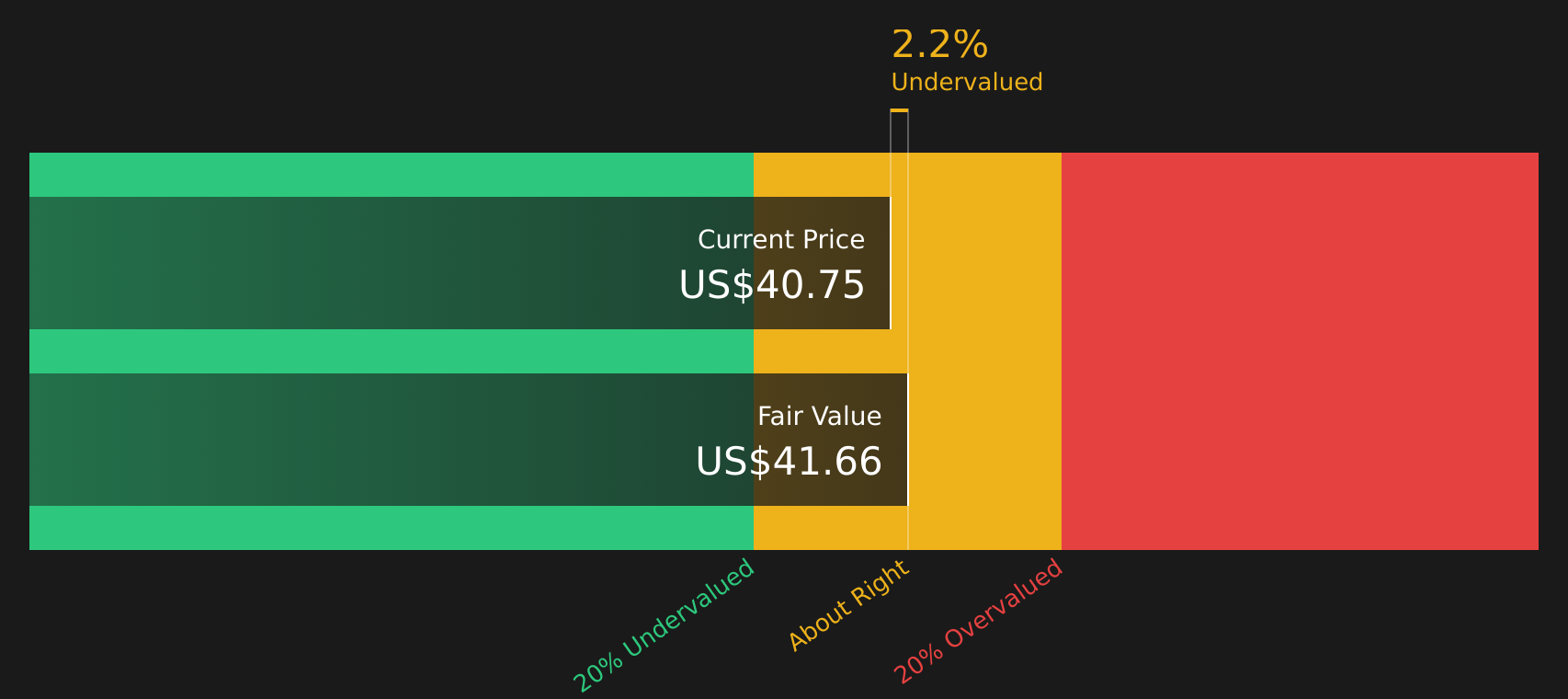
The Discounted Cash Flow (DCF) model here uses projected free cash flows to estimate what NIKE shares might be worth today. On this view, NIKE generated about $2.25b of free cash flow over the latest twelve months, and the model assumes these cash flows continue growing from this base. That produces an estimated intrinsic value of around $41.66 per share.
Compared with the current share price of $40.76, NIKE screens as only around 2.2% undervalued, which is effectively in line with the DCF estimate. Recent coverage of Nike shares plunging to a multi year low, despite ongoing turnaround efforts, helps explain why the market price is still sitting close to the value implied by cash flows rather than placing a higher multiple on the stock.
On this DCF view, NIKE appears roughly fairly valued, with the share price sitting close to the model’s estimate of intrinsic value.
NIKE is fairly valued according to our Discounted Cash Flow (DCF), but this can change at a moment's notice. Track the value in your watchlist or portfolio and be alerted on when to act.
Is NIKE Still Cheap on Earnings?
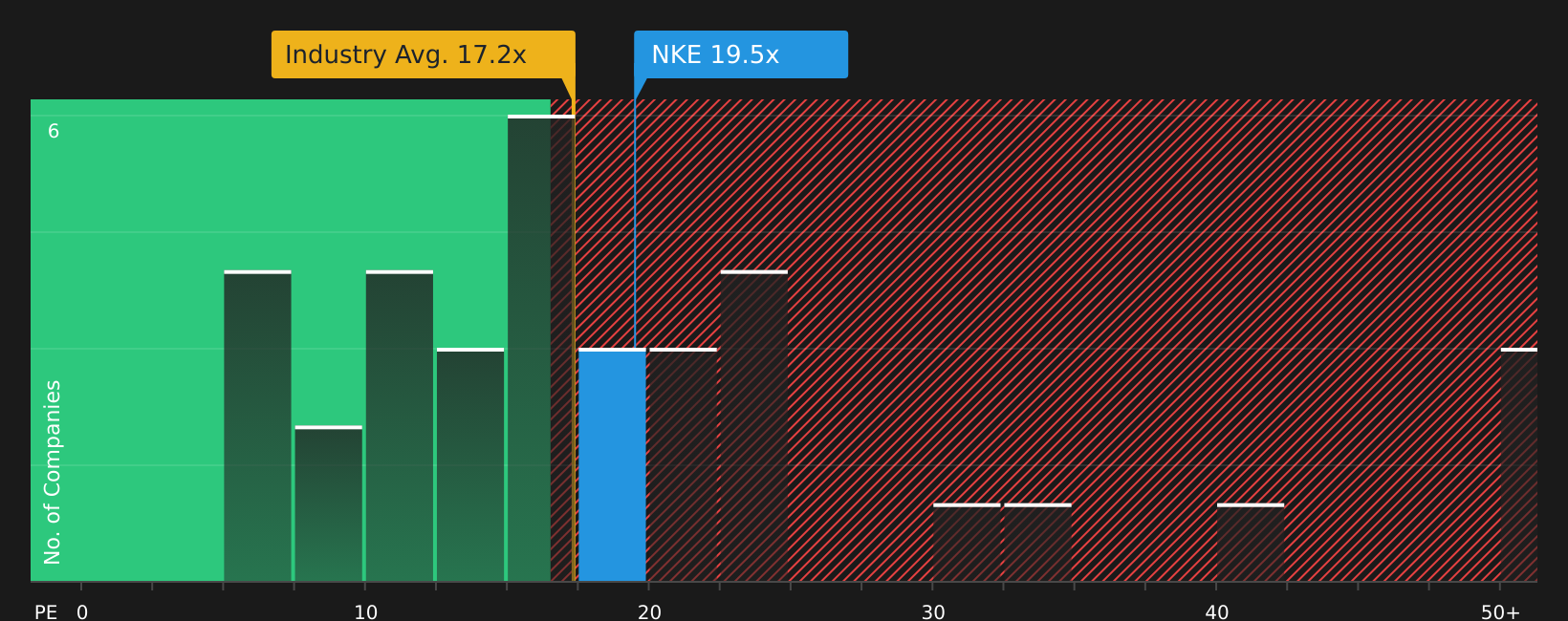
The P/E ratio is a useful lens for NIKE because earnings are still a key anchor for how investors value established consumer brands. At the current level, NIKE trades on a P/E of about 19.5x, compared with an industry average of roughly 17.0x for luxury peers and a peer group average near 14.7x.
The fair P/E ratio implied by Simply Wall St’s model is higher, at about 25.5x, based on NIKE's profile within its sector. Against that benchmark, the current 19.5x multiple sits at a discount, even though it looks richer than the simple industry and peer averages. In other words, the stock screens as cheaper than the model suggests would be typical for NIKE, given its size, margins and risk mix.
On this P/E basis, NIKE stock appears undervalued relative to the earnings multiple the model indicates could be reasonable for the company.
See what the numbers say about this price — find out in our valuation breakdown.
The NIKE Narrative: What Would Justify Today's Price?
Simply Wall St Narratives pick up where the valuation puzzle for NIKE leaves off. They spell out which assumptions about NIKE's future growth, margins and earnings would need to hold for the stock to be worth materially more or less than today's price, and they sit on Simply Wall St's Community page. Each one treats fair value as a thesis about NIKE's business that you can revisit over time, rather than a one off snapshot.
Community views on NIKE are sharply split, with some investors framing the reset as an opportunity and others arguing the stock still carries too much optimism.
Bull case: 20% undervalued
"Nike is accelerating the transition of its product portfolio, aiming for sport performance dimensions to drive growth, decrease reliance on declining lines, and positively impact revenue…"
Read the full Bull Case to see why NIKE could be undervalued
Bear case: 11% overvalued
"As you can see from the above Nike seems to be overvalued given that its current price of 40 dollars is well above P90…"
Read the full Bear Case to see why NIKE could be overvalued
Do you think there's more to the story for NIKE? Head over to our Community to see what others are saying!
The Bottom Line
For NIKE, the Discounted Cash Flow (DCF) work points to a share price that is close to intrinsic value, so there is no clear signal that the market is mispricing the stock based on cash generation alone. The P/E view is more generous and still suggests the shares are undervalued relative to what the tailored multiple implies, even though the broader valuation checks are weak overall. The real split between bull and bear arguments now comes down to whether NIKE can rebuild earnings quality and brand momentum enough for investors to pay a higher multiple again, rather than treating the current discount as justified.
This article by Simply Wall St is general in nature. We provide commentary based on historical data and analyst forecasts only using an unbiased methodology and our articles are not intended to be financial advice. It does not constitute a recommendation to buy or sell any stock, and does not take account of your objectives, or your financial situation. We aim to bring you long-term focused analysis driven by fundamental data. Note that our analysis may not factor in the latest price-sensitive company announcements or qualitative material. Simply Wall St has no position in any stocks mentioned.
Have feedback on this article? Concerned about the content? Get in touch with us directly. Alternatively, email editorial-team@simplywallst.com