
One financial report involves “AI beliefs”, and a speech affects risk appetite! Nvidia and Walsh will decide the fate of a rotating bull market
As the global stock market enters the most decisive week of this summer, two things are already clear: the current market is no longer trading only around the topic of artificial intelligence computing power, especially the gold-led precious metals sector, the rise of the healthcare sector after mRNA technology led cancer treatment into a new era, and the rise of traditional defensive value sectors such as energy, telecommunications, and bank stocks where valuations have been sluggish and are seriously lagging behind in recent years, breaking the “AI computing power alone” situation in recent years, showing a broader and healthier bull market; The recent sharp fluctuations in the US bond market are also limited It has been proven that catalytic factors will not only drive up assets, but may also fuel further shorting for bears.
This is the background of the market at the critical moment at the end of August. On Wednesday, Nvidia will announce results — this is almost the closest event to a “quarterly referendum” that AI computing power exchanges can usher in. Afterwards, on Friday local time, Federal Reserve Chairman Kevin Walsh will deliver his first keynote speech in Jackson Hole; at the same time, the market is fiercely debating the US Treasury's actions to curb the sell-off of long-term US Treasury bonds. The public topic of Walsh's speech was payment innovation, and it doesn't sound like it will have a significant impact on the market. However, he may still be on the sidelines of other topics in his speech, and there is also a risk that the market will overinterpret a comment.
The picture drawn by Bank of America's August global fund managers survey is not “investor sentiment has turned cautious and pessimistic,” but rather a paradox where institutional risk perception has risen sharply, real positions are still extremely risky, and AI positions are crowded: a record 56% of respondents bet that the US economy will “not land” in the next 12 months, net 37% expect corporate profits to achieve double-digit growth, and 72% believe that the Federal Reserve will not raise interest rates before the midterm elections; in response, the net overallocation of global stocks rose to 56%, the highest since November 2021, and the cash ratio fell to the sixth lowest in history. Net low bonds Allocation increased to 39%.
During the preparation of the fund manager survey, another Bank of America research report showed that at a time when the AI theme faced a storm of deleveraging and extreme overcrowded bullish positions, and the risk of inflation posed a challenge to traditional portfolios, value stocks, biotechnology, regional banks, some credit types, and commodities all provided attractive investment opportunities. Furthermore, international small-cap value stocks were already more attractive than US large-cap growth stocks, and the profitability of Japanese companies had risen to historical record levels. The agency also sees listed private equity management companies as a reverse investment opportunity and favors high-quality high-yield bonds over investment-grade bonds.
Wall Street financial institutions, including Bank of America, have not recently been bearish on the AI theme, but have emphasized a very clear asset allocation upgrade: from highly concentrated AI/US growth stock transactions to “retaining structured AI longs+increasing low-correlation, high cash flow, and undervalued assets” portfolio proliferation. As AI moves from a scarcity narrative to a trillion-dollar capital expenditure payment period, the determinants of excess earnings will shift from “whether there is AI exposure” to “whether valuation, free cash flow, ROIC and congestion match.”
This week is by no means just an Nvidia performance week; it is a double stress test of “corporate profit anchor+global discount rate anchor”: Nvidia will answer whether token computing power resource requirements can be transformed into continuous inference revenue, profit, and AI capital returns, while Walsh may re-set the valuation benchmark for all risky assets by influencing policy interest rate expectations, term premiums (Term Premium), and dollar asset liquidity.
The correlation between artificial intelligence and non-artificial intelligence sectors fell to about minus 0.6, indicating that currently it is more like capital redistribution rather than complete withdrawal; however, in the context of insufficient hedging and the first batch of systematic quick money quantitative sales of only about 4% of the current market price, “strong Nvidia financial report+stable long-term debt” can turn the sector rotation into a stock market bull market in the context of healthy spread. The opposite may upgrade partial adjustments to systemic risk removal.
The Token throne ushered in a quarterly referendum: instead of falling into a bear market trajectory, AI's return on investment trial
Before the critical moment at the end of August, it is necessary to accurately assess the current position of the stock market. Despite a rebound in some technology stocks, the rotation of capital withdrawals from the AI sector continues. Over the past five trading days, the best-performing assets include “high-quality stocks” with abundant cash flow over a long period of time, a basket of stocks aimed at tracking so-called “AI victims,” and all value stock assets that are sensitive to inflation data or have a comparative advantage in a stagflation environment. Semiconductor stocks and AI data center infrastructure-related concept stocks declined sharply.
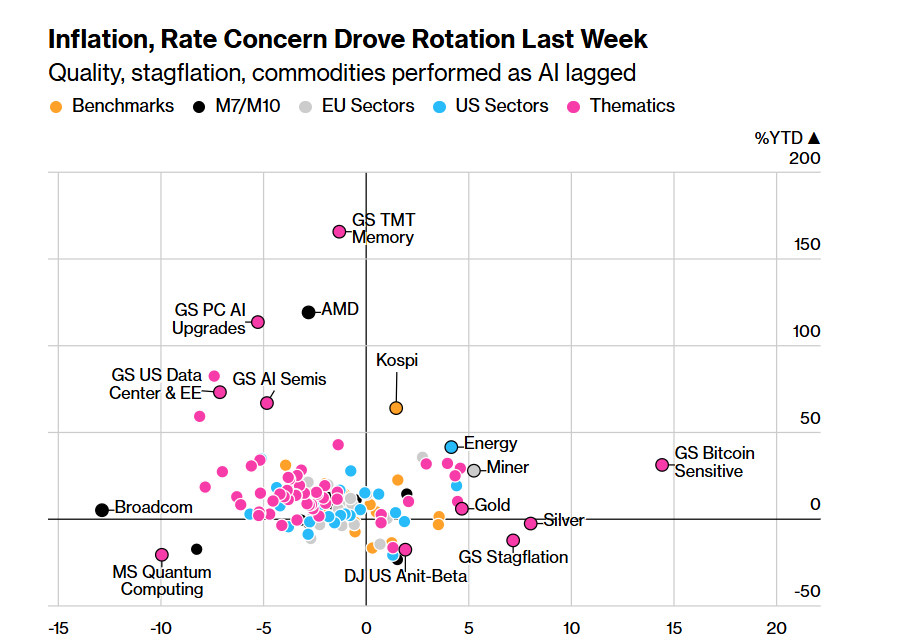
As shown in the chart above, inflation and interest rate concerns drove market rotation last week — high-quality fundamental assets, assets benefiting from stagflation, and commodities showed strong performance, while the AI sector lagged behind.
There's a picture that pretty well sums up the bigger picture of the market. The 40-day correlation between the generalized AI stock basket compiled by Goldman Sachs and the S&P 500 index after excluding elements related to artificial intelligence turned sharply negative for the first time, and is currently around negative 0.6. This shows that capital outflows from the artificial intelligence sector have not completely left the stock market, but are providing large-scale net capital inflows to all other sectors.
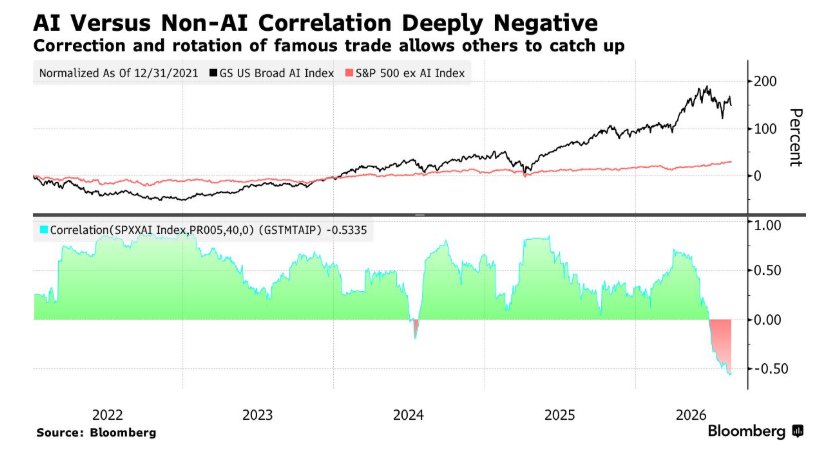
As shown in the chart above, the correlation between artificial intelligence and non-artificial intelligence sectors turned negative drastically — the pullback and rotation of popular transactions allowed other non-AI-related investment sectors to catch up.
However, all of this doesn't mean “the big story of artificial intelligence: it's broken. Infrastructure-type technology companies at the core of building artificial intelligence computing power still contributed about half of the S&P 500 index's profit growth figures. At the same time, the profits of S&P 500 median market capitalization companies increased sharply by 14% in the last quarter, which means that under the US economy's soft landing trajectory, the profit base of the stock market is also broadening.
Some media previously reported that Anthropic's annualized revenue operating rate index has exceeded 65 billion US dollars, while OpenAI is about 40 billion US dollars. These figures have given investors a degree of comfort and relief who are worried about whether demand for artificial intelligence terminal applications actually exists. But the tougher questions remain: who will be the ultimate winner, whether capital expenditure can continue to reap strong returns, and how much AI computing power resources are actually worth.
Currently, a widely watched token cost indicator — the Silicon Data AI Big Language Model Spending Index — has fallen by nearly half from its May high. Not only has it become a topic of discussion on major trading platforms, but it also frequently appears on social media in suggestions on how to save the model's inference costs using tokens. It is important to note that Ornn market statistics do not show a significant drop in token prices for large artificial intelligence laboratories in August. Regardless of the actual situation, the index's widespread attention itself fully reflects current market anxiety. At the same time, CDS interest spreads and credit spread indicators for hyperscale cloud computing vendors continue to rise, further increasing the market's nervousness about the return on investment in artificial intelligence and whether huge capital expenses will lead to credit defaults.
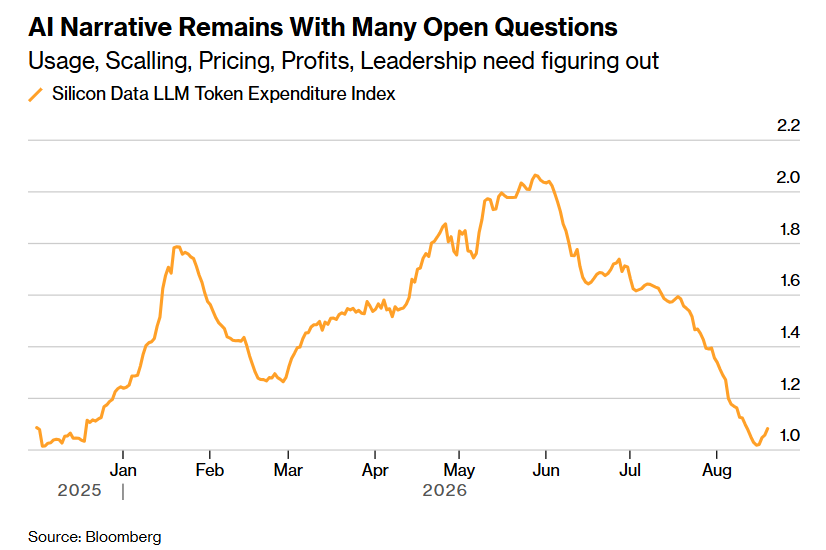
As shown in the image above, there are still plenty of unresolved questions about the AI narrative — usage, laws of scaling, pricing, actual profits, and industry leaders still need to be clarified.
Artificial intelligence infrastructure still contributed about half of the profit growth of the S&P 500 index. Anthropic and OpenAI reached annualized operating rates of over 65 billion US dollars and about 40 billion US dollars respectively, which also proved that terminal demand was not fictional; however, the Token cost index was almost lower than the May high, and credit spreads for hyperscale cloud vendors continued to widen, which means that the valuation focus has changed from “who has the most GPUs” to “who can turn computing power into cash flow”.
What Nvidia's financial reports and future prospects really need to be verified is not only the computing power resource requirements related to Vera-Rubin, the next-generation AI computing power cluster, but also whether AI inference computing power and revenue generation growth, pricing capabilities, customer capital returns, and credit bonds and asset securitized AI financing structures can jointly support the next stage of the AI computing power theme's super “main upswing” counterattack.
Walsh holds the global discount rate switch: 5.30% long-term bonds and $90 oil prices collide with technology stocks
This is followed by interest rates/US Treasury yields, a slower growing but more far-reaching source of concern. Last week, the yield on US 30-year Treasury bonds hit 5.30%; then, the US Treasury announced that it would at least double the scale of long-term treasury bond repurchases. This intervention caused yields to fall slightly, but when the US market closed last Friday, the yield on 30-year US bonds almost recovered from the decline since the Treasury Department's repurchase intervention. The MOVE index, which measures interest rate volatility, is currently close to 70. Although it is far below the peak in March caused by the US-Iran war, it is far from returning to the calm state of winter.
The current tension related to the expansion of yield is still slowly heating up and has not yet reached a boiling point, and the new chairman of the Federal Reserve is about to deliver an important speech in this context. Running through all of these market variables is also geopolitical risk. The price of Brent crude oil has remained stable above $90 per barrel, and has increased by more than 50% since this year. This not only supports energy stocks, but also strengthens market inflation anxiety and US bond maturity premiums, and prolongs the bond market's nervousness about long-term yields.
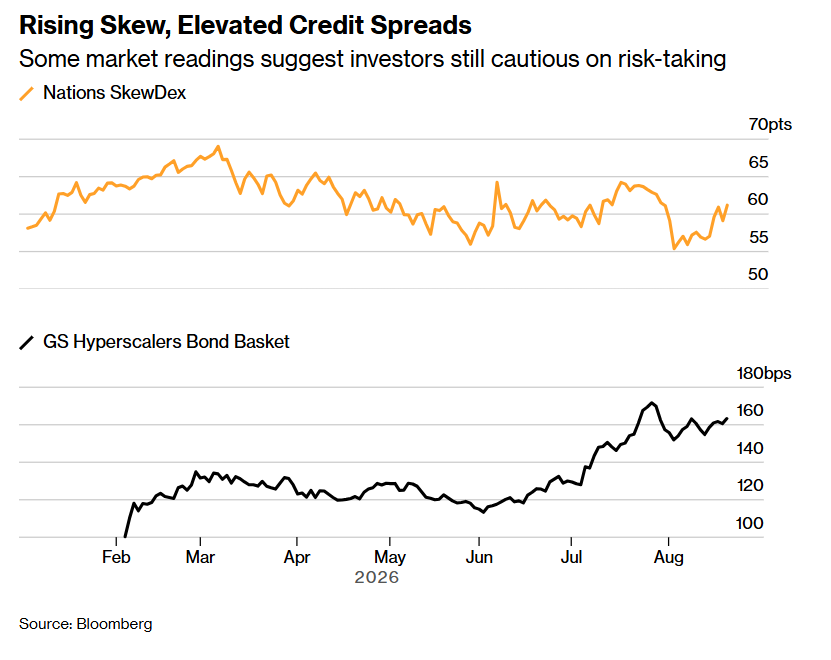
As shown in the chart above, options bias are rising and credit spreads are high — some market indicators show that investors are still cautious about taking risks.
The August capital position also tells its own story. In the middle of the month, hedge funds bought US stocks every trading day; the previous three consecutive weeks of buying power was the highest since March 2020. However, hedge funds' upward momentum over the past week is weakening rather than continuing to strengthen. According to Goldman Sachs trading desk data, global stocks experienced the fastest net sale in two months last week. The volume of bullish options in the S&P 500 index has also returned to normal from the fanatical state of July. The current buying is more like a cautious re-entry, rather than the breathless one-sided bullish chase of the past two years.
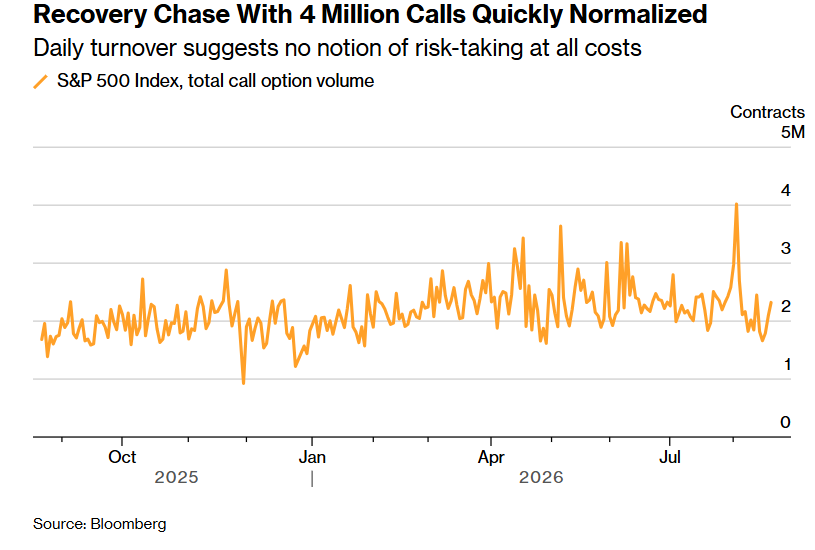
As shown in the chart above, the rebound chase driven by 4 million bullish options quickly returned to normal — the latest daily volume shows that the market is not tempted to take risks at any cost.
The trillion-dollar buyback provided the floor support, but the 150 billion dollar programmatic sale was hidden behind a secret door
As the market enters this week, it still has a solid layer of support, but the wrong combination of results may also suddenly open the “secret door” style sell-off switch under your feet. About 96% of the S&P 500 index's constituent stocks are currently in the corporate share repurchase window, and repurchase authorizations of more than $1 trillion are providing stable purchases.
Trend-tracking funds (CTA strategy funds, also known as “quick money”) hold about $140 billion in global stocks, and demand under their benchmark scenario is also showing a moderate trend of normalization. Systematic trend tracking funds, such as CTAs, are generally regarded as “fast money” that responds quickly and adjusts positions mechanically according to price signals.
However, the risk structure is not completely symmetric. If the market retracts significantly within a month, these systematic strategic fund capital flows may trigger a short-term sharp sell-off of stocks worth more than 150 billion US dollars globally, and the first batch of sales triggers is only about 4% below the current stock market benchmark level. These major events this week will determine which of these two risk structures actually comes into play.
At the end of the day, capital flows are still providing support, and the options gamma situation is stabilizing, and the withdrawal of capital from rotating transactions of pure artificial intelligence transactions — especially those around undervalued and long-term underperforming technology sectors such as value stocks and the healthcare sector, also seems to be very healthy. A more defensive asset allocation indicates that risk appetite is cooling down to a certain extent; the skew options bias curve indicator is steeper, indicating that investors are partially hedging against sharp fluctuations in interest rate/yield and increased uncertainty about the intrinsic value of artificial intelligence. If the market continues to be quiet during the summer, this pattern can continue.
However, a round of potential negative news will fall on such a market: the level of hedging by hedge funds or traditional asset managers is still near the lowest level this year, and various buffer mechanisms have yet to be tested. The floor support remained until the hidden door under the foot suddenly opened. This week, we'll probably find out if it can handle that weight.
Corporate buyback authorizations exceeded $1 trillion, and trend strategies held about $140 billion in global stocks. Coupled with stabilizing options gamma, providing a short-term buffer for the market; however, global stocks have turned net sales again, and the bullish options frenzy in July has clearly cooled down. If this week's two major events suggest a friendly combination, capital may continue to return to the AI computing power industry chain and is expected to spread healthily to high-quality stocks, energy, commodities, and stagflation-benefiting sectors with strong cash flow while the AI bull market continues to unfold, driving the stock market to achieve a broadly expansionary bull market; if earnings and interest rates simultaneously form a negative position, the index falls by about 4%, and the potential scale exceeds 150 billion US dollars — the market floor seems solid. What is really dangerous is a secret door underneath the floor that has not yet been tested.
Bank of America's team of strategists is urging investors to break away from the overcrowded topic of artificial intelligence trading. The agency believes that value stocks, biotechnology, regional banks, some credit products, and commodities all provide attractive investment opportunities at a time when the AI computing power theme is facing a storm of deleveraging and increasingly stringent profit expectations, and when the risk of inflation poses a challenge to traditional portfolios.
After the AI bull market entered the “high valuation+high congestion+high capital consumption” stage, Bank of America advocated shifting marginal capital from the most expensive AI computing power beta to “cheaper profit growth, real cash flow, and anti-inflation assets” — this is a rebalance from a single technology main line to the spread of profits and high-quality cash flow sectors across the market, not the end of the AI bull market. For example, Pershing Square, founded by billionaire and hedge fund legend Bill Ackman himself at the helm, switched to an investment framework of “buying high-quality fundamental stocks at misplaced prices/collapse prices” — opening new positions, the digital payment and bank card network giants Visa (V.US) and Mastercard (MA.US), as well as four other companies with low concentration of positions and high cash flow quality for a long time.