
Goldman Sachs deciphers $9.3 trillion AI holdings: hedge funds and mutual funds are “in the same path, different cars”, and chips and software are extremely divided
The Zhitong Finance App learned that Goldman Sachs's latest position analysis report revealed a clear signal of differentiation: although both hedge funds and mutual funds are increasing the AI circuit, the two are moving in a very different direction in terms of specific individual stock choices. As of the beginning of the third quarter of 2026, Goldman Sachs's analysis of 991 hedge funds (total stock holdings of about 5.4 trillion US dollars) and 504 large active mutual funds (total stock assets of about 4.6 trillion US dollars) showed that hedge funds as a whole are still more deeply exposed to AI transactions than mutual funds, but they have taken the exact opposite path for large technology stocks and individual semiconductor stocks.
Overall pattern: hedge funds “All in AI”, mutual funds are still seriously under-valued
According to the “Hedge Fund Trend Monitoring Report” and “Mutual Fund Fundamentals Report” released quarterly by Goldman Sachs, as of the beginning of the third quarter of 2026, the report covered 991 hedge funds (with total stock positions of 5.4 trillion US dollars) and 504 large-cap active mutual funds (holding stock assets of 4.6 trillion US dollars), with a total analysis position size of about 9.3 trillion US dollars.
Overall, the exposure of hedge funds to AI trading is still far higher than mutual funds, but both types of institutions made significant adjustments to AI stock holdings in the second quarter of 2026.
Hedge fund portfolios are still closely related to AI trading. The return rate of hedge funds and the performance of their heavy holdings in recent months are all highly correlated with fluctuations in AI trading. Although mutual funds have increased their holdings of AI infrastructure stocks, the increase is still insufficient to keep up with the weight of the benchmark index, causing mutual funds to have a large low allocation gap in the AI sector. This differentiation is most evident in large technology stocks. Hedge funds' returns have been highly correlated with the performance of their heavy stocks and the volatility of AI trading in recent months.
Big tech stocks: the big four “go their own way”
In the second quarter, hedge funds bought Microsoft (MSFT.US) and Amazon (AMZN.US), while mutual funds reduced their holdings of these two stocks. Microsoft and Amazon were the only two targets for hedge funds to increase their holdings in large AI technology stocks in the second quarter.
Meanwhile, hedge funds have reduced their holdings of several other large AI companies, including Alphabet (GOOGL.US), Meta Platforms (META.US), Nvidia (NVDA.US), Broadcom (AVGO.US), Fanlin Group (LRCX.US), Maywell Technology (MRVL.US), Cisco Systems (CSCO.US), and Applied Materials (AMAT.US).
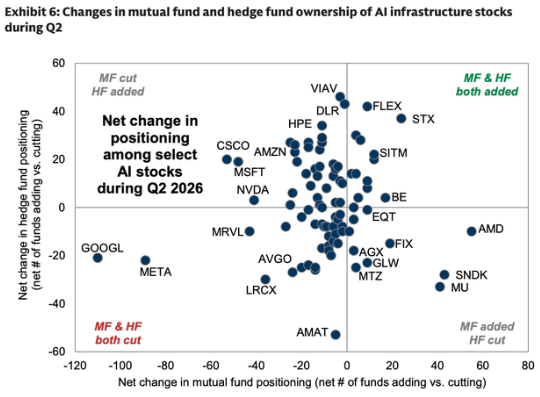
Hedge funds increased their holdings in Panlin Group, Applied Materials, and ASML.US (ASML.US) in the second quarter, while mutual funds increased their risk exposure to Intel (INTC.US) and SiTime (SITM.US).
Semiconductors and Memories: Mutual Funds “Bottom Out”, Hedge Funds “Retreat”
When it comes to semiconductor and memory transactions, the two types of institutions are also at odds. Mutual funds bought shares in AMD (AMD.US), Micron Technology (MU.US), and SanDisk (SNDK.US), while hedge funds sold these three stocks during the same period. This difference is particularly noteworthy — AMD, Micron, and SanDisk were all highly volatile targets of the AI hardware pullback in the second quarter. Mutual funds chose to buck the trend and increase their positions, while hedge funds chose to make profit settlements or reduce risk exposure.
Notably, Goldman Sachs data shows that among all AI-related stocks tracked, Nvidia (NVDA.US) is the individual stock with the largest low allocation margin of mutual funds, with an average low allocation margin of about 100 basis points. AMD's low profile is about 60 basis points.
The biggest consensus: AI infrastructure becomes a “united front”
Despite significant differences at the individual stock level, the two types of institutions reached a broad consensus in the field of AI infrastructure.
Goldman Sachs sorted out 12 AI infrastructure stocks that received increased holdings from hedge funds and mutual funds in the second quarter: American Electric Power Company (AEP.US), AXT (AXTI.US), Bloom Energy (BE.US), CoreWeave (CRWV.US), Flex (FLEX.US), Lion Electric (LGN.US), NiSource (NI.US), Sanmina (SANM.US), SiTime, Seagate Technology ( STX.US), Talen Energy (TLN.US), and Xcel Energy (XEL.US).
The two sides also jointly purchased three shares of Bloom Energy, Flex, and Seagate Technology, making it the clearest intersection between the two types of institutions in the AI field. Bloom Energy and Flex provide power and manufacturing infrastructure for AI data centers, while Seagate directly benefits from the explosive growth in AI storage demand.
However, although mutual funds have greatly increased the weight of AI infrastructure stocks this year, the increase in positions still cannot keep up with the increase in the weight of the benchmark index, causing them to remain drastically underallocated in the AI sector as a whole. Nvidia is the most prominent representative of this low-end trend.
Withdrawal of funds: Which AI stocks were abandoned by both types of institutions at the same time?
The two groups of investors also cut their holdings in a range of AI-related stocks, including Viavi Solutions (VIAV.US), Digital Realty Trust (DLR.US), Argan (AGX.US), MasTec (MTZ.US), Corning (GLW.US), and EQT (EQT.US). Comfort Systems USA (FIX.US) is a typical example of mutual fund purchases and weakening hedge fund holdings.
A “united front” beyond AI: the financial sector's historic overallocation
In addition to AI holdings, Goldman Sachs data reveals a more historic signal: hedge funds and mutual funds are currently overallocated to the financial sector. This is only the third time in Goldman Sachs's historical data.
In the second quarter, the net overallocation of hedge funds to the financial sector increased by more than 300 basis points, reaching the highest level since before the global financial crisis; the degree of mutual fund overallocation to the financial sector also rose to the highest level since at least 2012. Large-cap financial stocks that the two types of institutions have jointly increased their holdings include Capital One Financial (COF), Corpay (CPAY), Fiserv (FI), and Yingtou Securities Group (IBKR).
Goldman Sachs also selected six “shared favorites” stocks — all popular positions in hedge funds and mutual fund portfolios: Boeing (BA), Capital One Financial (COF), Mastercard (MA), SpaceX (SPCX), Thermo Fisher Scientific (TMO), and Visa (V). These “shared favorites” rolling combinations have accumulated returns of 29% since the beginning of the year, outperforming the return rate of 16% from weighting indices such as the S&P 500.
Both types of institutions are also greatly overallocated to the healthcare sector, but there are differences in the allocation of the consumer sector: hedge funds overallocate optional consumption and underallocate necessary consumption, while mutual funds allocate exactly the opposite direction.
epilogue
Goldman Sachs's position analysis reveals a new market order that is being formed: on the main line of AI trading, hedge funds and mutual funds are moving towards “different cars” — mutual funds are actively deploying in the field of AI infrastructure, but hedge funds have chosen to make a profit in large technology stocks and semiconductors; the two sides have intensified their differences in AI hardware pullbacks, yet they have reached a rare consensus in the financial sector.
As Nvidia's earnings report and the Jackson Hole conference approach, this AI position map, which was co-written with $9.3 trillion capital, is laying the groundwork for the next phase of the market trend. The volatility of AI trading is highly tied to the returns of hedge funds, and mutual funds still have a large underallocation gap in the AI sector — which means that whether the next step in AI trading continues to rise or a deep pullback, it will trigger an unprecedented wave of institutional position adjustments.