
Stellantis (BIT:STLAM) Stock May Be Undervalued Despite a 69% 3 Year Slump
Stellantis stock has been under pressure for several years, yet the company still screens as cheap on several valuation checks. After such a prolonged share price decline, investors are weighing whether that discount reflects real business risks or if the market is being too pessimistic.
- Over the past 3 years, Stellantis shares have declined about 68.6%, which puts the current valuation in sharp focus for long term holders.
- Heavy investment in retooling plants like Belvidere for new platforms can support the long term story. At the same time, issues such as large scale recalls and uncertainty around facilities like Brampton may weigh on how the market prices execution risk.
- Stellantis scores 5 out of 6 on our broader valuation checks, which indicates the stock leans cheap across several measures 5/6 valuation score.
The issue now is whether Stellantis deserves this discounted valuation or if the market is pricing the risks too harshly.
Find out why Stellantis' -46.1% return over the last year is lagging behind its peers.
Is Stellantis Still Cheap on Sales?
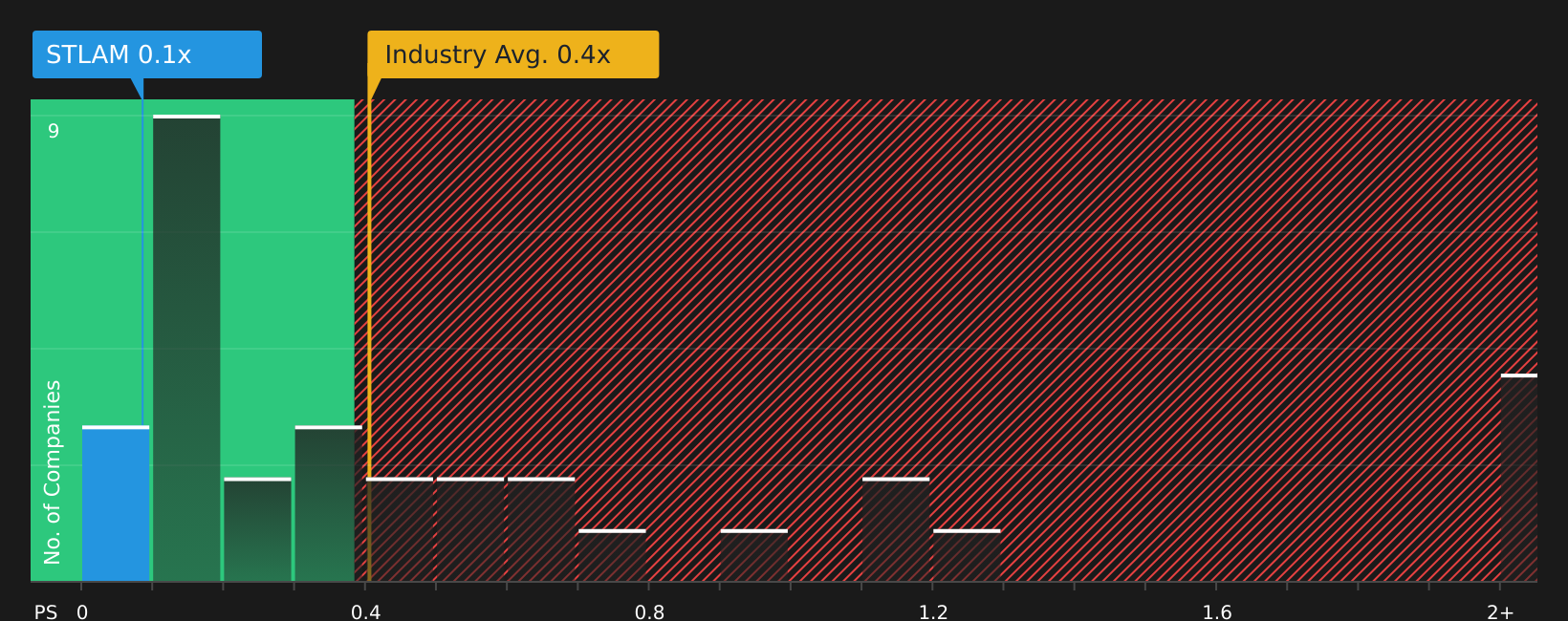
P/S is a useful lens for Stellantis because the company is heavily revenue driven and earnings can be affected by large investment cycles and recalls. On this measure, Stellantis trades on a P/S of about 0.1x, compared with an auto industry average of around 0.7x and a peer group closer to 3.0x.
The fair P/S ratio for Stellantis based on its profile is estimated at about 0.3x, which is still several times higher than where the stock is currently priced. That gap suggests the market is applying a steep discount to Stellantis revenue, even as the company commits billions to projects such as retooling Belvidere and reassessing assets including Brampton. The recent large recall and ongoing plant reshuffling help explain why investors may be cautious, yet the P/S multiple already reflects significant execution risk.
On the preferred P/S multiple, Stellantis stock currently appears undervalued compared with both its tailored fair ratio and wider auto sector benchmarks.
See what the numbers say about this price — find out in our valuation breakdown.
The Stellantis Narrative: What Would Justify Today's Price?
Simply Wall St Narratives for Stellantis pick up where this valuation puzzle leaves off and explain what growth, margin and earnings paths would need to hold for Stellantis stock to be worth meaningfully more or less than it is today. Each Narrative ties a fair value estimate to a clear story about Stellantis' possible catalysts and risks, which helps you track over time which version of events is actually taking shape on the Community page.
Community views on Stellantis are sharply split, with one camp focused on recovery potential and the other on structural pressure.
Bull case: 23% undervalued
"Continued investment in software innovation, as well as direct-to-consumer sales and refreshed product launches for key brands (e.g., Ram, Jeep, Fiat), lays the groundwork for future recurring revenue streams and supports gross margin stability."
Read the full Bull Case to see why Stellantis could be undervalued
Bear case: 12% overvalued
"Stellantis' heavy reliance on internal combustion engine vehicles, particularly in North and Latin America, puts it at a structural disadvantage as emissions regulations and consumer preferences shift rapidly toward electric vehicles worldwide."
Read the full Bear Case to see why Stellantis could be overvalued
Do you think there's more to the story for Stellantis? Head over to our Community to see what others are saying!
The Bottom Line
Stellantis screens as undervalued on its current market multiples, with the market assigning a steep discount to its sales relative to peers. That gap only closes if investors become more confident that recent recalls, plant changes and capital commitments do not erode future profitability. For you, the key question is whether this discount is a value trap or compensation for real execution and transition risk. The crux of the bull versus bear debate is simple. It comes down to whether Stellantis can convert its heavy investment and brand portfolio into resilient margins that eventually justify a higher multiple.
This article by Simply Wall St is general in nature. We provide commentary based on historical data and analyst forecasts only using an unbiased methodology and our articles are not intended to be financial advice. It does not constitute a recommendation to buy or sell any stock, and does not take account of your objectives, or your financial situation. We aim to bring you long-term focused analysis driven by fundamental data. Note that our analysis may not factor in the latest price-sensitive company announcements or qualitative material. Simply Wall St has no position in any stocks mentioned.
Have feedback on this article? Concerned about the content? Get in touch with us directly. Alternatively, email editorial-team@simplywallst.com