
The Korean storage giant gave back to shareholders with a big deal! The won may rise and receive a key assist
The Zhitong Finance App learned that the unprecedented shareholder return plans of South Korea's two largest memory chip giants are gradually becoming a key factor affecting the trend of the Korean won. If the two companies raise capital through the local currency market to support their shareholder return plans, the won may be able to continue its recent gains.
SK Hynix (SKHY.US) announced on Wednesday that it will repurchase and cancel 40 trillion won (US$28.6 billion) worth of shares and use more than 50% of the free cash flow generated between 2025 and 2027 to increase shareholder returns. Also, according to people familiar with the matter, SK Hynix has reached an agreement in a preliminary salary agreement. It plans to distribute 60% of this year's employee bonuses in the form of company shares, while the remaining 40% will be paid in cash.
Meanwhile, according to people familiar with the matter, Samsung Electronics plans to announce a new shareholder return plan on Friday, with a total scale of up to 110 trillion won (about 79 billion US dollars). The person familiar with the matter said that the scale of this shareholder return plan is expected to be between 90 trillion and 110 trillion won, making it one of the largest capital return initiatives in Samsung Electronics' history.
Thanks to news that SK Hynix and Samsung Electronics intend to increase shareholder returns, the won strengthened further on Friday, rising 1% at one point to 1380.35 won against the US dollar. Since the beginning of July, the won has risen sharply, recording the fastest 40-day increase since the end of 2022. This week, for the first time in more than 10 months, the exchange rate of the Korean won against the US dollar broke through the key mark of 1,400 won against the US dollar.
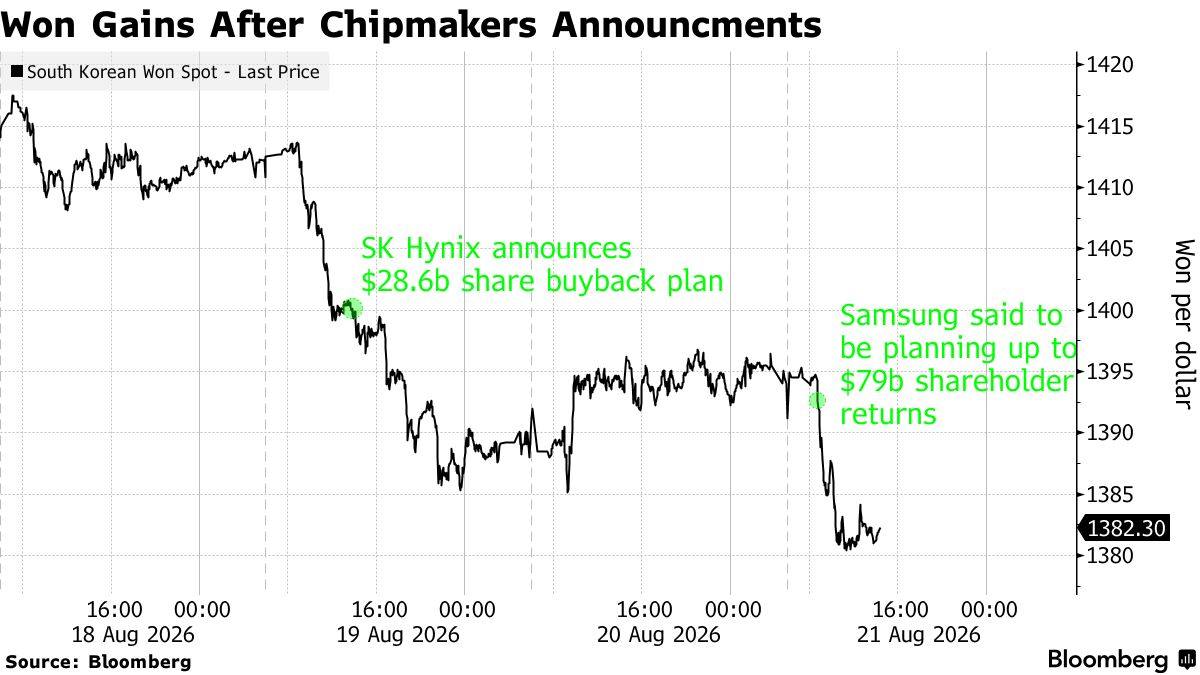
Investors are paying attention to how much demand will be brought to the won by SK Hynix and Samsung Electronics' shareholder return plans, and how much capital will eventually be remitted to Korea by overseas shareholders. Choi Kyu-ho, an economist at Hanwha Investment Securities, said, “These companies must pay shareholder returns in won, and they can use the won they already hold, or they can sell the dollar in other markets and then buy the won. Because the amount of money involved is huge, they may eventually need to sell more dollars to raise capital.”
Although these shareholder return plans initially boosted the won, there is still uncertainty about whether they can be a catalyst for the won to last longer. Analysts said, first, it is unclear whether these chip giants will use their existing cash reserves to pay shareholder returns or whether they will exchange their US dollar assets for Korean won.
Citigroup estimates that if overseas stock investors remit funds back to their home countries, about half of the funds in these shareholder return plans may be converted back into US dollars. As of August 20, according to Korea Exchange data, SK Hynix's foreign shareholding ratio was 50.1%, and Samsung Electronics' foreign shareholding ratio was 46.9%.
However, Citigroup Korea's chief economist Kim Jin-wook wrote in a report that these shareholder return plans should still constitute a net benefit for the won as a whole, because these companies will need to exchange more export revenue for the won. He added that strong exports, dollar financing, and active currency exchange and hedging operations by the private sector all form factors supporting the appreciation of the Korean won.