
Who will take over after the three major chip giants? The second-tier AI computing power in emerging markets has skyrocketed, and the computing power market has entered a “full stack revaluation” moment
The Zhitong Finance App learned that the rise in AI computing power-themed stocks in emerging markets is spreading rapidly to more new stocks, and investors seem to be starting to rotate more capital from the three trillion dollar chip manufacturing giants in the Asian market to small and medium capitalization AI computing power industry chain companies that are expected to provide key hardware support for AI data centers that are in full swing. Overall, the AI computing power market in emerging markets is spreading to cabinet-level infrastructure computing power fields such as server racks, optical communication/optical interconnection, liquid cooling, and power distribution in the first phase of “Advanced Foundry + 2.5D/3D Advanced Packaging + HBM/DRAM/NAND Storage” led by the three major chip giants of TSMC, SK Hynix, and Samsung Electronics.
Chuanhu Technology, a popular technology company in Taiwan, China, which has a leading position in the global server/data center cabinet slide market, and SME Shijia Optoelectronics and Changxin Bochuang, which focus on the fields of optoelectronic chips and optical modules, and optical communication/optical interconnection technology, all three are among the constituent stocks with the strongest gains in the MSCI Emerging Markets Index this month, with an increase of up to 90%. Together, these companies are rekindling the market's bullish enthusiasm for investing in AI computing power in Asia; previously, this narrative faltered in June and July after a round led by the three chip giants that continued for more than a year and reached a scale of 17 trillion US dollars in Asian AI computing power super bull market.
According to Wall Street strategists, the most important change in the semiconductor sector of the global stock market is that the July “AI congestion transaction settlement” is becoming more and more like an extreme leverage and speculative position clearing, rather than a trend reversal in the fundamentals of the AI computing power industry chain. According to the latest market data, the Philadelphia Semiconductor Index (SOX) once plummeted nearly 29% from a historical high on June 22 to a low on July 29, but then rebounded about 20% in just three weeks, which can be described as re-entering a technical bull market in a short period of time.
South Korea, which has the title of “AI computing power weather vane,” magnified this “fundamentals are not broken, AI leverage first” semiconductor counterattack market to the extreme: the benchmark index KOSPI rose 11.5% last week, ending a seven-week decline. Samsung Electronics and SK Hynix rose 19% and 16% respectively; based on the closing of 5,593.56 points on July 30, the benchmark KOSPI had rebounded about 24.75% by August 14. More importantly, South Korea's single-share leveraged ETF assets plummeted from about $50 billion to $17 billion, and J.P. Morgan predicted that hedge fund deleveraging had been completed by about 90%, compounded by a net foreign purchase of about 3 trillion won on August 14 — this means that the global semiconductor market is shifting from “forced sales” to “hedge funds and other institutions taking risks again.”
Who will take over after the Big Three chips? Asia's small and medium market “AI shovel sellers” ignite the second phase of the AI bull market in emerging markets
For many investors, this is the next major upward trend in the Asian AI computing power market. Chipmakers such as Samsung Electronics, SK Hynix, and TSMC are benefiting from the earliest stages of AI computing power infrastructure; today, the market focus is shifting to so-called small to medium sized “AI cluster sellers” — these companies supply core components, cooling equipment, and high-speed optical connectivity products related to AI server cabinets.
“AI computing power infrastructure is a full-stack capital cycle, and this investment logic is being verified layer by layer.” Ghitania Kandari, senior fund manager at Morgan Stanley Investment Management, which helped manage $2 trillion in assets in New York, said.
Candari said that US hyperscale cloud computing service providers have committed and invested nearly 2.4 trillion US dollars in the AI computing infrastructure construction process. Core hardware suppliers at the server cabinet level, suppliers of equipment such as system-level cooling systems and power distribution units are already in an advantageous position, and are expected to get a very strong share of this.
The companies, she said, basically “have strong on-hand orders that can provide years of revenue visibility.” “The market is putting a price on this kind of visibility.”
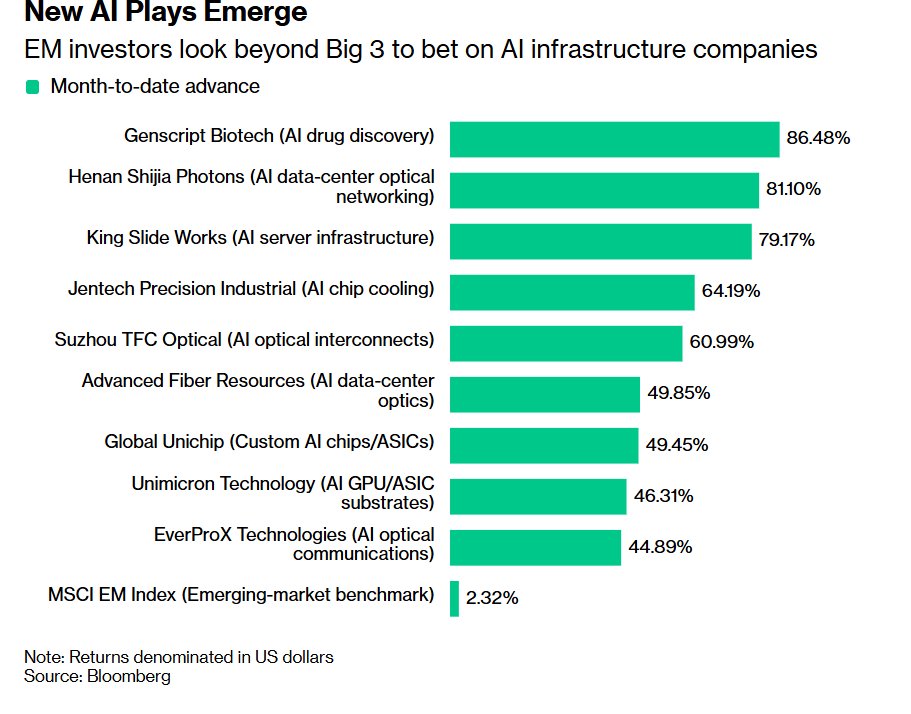
As shown in the chart above, new AI investment targets are emerging one after another — investors in emerging markets are no longer limited to the three chip giants, but are instead betting on AI infrastructure companies. Note: The rate of return is expressed in US dollars.
As China advances the AI computing power infrastructure construction process aimed at laying the foundation for long-term growth, almost all AI infrastructure companies in these emerging markets are also paying attention to the growth opportunities brought about by the unprecedented boom in the deployment of AI technology in China.
The investment logic of AI computing power infrastructure stocks is basically the same as the driving force behind the sharp rise in stock prices of memory chip makers over the past year — there is a continuous shortage of equipment and components needed to run extremely large AI training/inference systems, and the number of companies with corresponding production capacity is very limited.
“After a high concentration of stock market gains over the past two years, we have seen signs of the expansion of AI computing power supply chain leadership.” Nenad Dinić, a stock strategist at Swiss Prudential Bank in Zurich, said. He expects that the performance of emerging markets in the second half of this year will achieve a more balanced distribution among the core technology links in the AI computing power supply chain.
Even as investors are expanding the range of AI computing power infrastructure companies they are chasing, these companies are still mainly concentrated in the Chinese and Korean stock markets. This means that investment in emerging markets is likely to continue to show a pattern of significant imbalances.
Dinich said, “We will not regard second-tier AI computing power infrastructure-related companies as a tool to hedge against the weakening of AI superleaders.” “At the end of the day, they rely on the same underlying AI capital expenditure and infrastructure cycle.”
By weight, Asian countries account for 82% of the MSCI Emerging Markets Index, leaving only 18% of the weight to Eastern Europe, the Middle East, Africa and Latin America. The full rise of emerging AI computing power infrastructure companies may further consolidate the dominant position of the Chinese and Korean stock markets, while increasing the weight of the technology sector in the benchmark index.
This also poses a higher risk of concentration. Since so many large companies are closely linked to AI, any macro shock or any degree of reduction in AI capital spending by North American hyperscale cloud service providers could trigger a complete sell-off of the entire emerging market stock index.
Funding is always focused on growth! Stronger order visibility related to AI computing power ignites second tier
The AI market in emerging markets is spreading rapidly from TSMC, SK Hynix, and Samsung Electronics to cabinet-level infrastructure computing power fields such as server racks, optical communication/optical interconnection, liquid cooling, and power distribution. This is not about abandoning the three major chip giants; rather, with large-scale delivery of AI clusters, the market is beginning to price previously underestimated physical bottlenecks in the computing power stack layer by layer.
According to Wall Street financial giants such as Goldman Sachs and Morgan Stanley, which are optimistic about the AI computing power theme, the AI super bull market is far from over, but will move from the “AI chip purchase frenzy” to the second stage of “large-scale construction of AI factories” — that is, the next round of excess alpha earnings will no longer only belong to the list of the strongest leaders in the AI GPU/AI ASIC field, but will also spread systematically to data center high-performance CPUs, DRAM/NAND/HBM storage, AI PCBs, liquid cooling systems, data center optical interconnect systems, ABF carriers/glass substrates, MLCC An “AI factory” level full-stack AI computing power infrastructure layer such as electronic distribution and extensive foundry.
The underlying logic of this diffusion and rotation is that AI evolves from the “underlying computing power chip supermarket” to the full-stack AI computing power capital cycle: the increase in the number of GPU/TPU/AI ASICs will simultaneously amplify servers, memory, enterprise-grade NAND storage components, Ethernet switches, optical modules, data center optical communication/optical interconnections, high-speed connectors, server cabinet slides, cooling, and power distribution requirements; the larger the scale of training and inference clusters, the higher the number of ports, the value of a single cabinet, and interconnection complexity. Investment commitments from hyperscale cloud service providers of nearly $2.4 trillion will not only flow to computing chips, but will also be transformed into multi-year orders and revenue visibility for segmented equipment vendors along the supply chain.
Morgan Stanley predicts that by 2028, close to $3 trillion of AI-related infrastructure investment will flow through the global economy, and more than 80% of spending is still ahead. According to Goldman Sachs's latest calculation data, the global AI capital expenditure benchmark model is expected to grow from $765 billion per year in 2026 to 1.6 trillion US dollars per year in 2031, and the cumulative capital expenditure from 2026 to 2031 is estimated to be about 7.6 trillion US dollars. The power demand for US data centers is expected to rise from 31 GW in 2025 to 66 GW in 2027. This will directly spill AI computing power infrastructure investment into server CPUs, DRAM/NAND/HBM, advanced packaging, liquid cooling, power equipment, transformers, gas turbines, grid-connected equipment, data Links such as central REITs and engineering construction.
As global AI computing power-themed investments are accelerating from a small number of super-weighted stocks to structural diffusion driven by orders, supply bottlenecks, and the value of a single cabinet, it should be noted that this is not an indiscriminate small to medium market AI — a target that is truly worth configuring should also have irreplaceable technical positions, customer certification barriers, continuously increasing single-cabinet value, reliable order visibility, and profitability that can be converted into free cash flow. Furthermore, second-tier AI computing power resource vendors rely on the same AI capital expenditure cycle as the three major chip giants, and may not be able to completely hedge against the risk of hyperscale cloud vendors cutting investment.