
Did the US Treasury “buy debt and suppress interest rates” to hurt the dollar? Citi drastically lowered its three-month forecast for the US dollar, saying it is inappropriate to go long before the midterm elections
The Zhitong Finance App learned that Citigroup's foreign exchange strategy team recently turned bearish on the short-term trend of the US dollar as the market gradually digests expectations that the Federal Reserve's position is moderating, factors in the midterm election, and news that the US Treasury may step up treasury bond repurchases. Citi strategists led by Daniel Tobon lowered the US dollar index forecast for the next three months from 102.12 to 98.34 in a research report on Thursday.
Prior to this reduction, Citi warned that US Treasury Secretary Scott Bessent's latest move to reduce long-term borrowing costs — that is, to expand the repurchase of 10-year to 30-year treasury bonds — could be at the cost of a weaker dollar. On Wednesday, the US dollar index fell to its lowest level since May.
Tobon and his team said they have taken a “relatively neutral” stance on the US dollar in recent months, but warned that risks may increase in the coming months.
They wrote in the report: “The latest variable is that the US Treasury recently announced that it will double the scale of repurchases by November. This has added a new negative factor to the US dollar through two paths: first, it depresses US bond yields; second, it raises market concerns about financial suppression policies.”
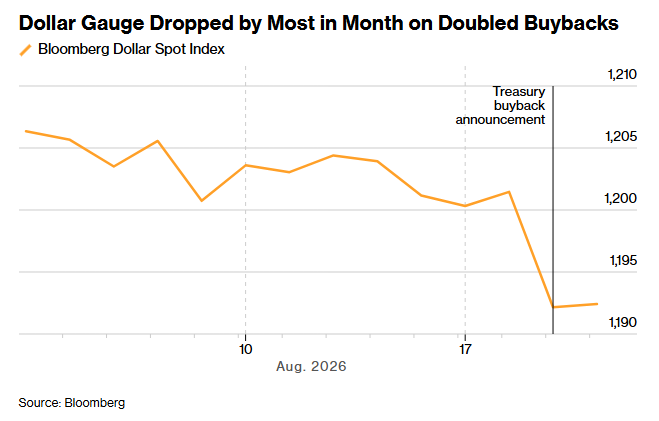
Before the Ministry of Finance's buyback program was introduced, there were recent signs that government borrowing costs continued to rise — interest rates for winning the 10-year and 30-year treasury bond auctions in August both hit new highs since the 2000s.
The strategist also pointed out that traders have lowered their expectations for the Fed's interest rate hike, which previously fueled a bullish sentiment in the US dollar. Looking ahead to the future market, they believe that the market may avoid long positions in the US dollar before the November midterm elections. “The reason is that US political uncertainty is rising, and the tail risks associated with election disputes cannot be ignored.”
However, the team has not changed its long-term view on the US dollar, and still believes that America's economic growth prospects are better than other G10 member countries.
They mentioned that the US-Iran conflict and the boom in artificial intelligence (AI) investment could pose an upward risk to their new predictions. In recent months, oil transportation in the Strait of Hormuz has declined, compounded by a surge in AI-related capital expenditure, which has raised market concerns about inflation or prompted the Federal Reserve to raise interest rates again.
Furthermore, strategists raised the EUR/USD exchange rate forecast for the next three months to 1.1750, mainly based on expectations of the ECB's interest rate hike of 25 basis points in September and the decline in market expectations for the Fed's interest rate hike.