
Daiwa House Industry (TSE:1925) Lifts Outlook And Plans Stock Split As Valuation Debate Builds
Daiwa House Industry (TSE:1925) drew fresh attention on 6 August 2026 after raising its full year earnings guidance, reporting first quarter results, outlining a two for one stock split and updating dividend expectations.
See our latest analysis for Daiwa House Industry.
The recent guidance upgrade, dividend update and planned stock split come after mixed share price momentum for Daiwa House Industry, with short term gains such as a 5.32% 90 day share price return set against a year to date share price decline of 11.09% and a longer record that includes a 27.71% three year total shareholder return and 66.76% over five years. This suggests longer term holders have still seen meaningful value creation even as near term sentiment has softened.
If you want to see how other companies are positioned around future housing, infrastructure and energy trends, now could be a good time to scan 39 power grid technology and infrastructure stocks
Daiwa House Industry has just raised guidance and outlined a stock split, which puts the focus on whether current holders are already well rewarded or whether waiting for a cheaper entry makes more sense. How does the valuation stack up now?
Preferred P/E of 8.1x for Daiwa House Industry: Is it justified?
Daiwa House Industry last closed at ¥4,651, and on a P/E of 8.1x it screens as cheaper than many peers even after the recent share price weakness.
The P/E ratio compares the current share price with earnings per share. For a mature, diversified construction and real estate group like Daiwa House Industry, it is a common shorthand for how the market is weighing current earnings against expected future profits.
Analysts currently see earnings growth, although not at high rates, and the company reports high quality earnings and profit growth that has been faster than the wider Real Estate industry over the last year. A lower P/E in that context can suggest the market is pricing those earnings more cautiously, rather than paying up for the recent 15.4% earnings growth or the longer 10% per year profit growth over five years.
The comparison with peers is where the valuation gap becomes clearer. Daiwa House Industry trades on a P/E of 8.1x versus 10.2x for the JP Real Estate industry and 14.4x for its direct peer set. The estimated fair P/E is 15.9x. Those gaps are sizeable and point to a level the market could potentially move towards if sentiment on its earnings durability improves.
Explore the SWS fair ratio for Daiwa House Industry
Result: Price-to-earnings of 8.1x (UNDERVALUED)
However, investors also need to watch for any slowdown in housing or construction demand, as well as for weaker profitability that could challenge the current P/E case.
Find out about the key risks to this Daiwa House Industry narrative.
Another view on Daiwa House Industry’s valuation
There is a catch. The SWS DCF model suggests Daiwa House Industry at ¥4,651 is trading above an estimated future cash flow value of ¥3,080.78, which points to an overvalued result instead of a bargain. Which signal matters more for you: earnings based pricing or cash flow value?
Look into how the SWS DCF model arrives at its fair value.
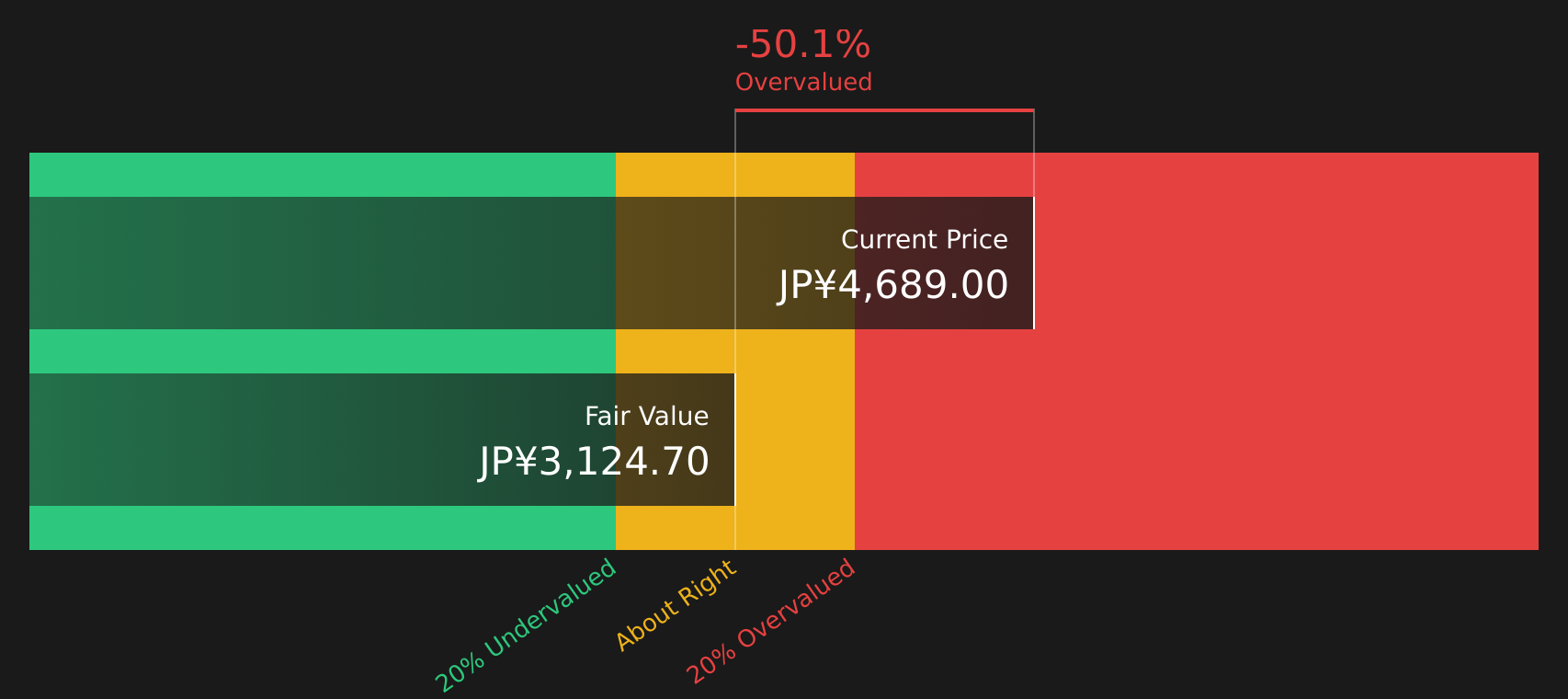
Simply Wall St performs a discounted cash flow (DCF) on every stock in the world every day (check out Daiwa House Industry for example). We show the entire calculation in full. You can track the result in your watchlist or portfolio and be alerted when this changes, or use our stock screener to discover 26 high quality undervalued stocks. If you save a screener we even alert you when new companies match - so you never miss a potential opportunity.
Next Steps
With Daiwa House Industry presenting both caution signals and reasons for optimism, now may be a suitable time to examine the numbers directly and decide where you stand based on the 4 key rewards and 2 important warning signs
Looking for more investment ideas beyond Daiwa House Industry?
If you want to build on what you have learned from Daiwa House Industry, now is the time to scan fresh ideas before the next market move passes you by.
- Target higher potential with carefully filtered opportunities by reviewing the 1 elite penny stocks with strong financials.
- Strengthen your portfolio with quality companies that appear cheap on fundamentals through the 26 high quality undervalued stocks.
- Prioritise resilience and sleep-better-at-night holdings by checking the 58 resilient stocks with low risk scores.
This article by Simply Wall St is general in nature. We provide commentary based on historical data and analyst forecasts only using an unbiased methodology and our articles are not intended to be financial advice. It does not constitute a recommendation to buy or sell any stock, and does not take account of your objectives, or your financial situation. We aim to bring you long-term focused analysis driven by fundamental data. Note that our analysis may not factor in the latest price-sensitive company announcements or qualitative material. Simply Wall St has no position in any stocks mentioned.
Have feedback on this article? Concerned about the content? Get in touch with us directly. Alternatively, email editorial-team@simplywallst.com