
The number of initial jobless claims in the US unexpectedly fell to 206,000, adding more leverage to the Federal Reserve's stay on hold in September
The Zhitong Finance App learned that data released by the US Department of Labor on Thursday showed that in the week ending August 15, the number of initial jobless claims in the US fell by 6,000 to 206,000, lower than economists' expectations of 210,000. Meanwhile, the previous week's data was revised up to 212,000 people. This data further confirms that the US labor market remained quite resilient after the unexpected weakening of non-farm payrolls data in July.
Since this year, the number of initial jobless claims has been hovering at the low end of the range of 189,000 to 230,000. This indicator once fell to 187,000 in mid-July, the lowest since 1969. Despite a recovery since then, the overall level is still at an all-time low.
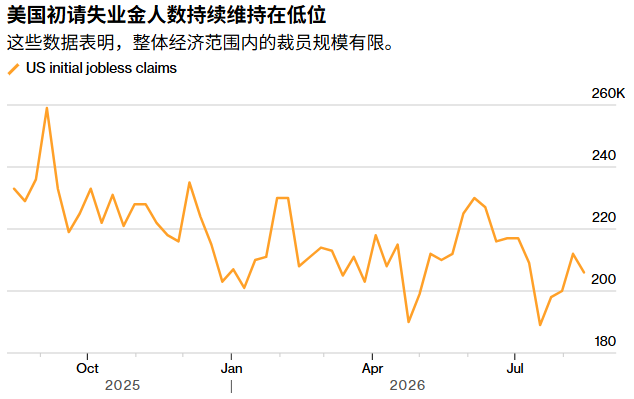
The four-week moving average rose from 19.975 million to 204,000. The rise in this indicator shows that although weekly data is still strong, the recent overall trend is slowly recovering from an extremely low level.
The number of people renewing unemployment benefits (measuring the number of people who continue to receive unemployment benefits) rose to 1.79,000, higher than the previous value of 1.781 million and the 1.79 million expected by the market. The insured unemployment rate remained unchanged at 1.2%.
Looking at the regional distribution, unseasonally adjusted data shows that Michigan, New York, Texas, and South Carolina saw the biggest increase in the number of first-time applicants. Among them, New York State attributed the growth to layoffs in the professional, technical services, construction, and healthcare industries. Ohio, Iowa, Kentucky, Louisiana, and North Dakota saw the biggest drop in the number of applicants.
The “no recourse” pattern continues: the stable appearance of the job market and hidden structural concerns
The most prominent characteristic of the current US labor market is the “no call to action” stalemate pattern. On the one hand, the scale of layoffs is still sparse — companies are generally unwilling to cut their current workforce. This behavior pattern is closely linked to deep memories of post-pandemic labor shortages. On the other hand, recruitment intentions were also sluggish: from January to July of this year, the average number of new jobs added by employers was only 61,000 per month. Although this is an improvement from 0.97 million last year, it is still far below the monthly average of 166,000 between 2023 and 2024.
The July non-farm payroll data unexpectedly dropped by 23,000 people, compounded by a sharp decline in May and June data, which once raised market concerns about the health of the labor market. However, some economists believe that the summer job market usually experiences a seasonal slowdown, which may be related to the difficulty of seasonal adjustments related to the time points of the school year.
The US unemployment rate remained relatively low at 4.1%. However, this stability has a specific structural background — relating not only to the economy's resilience in an environment of high energy prices, but also to the decline in labor participation due to the tightening of immigration policies and the continued retirement of baby boomers. Over the past year, more than 1.3 million people have left the labor force.
The moderate rise in the number of renewed jobless claims reflects a slowdown in the rate of labor absorption by enterprises, but it is not yet a sign of systemic weakening. First-time job seekers and re-employed groups still face intense competition, while the lagging effects of high interest rates and trade policy uncertainty continue to limit companies' willingness to expand.
Impact on the Federal Reserve's September Decision: Expanding policy space to remain on hold
The stability of the labor market, combined with recent signs of moderate inflationary pressure, is providing more policy space for the September meeting of the Federal Reserve to keep interest rates unchanged. The Federal Reserve kept the benchmark interest rate in the range of 3.50% to 3.75% last month. Three decision makers objected and believed that interest rates should be raised by 25 basis points.
At the July FOMC meeting, the Federal Reserve kept interest rates unchanged in the 3.5% to 3.75% range for the fifth time in a row, but there were three rare negative votes — all three regional Federal Reserve presidents advocated raising interest rates. The continued stability of the labor market provides new arguments for moderate officials who claim to “wait for more data before making decisions.”
However, the rise in unemployment claims and the rise in the four-week moving average are also reminding the market that the direction of marginal changes in the labor market is slackening rather than tightening. This state of “slow relaxation” is probably the ideal path the Federal Reserve hopes to see as inflation returns to the 2% target — without triggering recession fears, but also easing the pressure on the wage-price spiral.
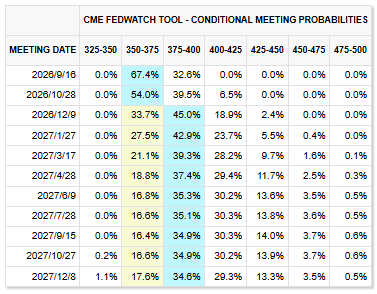
Weak US economic data has reduced the market's probability of the Federal Reserve's interest rate hike in September to about 33%. Non-farm payrolls unexpectedly weakened in July, but unemployment claims data did not deteriorate at the same time, and there was a certain divergence between the two.
Follow-up key observation window
Although current data supports the Federal Reserve remaining on hold, the market still needs to pay attention to the August non-farm payrolls report to be released at the beginning of next month to further verify whether there is a trend change in the job market. If the job market maintains its current resilience and inflation remains moderate, the probability that the Federal Reserve will keep interest rates unchanged in September will be further consolidated; if the labor market shows signs of systemic weakening, the Fed's policy balance will gradually shift from a single anchoring of inflation expectations to a dynamic balance between inflation and employment risk.