
J.P. Morgan warns that the US Treasury's doubling to buy back treasury bonds lacks credibility, and long-term yields may face further upward pressure
The Zhitong Finance App learned that J.P. Morgan's strategists warned that the market may think that the unexpected measures taken by the US Treasury to curb long-term financing costs lack credibility, which may drive up term premiums and returns over time.
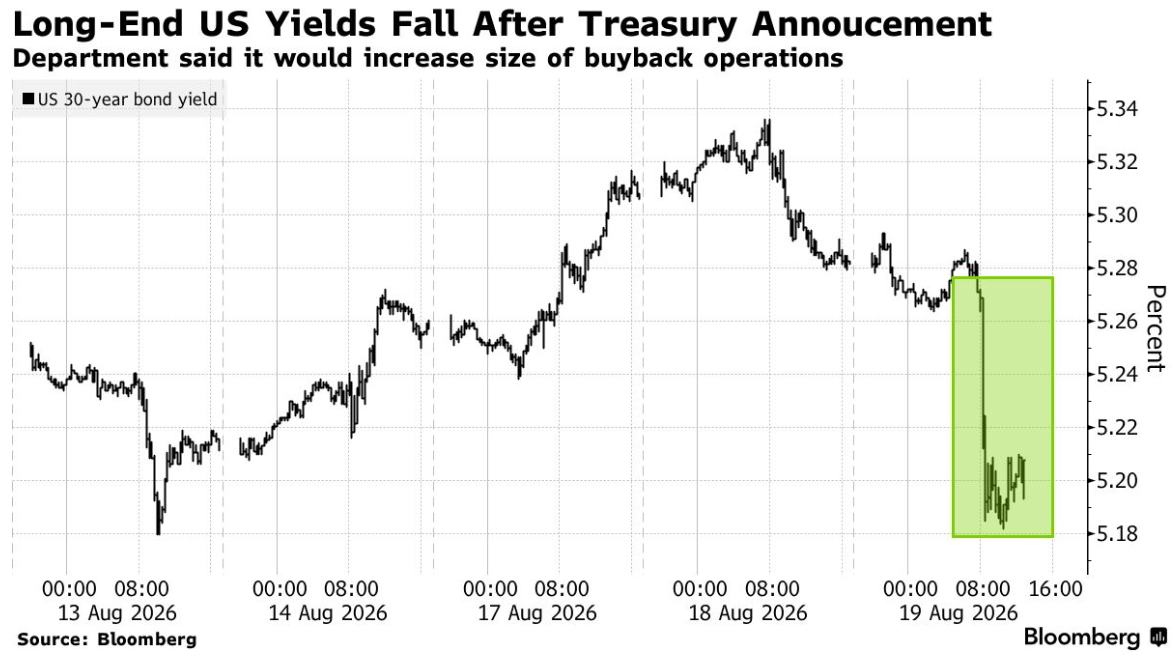
The US Treasury Department said on Wednesday that it will at least double the scale of treasury bond repurchases to provide “greater liquidity support,” which has led to lower yields on US long-term treasury bonds. However, according to J.P. Morgan Chase, the move is only treating the symptoms rather than the root causes: in an economic environment close to full employment, the US fiscal deficit rate is as high as 6%.
Strategists, including Jay Barry, wrote in a report, “If there is no real fiscal consolidation, we are concerned that the market will see this action as lacking credibility,” and “if the Treasury becomes more speculative in its debt management methods and deviates further from its 'routine and predictable' principles, this could lead to higher term premiums and yields over time.”
The US national debt has surpassed $40 trillion, putting policymakers trying to control financing costs at higher risk, even as Washington continues to sell more bonds. In a Markets Pulse survey, around 60% of respondents said that the US debt situation will continue to deteriorate until it triggers a major crisis.
The impact goes far beyond the US federal budget, because US Treasury yields are the benchmark for global financing costs. Higher yields could be transmitted to US mortgages and corporate debt, as well as global monetary and sovereign bonds.
This latest action follows a series of decisions made by the Treasury in recent weeks, which indicate growing concerns about rising long-term yields — which, by some measures, recently hit their highest level since 2001. The statement lowered the 30-year Treasury yield by 9 basis points to 5.19%, while a long-term treasury bond index surged 1.7%, the best single-day performance since February 2025.
Citigroup advises customers to buy 20-year US Treasury bonds, believing that the move appears to be aimed at keeping long-term yields at a reasonable level. In the context of cooling inflation, Citi expects a strong rebound in the bond market in the next few months.
“Regular and predictable”
What makes the Treasury's latest move particularly sensitive is that it has long been adhering to the principle of “routine and predictability” and not causing surprises to investors. Treasury Secretary Vincent himself endorsed this approach during a keynote address at a conference in November last year.
The Treasury reintroduced its buyback program in 2023, an initiative conceived more than 20 years ago when the government had fiscal surpluses and bought back and write off more costly debts. This time, one of the core goals is to improve market liquidity, as traders usually tend to hold current benchmark US bonds for a specific period, which makes trading old US bonds more difficult and more expensive.
Despite this, J.P. Morgan said the timing of the Treasury announcement was “extremely unusual,” and it was only two weeks since the Treasury announced its schedule to buy back old securities. This move increases the possibility that the Ministry of Finance may cut the scale of long-term auctions if yields continue to rise.
But the US federal government still needs to borrow large sums of money. J.P. Morgan expects a funding gap of more than $3.5 trillion over the next few fiscal years, which may require an increase rather than a decrease in the supply of long-term bonds.
The strategists wrote, “While it seems to us that the possibility of reducing the size of auctions has increased, we don't think this will have a lasting impact on reducing long-term returns. We believe that unless action is taken to reduce the deficit, the impact of today's actions on long-term yields may only be short-lived.”