
GPU prices skyrocketed 48% in a single month! Intel completely says goodbye to “AI supporting actors” and embraces the era of reasoning with “CPU and GPU demand fanatic+chip foundry+advanced packaging”
The Zhitong Finance App learned that as market research data showed that the price of GPUs dedicated to the Arc Pro B70 workstation built by Intel (INTC.US) rose as high as 48% in a month, Wedbush Securities, a well-known investment agency on Wall Street, commented that this largely reflects the fact that the price of memory chips continues to soar, and that Intel has gone from being an AI supporting actor with CPU+GPU product arrays to becoming a core participant in the AI reasoning era.
The Arc Pro B70 with 32GB GDDR6 ECC memory can be described as becoming a major selling point for Intel in the AI inference era. The large graphics memory capacity and error correction capabilities make it more suitable for AI inference type workloads, especially enterprise-level AI inference tasks that require long hours of stable operation and high data accuracy requirements. As the demand for video memory capacity and bandwidth from oversized parametric inference models continues to increase, Intel workstation GPUs and Crescent Island are becoming important computing power choices outside of AI datacenter-level GPU/TPU accelerator card clusters. Error correction capability (ECC) here means that video memory can automatically detect and correct single-bit errors during data transmission or storage, thereby reducing computational abnormalities, distorted results, or system crashes in model inference.
Intel is rapidly upgrading from an “AI supporting actor” in the AI big model training era to a multi-level AI computing power infrastructure beneficiary in the AI inference era led by AI agents (Agentic AI). The “CPU and GPU demand frenzy, chip foundry, and advanced packaging” is reshaping Intel's growth curve.
Not only has the growth in data center demand driven a sharp rise in sales of its x86 architecture central processor (that is, data center CPU), the 32GB large video memory enables it to carry local large model inference, small model fine tuning, and professional workstation tasks. Compared with expensive Nvidia professional cards, it has a capacity-price advantage and brings significant incremental workstation GPU demand; but this is mainly due to the scarcity premium of high video memory workstation reasoning cards. It is not that the Arc ecosystem has suddenly surpassed CUDA, nor does it mean that Intel is beginning to seize the share of data center GPUs.
32GB ECC memory on AI inference outlet! Intel Arc Pro B70 prices soar 48% in a month
Matt Bryson, a senior analyst from Wedbush Securities, wrote in a report to customers: “According to Tom's Hardware, the sales price of the Intel Arc Pro B70 workstation GPU in the US market has risen sharply by 30% — the ASRock Creator variant currently sells for $1,299, compared to $999 last month, and its recommended retail price is $949; the Arc Pro B70 workstation GPU has risen in the German market 26%; in South Korea, the price rose sharply by 48%, from 1,889,980 won (about 1,334 US dollars) on July 21 to 2,798,980 won (about 1,975 US dollars) on August 16.”
“Intel's official list price in Korea is currently 2,817,000 won. The graphics card is equipped with 32GB of GDDR6 ECC memory, making it attractive for artificial intelligence-related inference workloads. We believe that this news once again reflects the increased transmission of memory chip costs to terminal sales prices, and that Intel's GPU+CPU product line is beginning to play an increasingly important role in the AI reasoning era.” Bryson added in his report to clients.
The sudden increase in the price of the Arc Pro B70 cannot simply be interpreted as an explosion in demand for Intel GPUs. The core reason, as Wade Bush judged, is the transmission of memory chip costs. The B70 is equipped with 32GB GDDR6 ECC video memory, and the weight of video memory on the material cost (BOM) is much higher than that of ordinary consumer-grade video cards; after production capacity migrated to HBM, server DDR5, and high-end storage, GDDR6 supply costs increased, and tight channel inventories further amplified regional premiums.
At the same time, the 32GB large video memory allows it to carry local large model inference, small model fine-tuning workloads, and professional workstation tasks. It has a “capacity-price advantage” over expensive Nvidia professional cards, which does bring incremental demand; but this is mainly a scarcity premium for high-memory workstation cards. It's not that the Arc ecosystem suddenly surpasses CUDA, nor does it mean that Intel is struggling to seize the GPU share of data center GPUs.
Video memory price increases ignite the 1:1 trend of Arc Pro, CPU, and GPU, and Intel is moving from an AI supporting role to a core beneficiary of AI computing power requirements
As mentioned above, Intel is upgrading from an “AI supporting role” in the training era to a force benefiting from multi-level AI computing power infrastructure in the era of artificial intelligence reasoning, but it is still too early to say that it will become the dominant player in the inference era.
The proxy workflow dominated by the AI Agent Technology Route (Agentic AI) requires the CPU to undertake control plane tasks such as task planning, search enhancement generation (RAG), vector database queries, API calls, state management, and multi-agent orchestration, while the GPU continues to be responsible for the data plane (Data Plane) for matrix computation and high-throughput inference. As a result, Bank of America raised the potential market size of server CPUs to more than 210 billion US dollars in 2030, increasing the compound annual growth rate to 36%, and predicts that the ratio of CPU to GPU will narrow from about 1:4 during the training phase to about 1:2 in the inference stage and eventually approach 1:1; this will significantly amplify the value of the CPU installation base in Intel Xeon data centers.
What is really likely to reshape Intel's growth curve is the four-layer combination of “CPU+inference GPU+foundry and advanced packaging”, which can be called a “complex repair asset in the expansion of inference computing power led by AI agents” — that is, Xeon Intel's data center CPU demand increases to provide a performance chassis, and exclusive GPUs with high video memory types open up differentiated inference entrances, and 18A and advanced packaging provide valuation options.
For Intel's new fundamental growth trajectory, Xeon undertakes intelligent orchestration and independent CPU rack requirements; Gaudi 3 and Crescent Island with 160GB LPDDR5x target the cost-sensitive, air-cooled enterprise inference market; Arc Pro B70 targets local large model reasoning, small model fine tuning, and professional workstation tasks; 18A advanced process technology undertakes future server CPU iterations; EMIB bridging and Foveros Direct 3D hybrid bonding can serve third parties AI accelerators and hyperscale chiplet (Chiplet) systems.
According to the 2026 second quarter results data, revenue related to Intel's data center and AI business reached 6.3 billion US dollars, up 59% year on year, and the wafer foundry business revenue reached 5.8 billion US dollars, an increase of 31% year on year, which is enough to show that strong demand related to AI server computing power clusters has begun to enter the report; however, Intel's 18A/14A chip foundry and advanced packaging revenue still includes a large amount of internal settlement. Only mass production of advanced process chips from external customers, yield improvement, and large-scale conversion of EMIB/FOVEROS 3D advanced packaging orders can prove that it has already been completed Form an independent profit engine.
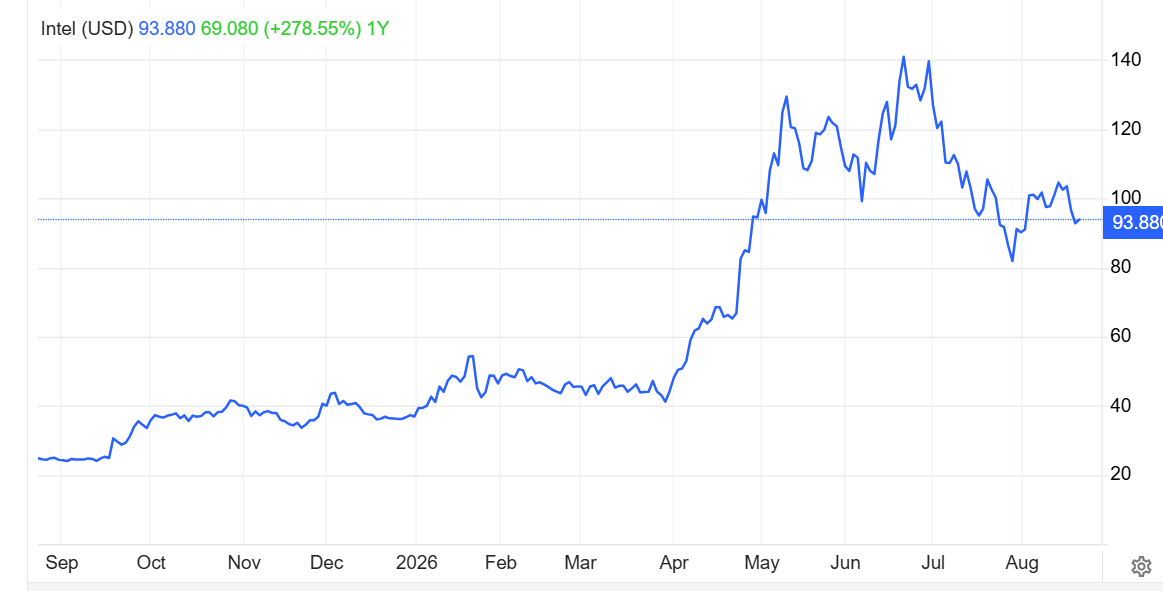
Since 2026, Intel's stock price has risen sharply by 150%. Regarding Intel's stock price outlook, the most optimistic target price on Wall Street is the target price of $200 given by HSBC analyst Frank Lee, which represents a potential increase of about 115.5% compared to Intel's closing price of $92.80 on August 19. The analyst directly doubled the target price from $100 and maintained a “buy”. The core logic is that the agency included Intel Foundry (Intel Foundry) in the valuation for the first time, and believes that 18A/14A advanced manufacturing process, EMib/FOVeros advanced packaging, and potential external customers will make Intel has become an important alternative to TSMC, while demand for data center CPUs and AI accelerators continues to expand to strengthen profit recovery.