
Can Oracle (ORCL) Stay Cheap If AI Growth Meets Buildout Risks?
Oracle stock has fallen sharply over the past year but still screens as attractive on valuation checks, which raises a clear question for investors comparing the recent share price path with the current fundamentals view.
- Over the last 5 years, Oracle has returned 72.5%, which indicates that long term holders are still meaningfully ahead despite the recent pullback.
- Partnerships around Oracle AI Database with hyperscalers such as AWS may support long term growth expectations, while large capital needs and community pushback linked to data center expansion projects like Project Jupiter can add risk to how those expectations are priced.
- Oracle is assessed as undervalued on 5 of 6 checks, so the broader valuation work points to a stock that currently leans cheap rather than expensive on key metrics here.
The stock's next move may depend on whether that high valuation score or the recent share price weakness proves to be the better guide for investors evaluating Oracle.
Find out why Oracle's -38.4% return over the last year is lagging behind its peers.
Is Oracle Still Cheap on Earnings?
The P/E ratio is a useful way to judge what you are paying today for each dollar of Oracle earnings. Oracle currently trades on a P/E of about 24.2x, which is below the broader software industry average of 31.4x and also below the peer group average of 42.8x. That places Oracle at a discount to much of its sector on earnings.
The fair P/E ratio from the model is 58.6x, which reflects what investors might typically pay for Oracle given its sector, margins, size, and risk profile. Compared with that fair ratio, the current 24.2x looks low. This is consistent with the earlier checks that suggest the stock is screening as cheap. Despite recent headlines around data center expansion and large AI infrastructure commitments, the market multiple still prices Oracle below both peers and the modelled fair earnings level.
On the P/E multiple, Oracle stock appears undervalued relative to both its industry and the modelled fair ratio.
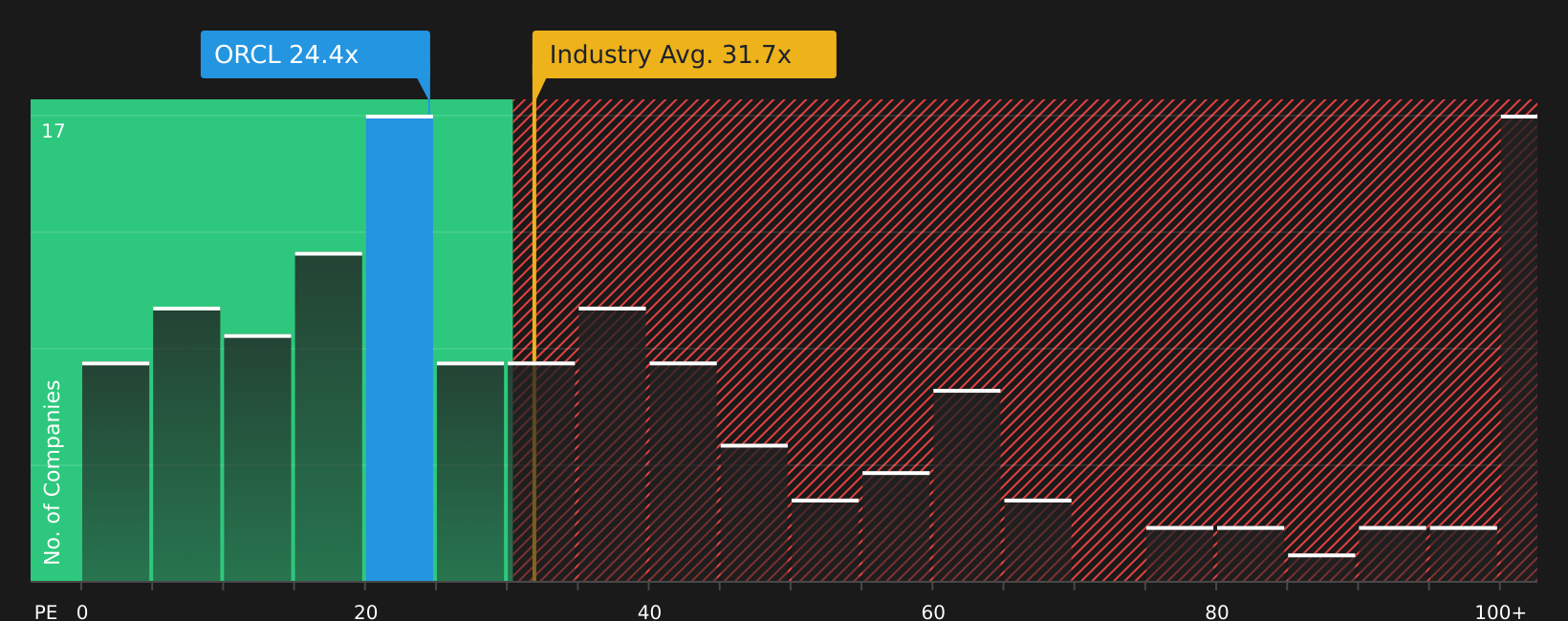
See what the numbers say about this price — find out in our valuation breakdown.
The Oracle Narrative: What Would Justify Today's Price?
Simply Wall St Narratives give you a way to connect Oracle's current P/E discount with clear scenarios for its future. Each Narrative sets out the specific assumptions for Oracle's growth, margins, and earnings that would need to hold for the stock to be priced meaningfully higher or lower than today. Rather than relying on a single multiple or model output, they spell out the moving parts behind each fair value so you can compare them with actual results over time.
Oracle investors are looking at two very different storylines, with community views split between a deep value AI rebuild and a more measured cloud transition.
Bull case: 63% undervalued
"Oracle is building gigawatt-scale data centers, one massive 1,100-acre campus in Abilene, Texas, featuring eight buildings, is dedicated initially to OpenAI workloads..."
Read the full Bull Case to see why Oracle could be undervalued
Bear case: 19% overvalued
"Oracle’s key advantage is its enormous installed base of customers already running Oracle databases..."
Read the full Bear Case to see why Oracle could be overvalued
Do you think there's more to the story for Oracle? Head over to our Community to see what others are saying!
The Bottom Line
Oracle currently screens as undervalued on the market-multiple work, with the P/E discount pointing to a stock that the market prices more cautiously than many software peers. The key question is whether that gap reflects genuine mispricing or a sensible buffer for execution and capital intensity risks around large AI and data center projects. For investors, the central consideration is whether Oracle can translate its AI partnerships and cloud push into durable earnings without eroding returns through heavy buildout costs. The outcome of that dynamic will likely determine whether today’s discount is attractive or represents a value trap.
This article by Simply Wall St is general in nature. We provide commentary based on historical data and analyst forecasts only using an unbiased methodology and our articles are not intended to be financial advice. It does not constitute a recommendation to buy or sell any stock, and does not take account of your objectives, or your financial situation. We aim to bring you long-term focused analysis driven by fundamental data. Note that our analysis may not factor in the latest price-sensitive company announcements or qualitative material. Simply Wall St has no position in any stocks mentioned.
Have feedback on this article? Concerned about the content? Get in touch with us directly. Alternatively, email editorial-team@simplywallst.com