
Qunzhi Consulting: The structural differentiation of the flexible OLED market highlights the expected increase in BOM costs for the whole machine
The Zhitong Finance App learned that Qunzhi Consulting published an article stating that the structural differentiation of the flexible OLED market is prominent. In the second half of the year, orders from panel manufacturers in the Apple supply chain alone were relatively steady, and demand was supported. FOLED prices continued to decline in the third quarter against the backdrop of continued price pressure on terminals and factories seizing share. Sigmaintell (Sigmaintell) predicts that although the third quarter entered the centralized release window for high-end and flagship models, due to the continued rise in prices of upstream components such as memory chips, BOM costs for complete machines rose markedly, terminal sales prices generally faced upward pressure, and consumers' willingness to switch was suppressed.
At the same time, rising prices of ICs, semiconductor materials, etc. continue to push up display module costs, while the profit margins for terminal brands have further narrowed, cost control efforts have continued to increase, and sensitivity to panel purchase prices has increased markedly. Under the double pressure of weak demand and rising costs, the transmission of panel factory costs to the downstream was blocked, and overall prices remained weak.
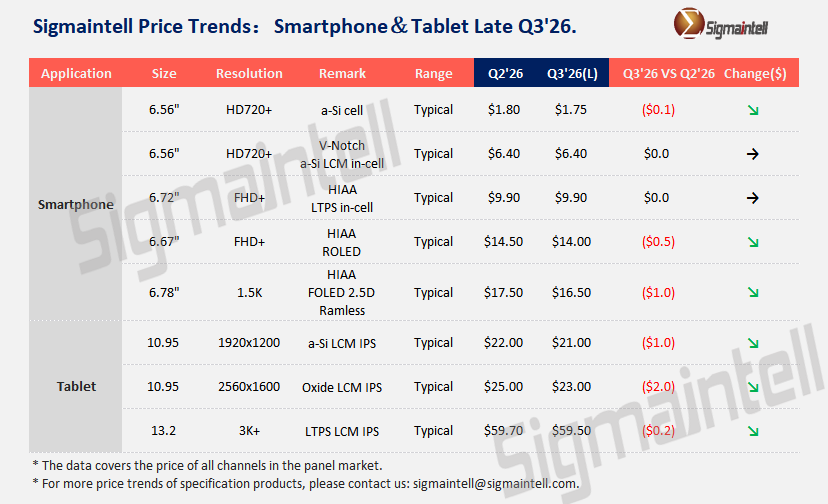
The specific price performance of each technology route is as follows
a-Si LCD:
Affected by the increase in the price of memory chips, the overall cost pressure on low-end mobile phones has further intensified. The rise in terminal sales prices suppresses demand to a certain extent, and demand in the low-end market is expected to shrink further in the second half of the year. At the same time, brand cost control continues to be strengthened, and the willingness to reduce module procurement prices has increased markedly. It is difficult for module manufacturers to effectively transmit rising IC and other costs downstream, and demands for price increases have basically come to naught. Only a few brands have adopted their own IC projects, and the overall cost of the module has increased.
LTPS LCD:
Due to continued substitution of other technologies and weakening demand for terminals, demand for LTPS LCDs for mobile phones has shrunk markedly. Current orders are mainly based on final order demand for old projects, and overall prices are expected to remain relatively stable in the third quarter. In the medium to long term, IT demand is also facing contraction pressure, and in-vehicle racing tracks have continued to grow. In the face of a further decline in mobile phone orders, panel manufacturers are willing to actively make concessions to obtain orders in order to compete for limited orders, especially for new projects of a certain scale, and prices are still facing some downward pressure.
ROLED (rigid OLED):
Due to FOLED replacement pressure, demand continued to shrink, and ROLED panel prices continued to be weak in the third quarter.
FOLED (flexible OLED):
The structural differentiation of the flexible OLED market is prominent. In the second half of the year, orders from panel manufacturers in the Apple supply chain alone were relatively steady, and demand was supported; demand for the rest of Android brand terminals generally continued to shrink, and competition for production capacity in the industry was fierce. FOLED prices continued to decline in the third quarter against the backdrop of terminals continuing to push prices and factories seizing share.
Tablet panel
The continued rise in the price of memory chips further boosted the BOM cost of tablet machines. Brand profit margins are being squeezed, and cost pressure continues to be transmitted to the supply chain of core devices such as panels. However, at the same time, the prices of some raw materials at the panel end are still on the upward channel. The cost pressure on panel manufacturers themselves is also increasing, and there is limited room for costs to be transmitted downstream. Since the second quarter, tablet prices have generally risen, and market demand momentum has further slowed. Under the double pressure of weakening demand and rising costs, panel manufacturers will pay more attention to the balance between utilization rate and profitability, and overall panel prices will operate under pressure.
Sigmaintell (Sigmaintell) predicts that the price trends for different technology routes are as follows:
a-Si LCD: As Oxide LCD continues to penetrate the middle and lower end markets, a-Si LCD faces further pressure to replace products; at the same time, weakening brand demand in the second half of the year will further weaken the demand support for a-Si LCD, and prices are expected to continue to decline as demand falls.
Oxide LCD: As the penetration rate of Oxide LCD increases and the scale of demand expands, market participants and supply competition have further increased. At the same time, terminal brands are still facing greater cost control pressure, and demand for panel prices continues to increase. Oxide LCD panel prices will face obvious downward pressure due to the dual effects of increased supply competition and continued brand price pressure.
LTPS LCD: Currently, LTPS LCD demand is mainly concentrated in the middle and high-end tablet market. 13.2 inch and 3K+ resolution have become the mainstream specifications for high-end brand products. As demand for high-end tablets weakens in the second half of the year, brand cost pressure is further transmitted to the panel side. LTPS LCD prices are expected to decline slightly, but the decline is relatively limited, supported by automotive demand for production line operations.