
Jibang Consulting: It is estimated that in 2026, the size of China's humanoid robot market will reach 15 billion yuan, and commercial inspection will commence
The Zhitong Finance App learned that according to TrendForce Jibang Consulting's latest robot industry research, the deployment of humanoid robots in China has begun to enter various scenarios such as automobiles, 3C, aviation, logistics, and energy, and the test of product commercialization has begun. The 2026 World Robotics Conference (WRC) on August 19 planned a “procurement day” for the first time, focusing on procurement negotiations and connecting with the industrial chain, reflecting the extension of the focus of industry development from technology display to actual demand. TrendForce Jibang Consulting estimates that in 2026, China's humanoid robot market will reach 15 billion yuan, and as mass production scales expand and application scenarios increase, the market size can maintain growth of at least 60% in 2027.
TrendForce Jibang Consulting said that humanoid robots are also the focus of this year's WRC. Major manufacturers have introduced new products. For example, Yushu Technology released a video of the new “Superman” before the exhibition, which emphasized that it can jump 2 meters high in place and reach a maximum speed of 12.66 meters per second, indicating that the industry is still rapidly advancing its body performance. However, the market is more concerned about whether the product can enter the commercial market from the exhibition hall. Therefore, in addition to showing difficult movements and AI capabilities, the participating manufacturers also actively demonstrated the robot's ability to handle, quality inspection, and logistics.
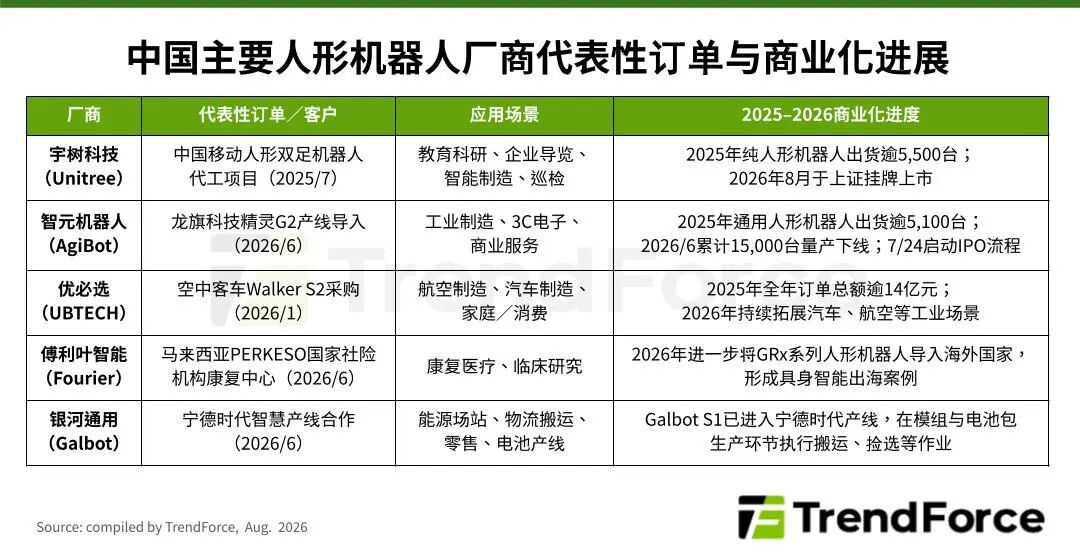
Observe the recent development of major humanoid robot companies in China. As of June 2026, Zhiyuan Robotics will mass-produce a total of 15,000 robots and continue to advance to the 3C manufacturing scenario. Preferred products have been introduced to customers such as Airbus, and the number of U1 pre-orders reached 13,361 units by the end of June. Galaxy GM, on the other hand, cooperated with Ningde Times and won a bid of 236 million yuan for a personalized smart device procurement project.
Profit growth is a major challenge for manufacturers
TrendForce Jibang Consulting pointed out that although humanoid robot deployment scenarios are gradually diversifying, they are still in various stages of introduction, such as formal procurement, reservation, intention, and scenario cooperation, and there is still a gap between large-scale, standardized and repeated procurement. For enterprises, what really needs to be verified is whether customers are willing to purchase again after completing the initial introduction of robots, and whether hardware, maintenance costs, and actual work efficiency can bring a reasonable return on investment to the company.
The indicator manufacturer Yushu Technology is an important example of observing the commercialization of humanoid robots in China. The company was listed on the Shanghai Stock Exchange Science and Technology Innovation Board on August 19. After opening, the market value once reached 444.9 billion yuan, showing that the capital market has high expectations for the growth potential of humanoid robots. Looking at Yushu Technology's recent financial performance, revenue in 2025 reached 1,699 billion yuan, an annual increase of more than three times. Although revenue is estimated to grow 36%-45% in the first half of 2026, recurring net profit is estimated to decrease 6%-22% per year, and profit for the first quarter of 2026 has also decreased by 52.55% per year. The above data shows that while revenue is growing, large manufacturers are facing phased cost and profit tests. It also highlights that after humanoid robots enter mass production, they still face the challenge of how to obtain cost advantages and increase profits through the scale of shipments.
TrendForce Jibang Consulting believes that in addition to showing various WRC robots, the market should observe which products already have clear customers, begin batch delivery, and whether the first batch of customers can be converted into repeat orders. For the humanoid robot industry in China, the next stage of development will focus not only on technical competition, but also on continuous delivery and verification of profitability.