
The Swiss franc temporarily seizes the limelight of yen and surges as a “new favorite” for arbitrage traders to finance
The Zhitong Finance App learned that arbitrage traders are turning their attention to the Swiss franc due to the threat of intervention and higher interest rates weakening the attractiveness of the yen as a financing currency.
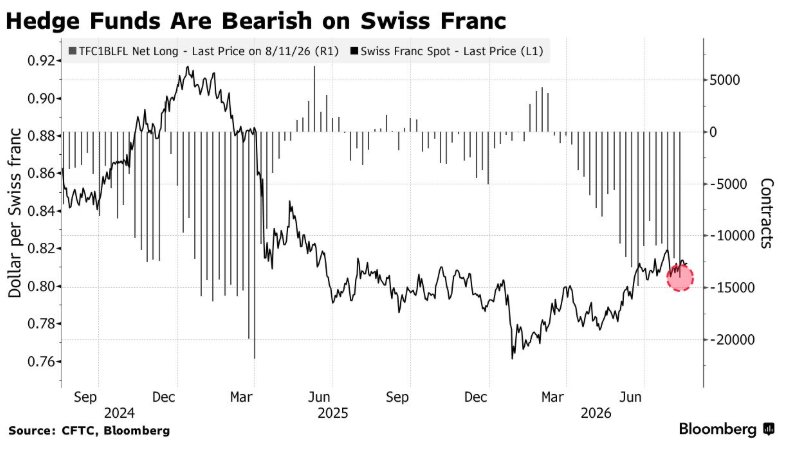
According to the latest data from the US Commodity Futures Trading Commission (CFTC), hedge funds have pushed their net short positions in the Swiss franc to a two-month high for the week ending August 11. Meanwhile, they have cut short positions in yen for the second week in a row.
Hedge funds short the Swiss franc
Financing costs and exchange rate intervention are key considerations
Tobias Jungman, head of American foreign exchange options at Bank of America in New York, said, “The market has recently increased short positions in the Swiss franc to finance foreign exchange arbitrage transactions.” He also pointed out that the ratio of volatility and arbitrage returns in emerging market transactions funded by the Swiss franc also makes options an effective way to both gain exposure and limit risk.
The Swiss franc's appeal for financing stems from Switzerland's near-zero interest rate level and the Swiss central bank's desire to curb the sharp appreciation of the Swiss franc. On the other hand, looking at yen, the Japanese and US authorities joined forces to push up the yen exchange rate at the end of July, which directly led to a sharp rise in yen volatility, making investors wary of yen financing transactions. A person familiar with the matter revealed last week that the Japanese government supports the central bank's interest rate hike in the near future.
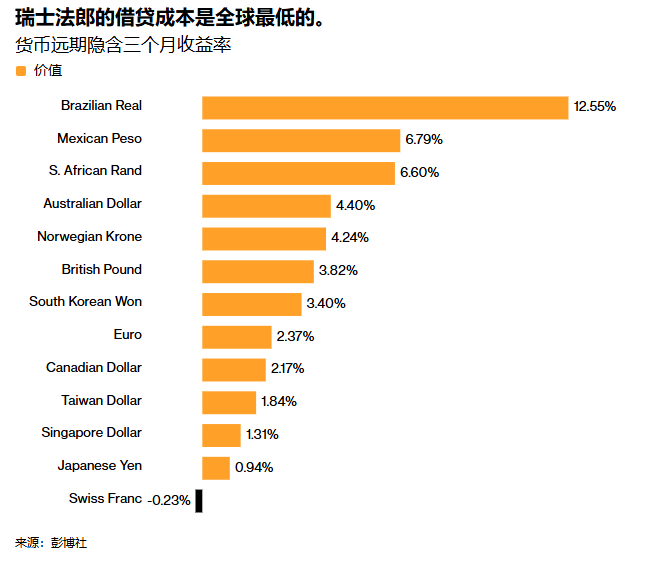
Higher spread returns are making the Swiss franc more attractive as a financing currency. The data shows that in the past month, the cumulative return of the strategy of borrowing the Swiss franc and investing in the high-interest currency Mexican peso was close to 4%; however, if the same strategy was funded in yen, the return was only 1.3%.
Simply put, arbitrage trading refers to investors borrowing low-interest currencies and switching to high-interest currencies to earn profit from interest spreads.
Stephen Jeffries, head of foreign exchange and emerging markets at J.P. Morgan Chase in London, said, “Large-scale intervention in 2024 severely damaged Japanese yen arbitrage transactions, and now market participants have lingering feelings about this.” He also pointed out that demand for alternative financing currencies such as the Swiss franc, the euro, and even the Taiwan dollar has recently rebounded.
The Japanese yen's status as the “king of finance” is difficult to shake in the short term
However, the yen has long been the preferred financing currency for arbitrage transactions, and is still favored by some industry insiders.
The Bank of Japan's 1% policy interest rate is lower than most developed market countries. At the same time, market concerns about Japan's long-term fiscal situation are also putting pressure on the yen. The yen exchange rate has now recovered more than half of the increase since the intervention.
“The yen is still the main global financing currency, and recent interventions have not changed this basic reality,” said Markus Schmidt, head of European linear foreign exchange and local market interest rate trading at Crédit Agricole. As long as the spread gap between Japan and other economies persists, arbitrage traders will continue to short the yen.
Graham Smolshaw, a senior foreign exchange spot trader at Nomura Singapore Ltd., said that during the recent correction in the yen exchange rate, the company did observe a resurgence in market interest in doing long yen crosses (EURJPY, AUD/JPY, and NZD/JPY). These trades are mainly executed through European reverse knockout options (ERKO).
Some market participants believe that, at least at this stage, the Swiss franc is still the most popular financing option. Steve Brice, the global chief investment officer of Standard Chartered Bank in Singapore, said bluntly, “Arbitrage trading in the Swiss franc is more popular. We are seeing more arbitrage trading capital coming from the Swiss franc.”