
Another strong proof that the global bond market is under pressure! Investors demand higher risk premiums. The yield on German 30-year treasury bonds is expected to reach a 15-year high
The Zhitong Finance App learned that Germany is expected to face the highest financing costs in 15 years in a large-scale long-term bond issuance as investors demand higher compensation for financing a government with increasing debt and is still dealing with inflation.
Germany issued a small number of 30-year treasury bonds with a yield of 3.64% last month. This is the highest yield since 2011 when issuing bonds with this maturity. People familiar with the matter revealed that Germany now issues 30-year treasury bonds due in August 2056 through bank syndicates, and the issuance yield will be 0.4 basis points higher than the current yield (3.77%) of 30-year treasury bonds due in 2054. People familiar with the matter added that the pricing for this 30-year treasury bond issue is expected to be announced later on Tuesday.
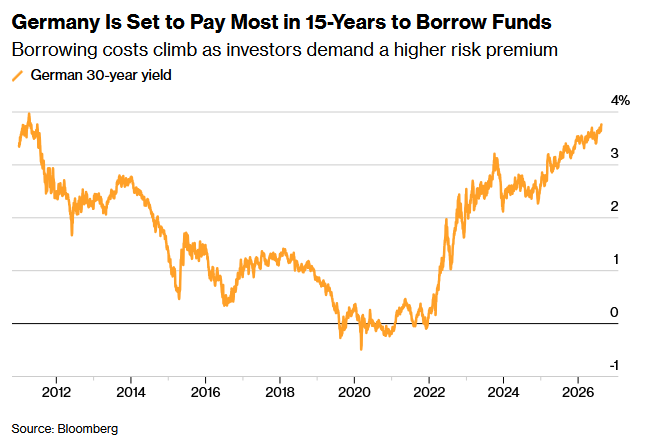
Investors demand higher risk premiums, driving up financing costs
The cost of bond syndication is usually higher than issuing through auction, but this method allows the government to quickly raise large sums of money, while expanding the investor base and diversifying the investor structure. The bonds involved in this syndicated offering were first issued in March of last year. At that time, the issuance scale was 6 billion euros and attracted 36 billion euros in subscription orders. In May, when the bond yield hovered slightly below its 15-year high, Germany once again issued additional bonds, which also attracted 36 billion euros in demand.
Christoph Riegel, head of interest rate and credit research at Commerzbank, predicts that the maximum size of the deal on Tuesday could reach 3.5 billion euros (about 4.1 billion US dollars). His colleague Hawke Simson wrote in a report last month that Germany's financing needs are expected to increase dramatically in 2027. The draft budget shows that Germany's net financing needs will reach 204 billion euros. He predicts that Germany's net issuance of new federal bonds will reach a record of 163 billion euros next year, up from about 137 billion euros in 2026; at the same time, total bond issuance is also expected to reach the highest level in history of about 400 billion euros.
Increased demand for financing reflects increased German defense and infrastructure spending, while the country will face a record 238 billion euro bond repayment pressure next year. However, not all capital must be raised through the issuance of federal bonds. Simson said that short-term treasury notes, cash reserves, asset sales, and funds from KfW, the German state-owned development bank, can all provide other sources of financing.
The global bond market is facing a “protracted storm”
As governments expand spending and inflationary pressure continues after the oil price shock this year, the global bond market has generally weakened and has experienced further sell-off in recent weeks. Last week, the yield on 30-year German treasury bonds hit a new high since 2011, and the yield on 10-year French treasury bonds rose to the highest level since 2009. Overnight, 30-year US Treasury bonds continued to be sold off. The yield once rose to 5.29%, the highest level since 2007, and further approached the high at the beginning of the global financial crisis that year. This pressure also spread to Asia — on August 18, the yield on Japan's 5-year treasury bonds rose to 2.18%, a record high; the 10-year treasury yield rose to 2.945%, the highest level since September 1996.
Although each country's bond market is affected by local factors, the structural forces driving upward yields are in fact common to the world. On the one hand, markets worry that an increasingly divided world order will make economies more vulnerable to supply shocks, and inflationary pressure will continue; on the other hand, bondholders worry that it will be difficult for governments to control fiscal spending, forcing interest rates to remain high for a longer period of time.
In this “storm,” nothing attracted more attention than US Treasury bonds. Like German treasury bonds, US treasury bonds also face higher financing costs due to rising risk premiums. On August 12, the winning bid interest rate for the $42 billion 10-year US Treasury bond bid reached 4.683%, the highest since the 2007 global financial crisis; on August 13, the US Treasury completed the bid sale of 25 billion US dollars of 30-year treasury bonds, and the bid interest rate was 5.216%, the highest level since 2001.
Behind the sharp rise in long-term debt financing costs are market concerns about the worsening US fiscal deficit. The total US fiscal deficit reached 432.3 billion US dollars in July, an increase of about 48% over the same period last year, making it the largest monthly deficit since March 2021. Worse still, not only did the monthly deficit expand dramatically; the cumulative US fiscal gap for the first 10 months of the current fiscal year was close to 1.8 trillion US dollars, exceeding the same period in 2025.
Meanwhile, the total size of US treasury bonds has reached 39.9 trillion US dollars. In the first 10 months of this fiscal year, interest on debt paid by the US government reached 1.17 trillion US dollars, up from 1.01 trillion US dollars in the same period last year, and an increase of about 160 billion US dollars.
Against the backdrop of recent market expectations of the Fed's interest rate hike cooling down, the key reason why long-term US bonds are still being sold off is the risk premium. Holding long-term US bonds means facing repeated fiscal supply, inflation, and policy uncertainty, so the compensation required by investors has increased markedly.
Some analysts have pointed out that fiscal expansionary pressure and monetary policy uncertainty constitute a double constraint on long-term interest rates on US debt. On the supply side of US bonds, 2027 is likely to usher in a new round of long-term treasury bond issuance. The scale of US long-term treasury bond auctions has not changed since May 2024, and incremental financing needs are met by short-term treasury bonds. The demand for US fiscal financing in 2026 can be temporarily absorbed by increasing the supply of short-term treasury bonds. However, if the current treasury bond issuance structure continues, the overall financing gap from 2027 to 2028 will widen to 1.5 trillion US dollars.
In terms of monetary policy, uncertainty about the Fed's policy communication has become a new factor in the rise in term premiums. Historically, rising uncertainty in US monetary policy is usually accompanied by a rise in term premiums. Even if short-term interest rate hikes fall due to weak employment, uncertainty in monetary policy may keep long-term term premiums in a high range.
Furthermore, the evolution of the market structure is gradually weakening once-stable buyer demand. In the past, important buyers of US bonds were foreign central banks and the Federal Reserve, which were less sensitive to prices. However, now more new demand comes from value traders such as funds, insurance institutions, and monetary funds. These funds believe that if the yield is not high enough, they will not buy it. This determines that a fiscal deficit of the same size requires a higher yield to be cleared.
Outside of the US, market expectations for further tightening monetary policies in many countries continue to heat up as the conflict in the Middle East drives up energy prices and heightens concerns about inflation. The systemic threat this poses to the traditional bond market has even surpassed the uncertainty brought about by the Federal Reserve's policy trends. Traders generally expect that borrowing costs will rise faster than the US in Japan, Canada, the UK, and the Eurozone over the next year.
In Asia, Japan and South Korea are seen as “pioneers” of this round of global austerity — high energy costs are intertwined with demand for AI-driven chips, electricity, and labor, directly driving upward pressure on interest rates. It is also difficult for the European market to stand alone. High energy costs and surging defense spending are overshadowing the European bond market. Since this year, the benchmark yields of Germany, Italy, and France have all risen by about 30 basis points.
This shift marks a shift in the “Fed-centered” interest rate cycle of the past few years. This situation has left investors in trouble. In traditional asset allocation, bonds are supposed to act as “shock absorbers” to hedge risks when a stock market rebound is blocked or trade frictions impact the economy. However, if central banks other than the Federal Reserve are forced to aggressively raise interest rates, bonds will not only be unable to spread risk, but may instead become a “burden” dragging down the performance of asset portfolios.
For financial authorities in various countries, the recent simultaneous sell-off of global long-term bonds is tantamount to a storm. From the risk of inflation, government debt, to financing needs brought about by the artificial intelligence (AI) boom, multiple factors are driving long-term bond yields higher. Although many countries are shifting their focus on issuing bonds to shorter term varieties with lower yields, in the face of a new reality where they can no longer lock in financing costs for decades at ultra-low interest rates, their fiscal discipline is being “judged” by the bond market.