
The “Bonds Volunteer Police” are in a hurry! The AI debt issuance frenzy hit the fiscal deficit, and the “anchor of global asset pricing” is approaching the 5% mark
The Zhitong Finance App learned that Ed Yardeni, founder and senior macroeconomist of Yardeni Research, who has the title of “Wall Street Prophet,” recently said that there is currently no reason to panic about the US bond market, although investors have shown more and more obvious signs of unease as government debt continues to rise. The senior Wall Street analyst said that the market is increasingly concerned about the surge in credit loans linked to the construction of AI computing power by hyperscale cloud computing giants, and is also questioning whether the Federal Reserve will continue to be sufficiently wary of inflation if oil prices rise sharply again.
A team of strategists led by Ed Yardeni wrote in a report on Tuesday EST: “We haven't pressed the panic button on the US bond market. However, we are watching closely to see if the Bond Volunteer Police will push this critical button.”
Yardeni specifically mentioned the summer of 2023, when US Treasury yields soared from 4% to 5% in just a few months. As it turns out, this level of yield is ultimately a major attraction for buyers, and the research agency led by Yardeni believes that similar buying opportunities may reappear in the future.
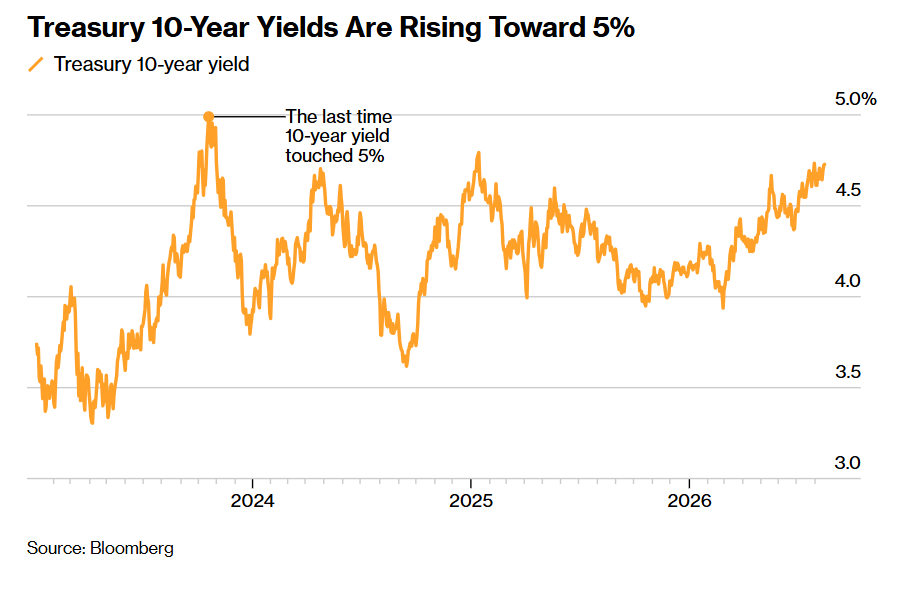
As shown in the chart above, the benchmark US Treasury yield — that is, the yield on 10-year US Treasury bonds with the title of “the anchor of global asset pricing” — is rapidly approaching 5%. From a theoretical perspective, the 10-year US Treasury yield is equivalent to the risk-free interest rate indicator r on the denominator side of the DCF valuation model, an important valuation model in the stock market. Other indicators (especially the molecular side's cash flow expectations) have not changed significantly — for example, during the earnings season, the molecular side is in a vacuum due to lack of active catalysts. At this time, if the denominator level is higher or continues to operate at a historically high level, the valuations of risky assets such as technology stocks, high-yield corporate bonds, and cryptocurrencies closely linked to AI are facing a collapse.
What is a “Bond Volunteer Police”?
The so-called “Bond Vigilantes (Bond Vigilantes)” is a type of market discipline mechanism that forces policy makers to pay higher financing costs by actively selling long-term treasury bonds and demanding higher yields when bond investors believe that government finances are excessive expansion, inflation policies are unreliable, or that the debt path is unsustainable; this concept was proposed by Ed Yardeni in the 1980s.
Therefore, what the “volunteer police” actually attacks is not usually overnight policy interest rates, but long-term inflation risk+fiscal risk+long-term debt maturity premiums: that is, bond transaction prices continue to fall under the impetus of the bond voluntary police, which in turn drives up 10-year and 30-year US bond yields and further worsens the fiscal interest burden, which in turn forces the government to restore fiscal discipline.
“Wall Street Prophet” Yardeni still believes that 4-5% of 10-year US bonds are in the normal range, but after the 10-year US Treasury yield quickly rose to about 4.75% and quickly approaching the upper end of this range, he began to pay more close attention to whether the Volunteer Police will push the yield to 5%; his core judgment is not “a bond market crisis has occurred,” but 5% is changing from a valuation anchor to a stress test for the credibility of the Trump administration's fiscal policy.
US Treasury yields are approaching the 5% warning line! Yardeni warns of 'bond police' or regrouping
The strategists from Yardeni Research wrote in the research report: “We still adhere to the previous view that US Treasury yields should continue to operate within the normal range of 4% to 5%, and there will be no adverse consequences for US economic growth and corporate profits. However, now that the yield is close to the upper end of this normal range, we are watching the financial movements of the Bond Volunteer Police more closely.”
The yield on US 10-year Treasury bonds has now reached 4.73%, close to the highest level in more than a year, mainly driven by the government's long-term huge fiscal deficit and concerns about inflation. The rise in oil prices due to the longer US-Iran war may further increase the pressure on domestic US prices and reinforce the reasons for the Federal Reserve to raise interest rates. At the same time, corporate borrowing has surged, driven by the global AI computing power investment boom, causing Washington and Silicon Valley to compete for the same limited pool of capital.
Higher US interest rates will also attract global capital flows to the US dollar, which complicates Japan's efforts to prevent the yen from falling below 1 dollar to 160 yen, and also makes it more difficult for China to maintain a stable RMB exchange rate. Yardeni said that since US Treasury bonds are the benchmark for global debt pricing, rising US interest rates will be transmitted globally, driving up the financing costs of sovereign bonds, corporate bonds, and home mortgages in various countries.
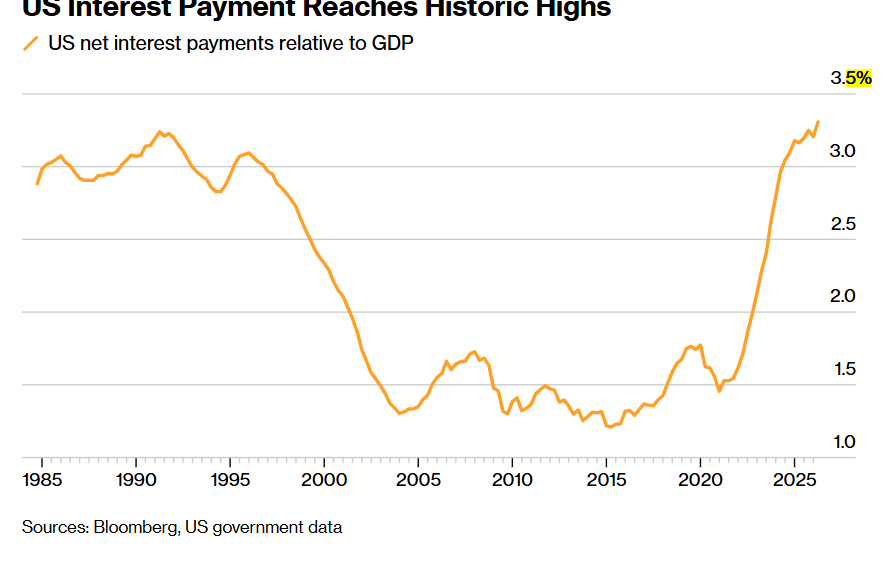
As shown in the chart above, US interest expenses have quietly risen to near their highest position in history.
Ed Yardeni, president and chief market investment strategist from Yardeni Research, coined the term “bond vigilante” in the 1980s to describe investors who protested by selling bonds because they were dissatisfied with the government implementing policies they thought were inflationary. Such behavior will drive down bond prices and increase yields, thereby forcing the government back on the path of fiscal discipline and fiscal austerity.
The agency said that in recent months, the global bond police have begun to act recklessly, which shows that market concerns about government debt are not limited to the US. Strategists pointed out that in the UK and Japan, capital sell-off activities related to the bond police are particularly obvious, because both countries are burdened with huge debts at the government level compared to the size of the economy.
The biggest opponent of the AI super bull market may come from the bond market!
As far as the steepness of the US bond yield curve is concerned, the current “bond volunteer trading” is more biased towards driving the long-term upward trend and leading to a steeper bear market, rather than simply moving the entire curve parallel upward. The reason is that the real increase in risk premiums recently is concentrated at the farthest end of the term: the yield on 30-year US Treasury bonds rose to 5.31% on August 17, the highest level since June 2007, and about 4.73%; if moderate CPI, employment, and consumption continue to restrain the Federal Reserve to raise interest rates further, short-term policy interest rates are relatively anchored, but fiscal deficits, inflationary endings, and the supply of huge long-term bonds still force investors to raise the required long-term returns, so the 10s/30s and 2s/10s US Treasury yield curves are easier to steeper.
If another sharp rise in oil prices forces the Federal Reserve to raise interest rates again, front-end yields will also rise at the same time, and the curve will not necessarily be steep in one direction. However, what is most worthy of investors' attention at this stage is that the long-term yield curve of 10 years or more has begun to show the characteristics of supply spillover and term premiums “even if economic data weakens”. This is the most typical market expression of a bond volunteer.
Meanwhile, the wave of AI debt issuance is upgrading this traditional “financial police” logic to a new version of “Washington+Silicon Valley fighting together for capital.” According to the data, Google's parent company Alphabet, and AI hyperscalers (AI Hyperscalers), such as Amazon (Amazon) and Facebook parent company Meta, have raised bonds close to US$220 billion since 2026, a significant surge from 2025; Amazon, Alphabet, Meta, and Oracle (Oracle) alone had issued about US$1940 billion in bonds as of the beginning of July, while AI-related debt was once close to 15% of US investment-grade issuance . Alphabet also expanded from the US dollar to the British pound, Swiss franc, euro, Canadian dollar, yen and other markets this year, and continued to finance data centers and AI infrastructure with 25 billion dollar bonds.
The US Treasury needs to finance huge deficits, and AI giants also need to finance data centers, power equipment, and network infrastructure around AI GPU clusters. The two together increase long-term capital requirements and long-term supply — which in turn causes global investors to demand higher real returns and term premiums — so long-term US bonds and corporate financing costs are rising together. Therefore, if the “Bond Volunteer Alert” actually works, it is most likely that demand for AI will not suddenly disappear, but rather that risk-free interest rates and weighted average cost of capital (WACC) will be raised to restrain the AI supercycle from both sides of valuation and ROIC — this is why 5% of US bonds over the next 5 years is more likely to become an “interest rate ceiling” for technology stocks and even global risk assets to be wary of than a certain FOMC rate hike itself.