
Kernel Holding Stock And European Grain Logistics Shares After The Izmail Port Attacks
Escalating attacks on Ukraine’s Danube port of Izmail have pushed grain routes and European commodity logistics into the spotlight, and with them a small group of stocks directly exposed to this news. When trade flows are disrupted, some companies face pressure while others find new demand for their assets and services. This article walks through 3 stocks from our European Agricultural Commodity Trading & Grain Logistics screener that may be positioned on the positive side of this shock.
The stocks covered below are just a starting sample, since the full screen surfaced 21 more companies with equally detailed stories around grain origination, storage and logistics that are not included here. To identify and analyze your own highest conviction ideas from this group, head straight to the European Agricultural Commodity Trading & Grain Logistics Stocks screener.
Kernel Holding (WSE:KER)
Kernel Holding is a Kyiv based agribusiness that runs a full chain from farming and grain origination through sunflower oil processing, storage, port terminals and its own inland logistics fleet across Ukraine and export routes into Europe and Asia. Most revenue currently comes from Oilseed Processing at about US$2.37b, with Infrastructure and Trading adding around US$1.83b and Farming about US$471 million, partly offset by a segment adjustment. On the equity market, Kernel Holding is valued at roughly PLN 5.7b, placing it firmly in mid cap territory for investors seeking agricultural and logistics exposure linked to Black Sea and alternative European routes.
Investors watching grain flows after the Izmail attacks may consider Kernel Holding as it sits at the heart of Ukrainian origination, storage and export infrastructure, with a footprint that touches both Black Sea and alternative European routes. The stock trades on a relatively low P/E, while earnings grew 25.2% in the last year and net profit margins improved to 5.5%. The company has relied heavily on external borrowing and its port and terminal assets have been repeatedly hit by Russian drone and missile attacks in 2026, which may mean higher repair capex and operational strain. The combination of improving profitability, a 10.2% return on equity and elevated geopolitical and funding risks creates a complex setup that may warrant closer inspection.
Kernel Holding’s improving profitability and 10.2% return on equity might not fully align with today’s headline risk. Get the full context in the 2 key rewards and 1 important major warning sign

Build your own Kernel Holding style grain logistics shortlist
Kernel Holding and the other 2 stocks in this article all came from a single Simply Wall St screener, but the real edge comes when you create your own filters to blend valuation, growth, quality and risk checks. Use our flexible Screener to shape a watchlist that suits your approach, or tap into our curated Investing Ideas for ready made starting points.
Novorossyisk Grain Plant (MISX:NKHP)
Novorossyisk Grain Plant is a Russian grain logistics company that owns and operates grain terminals in Novorossiysk, handling port transshipment of grain crops alongside grain trading and the production of flour, semolina and bran. It also offers transport, freight forwarding, warehouse and berthing services, making it a vertically integrated hub within the Black Sea export corridor. On the equity market, Novorossyisk Grain Plant is valued at about RUB 20.7b, which puts it in mid sized territory for investors tracking grain infrastructure stocks.
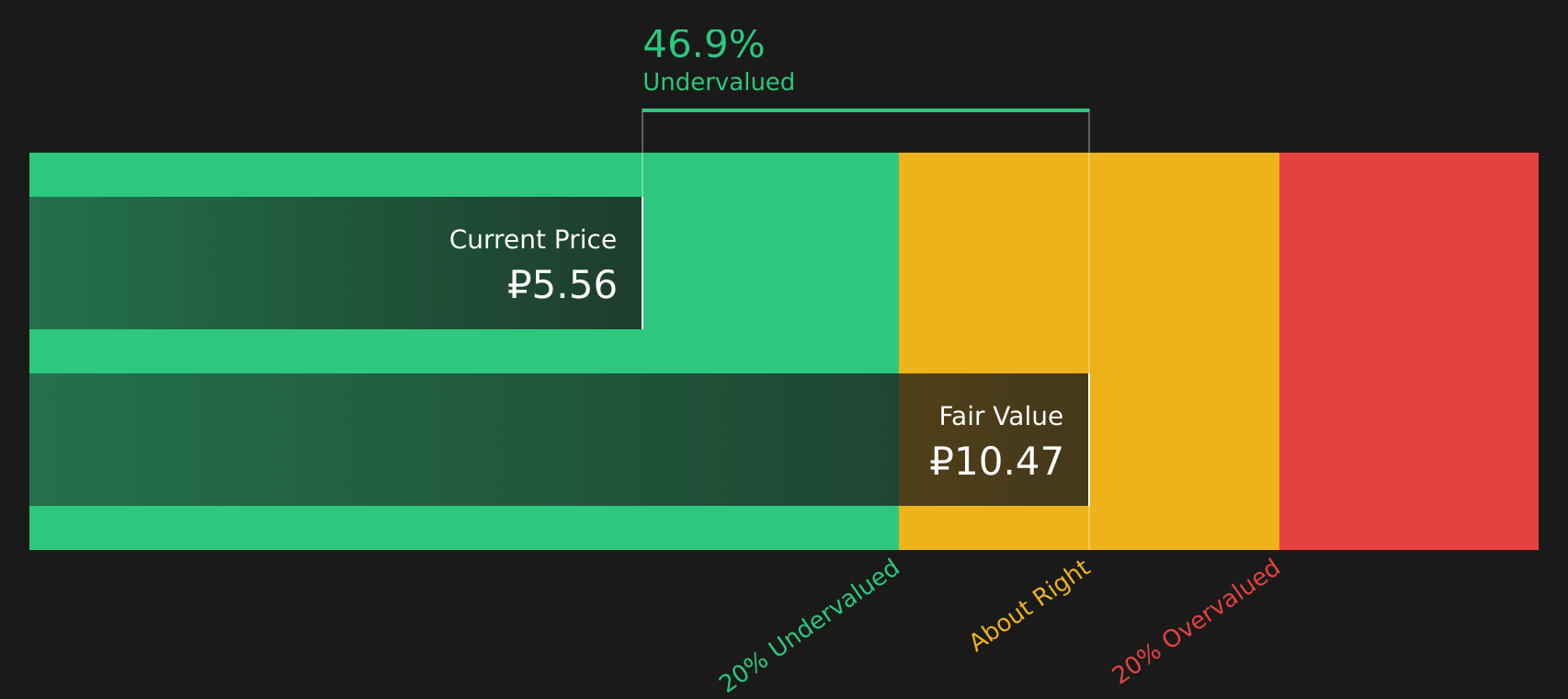
For investors following the disruption around Ukraine’s ports, Novorossyisk Grain Plant sits in a critical Black Sea export hub that may pick up rerouted volumes as risk premia rise on some competing routes. The stock trades at a discount to a DCF based fair value estimate, yet runs on margins of 36.1% and an ROE of 16.7%, which can make that valuation gap difficult to ignore. The flip side is meaningful risk, from declining earnings and unstable dividends to high reliance on external borrowing and very low board independence. With the stock also highly illiquid and an AGM coming up on 23 June 2026, this is a company where both the potential rewards and the governance questions may warrant closer attention.
Novorossyisk Grain Plant’s rich margins and ROE hint at a story that current pricing might not fully reflect. Get the full 1 key reward and 3 important warning signs (2 are major!) to see how governance and liquidity tilt the balance.

Novorossiysk Commercial Sea Port (MISX:NMTP)
Novorossiysk Commercial Sea Port is one of Russia’s major Black Sea port operators, providing stevedoring, storage, freight forwarding, vessel support and emergency response services across oil, grain, containers and other bulk cargoes. The company also runs container and passenger terminals and offers tugging, towing and bunkering services to ship owners, cargo clients and agents. On the market, Novorossiysk Commercial Sea Port is valued at about RUB 102.7b, which places it firmly in large cap territory for investors tracking core Black Sea infrastructure.
Investors watching the fallout from the Izmail attacks may find Novorossiysk Commercial Sea Port hard to ignore. The stock screens as materially below an internal fair value estimate and sits on high margins of 35.3% with a 17.9% return on equity. However, revenue slipped slightly in the last year and the business relies entirely on higher risk external borrowing. In addition, highly illiquid trading, an unstable dividend history and a board with 0% independent directors create a situation where strong profitability, a key Black Sea position and a 2026 AGM and extraordinary meeting calendar intersect with funding and governance questions that merit closer review.
High margins and a key Black Sea position make Novorossiysk Commercial Sea Port look like a mispriced engine of cash generation, yet the full picture of funding and governance only comes through in the 2 key rewards and 4 important warning signs (2 are major!)
Curious About Alternatives Worth Exploring
Fresh ideas can move quickly once momentum builds and early buyers spot a breakout before the crowd. Do not get caught watching from the sidelines while it matters; act now.
- Spot resilient income opportunities by scanning the 431 dividend fortresses that aim to keep cash flows flying even when markets cool.
- Track high conviction outliers with the 610 high quality undiscovered gems that remain under the radar for now but could draw attention once volumes pick up.
- Map out future critical materials demand through the 28 best rare earth metal stocks and see which producers might matter most if supply chains tighten.
This article by Simply Wall St is general in nature. We provide commentary based on historical data and analyst forecasts only using an unbiased methodology and our articles are not intended to be financial advice. It does not constitute a recommendation to buy or sell any stock, and does not take account of your objectives, or your financial situation. We aim to bring you long-term focused analysis driven by fundamental data. Note that our analysis may not factor in the latest price-sensitive company announcements or qualitative material. Simply Wall St has no position in any stocks mentioned.
Have feedback on this article? Concerned about the content? Get in touch with us directly. Alternatively, email editorial-team@simplywallst.com