
Global asset allocation has entered the “decongestion” moment! Bank of America shifts from AI computing power to value, biotechnology, and commodities to find a “non-consensus alpha”
The Zhitong Finance App learned that a team of strategists from Wall Street financial giant Bank of America is urging investors to break away from the overcrowded topic of artificial intelligence computing power trading. The agency believes that at a time when the AI theme is facing a deleveraging storm, forced clearance of extremely crowded positions, and inflation risks are challenging traditional portfolios, value stocks, biotechnology, regional banks, some credit products, and commodities all provide attractive investment opportunities. Bank of America's latest investment layout highlights that the investment focus is beginning to shift to high-cash flow compound interest assets, that is, the rapid spread from AI computing power themes where leveraged positions have reached extreme levels in history and high-beta momentum transactions with extremely high position congestion to “high-quality cash flow compounding+valuation misalignment alpha.”
In a major research report released recently, the Bank of America strategist team said that apart from the attractive investment themes mentioned above, international small-cap value stocks are already more attractive than US large-cap growth stocks, and at the same time, the profitability of Japanese companies has climbed to record levels. The agency also sees listed private equity management companies as a reverse investment opportunity and favors high-quality high-yield bonds over investment-grade bonds.
For investors, the report clearly points — after US technology stocks have dominated the global stock market for many years, more diversified asset allocation should be carried out. Bank of America believes that there are significant investment opportunities in profitable cyclical strong fundamental companies and real assets, and also questions whether the record scale of AI investment has created strong enough economic benefits to prove that its high cost is reasonable. Meanwhile, the agency is still technically bullish on the S&P 500 index.
Bank of America is not bearish on the AI theme, but instead emphasizes a very clear asset allocation upgrade: from highly concentrated AI/US growth stock trading to “retaining structured AI longs+increasing low-correlation, high cash flow, and undervalued assets” portfolio spread. As AI moves from a scarcity narrative to a trillion-dollar capital expenditure payment period, the determinants of excess earnings will shift from “whether there is AI exposure” to “whether valuation, free cash flow, ROIC and congestion match.”
Therefore, after the AI bull market entered the “high valuation+high congestion+high capital consumption” stage, Bank of America advocated shifting marginal capital from the most expensive AI computing power beta to “cheaper profit growth, real cash flow and anti-inflation assets” — this is a rebalance of spreading from a single technology main line to the profit and high-quality cash flow sector of the entire market, not the end of the AI bull market.
Massive AI spending has yet to lead to a productivity boom
Among the constituent stocks of the S&P 500 index, after excluding the financial sector, capital expenditure as a share of sales has reached a new historical record level, but according to this Bank of America research report, productivity growth in the US economy as a whole is still relatively moderate.
US productivity is currently growing at a rate of 2.2%, which is only slightly above the 2% average since 1987. Bank of America economists estimate that AI currently only contributes about 0.1 percentage points to productivity growth each year because the slow rate of AI adoption, lack of skills, and organizational barriers limit its scope of influence.
This is in stark contrast to the Internet boom from 1996 to 2004, when investment in technology was accompanied by a more obvious acceleration in productivity growth.
Bank of America strategists acknowledge that AI is improving the efficiency of economic output in fields such as software development. However, the bank warned that in the long run, the largest incremental revenue may end up going to consumers and the global economy as a whole, rather than technology companies that support large-scale construction of AI computing power infrastructure.
Among the respondents to the bank's latest fund manager survey, semiconductors are still what they think is the most crowded trading topic, and semiconductor exchange-traded funds (or semiconductor ETFs) attracted about $17 billion in capital inflows in July.
Biotech, banking stocks, and value stocks provide alternatives
Bank of America strategists pointed out that biotechnology, insurance, regional banks, and small-cap stocks weighted by operating income are all important investment directions that are less dependent on the AI boom and fluctuations related to AI computing power. The report said that since June, these sectors have all had returns of about 10% or more.
Bank of America suggests rotating capital to more profitable cyclical value companies in the fourth quarter, particularly those closely linked to parts of the economy that can generate huge cash flows.
International small-cap value stocks also performed well. Over the past five years, the cumulative return on this type of asset has reached 98%. In contrast, US large-cap growth stocks rose 85% over the same period. The current forward price-earnings ratio of international small-cap value stocks is about 12 times, while US large-cap growth stocks are about 30 times, while their exposure to the technology industry is only about 6%.
Since this year, US value stocks have outperformed growth stocks by 10 percentage points, which is the strongest relative performance since 2022.
Japan's reforms drive up corporate returns
The return on net assets (ROE) of Japanese companies has risen to a record 12%. Bank of America believes this is partly due to corporate governance reforms and other policies aimed at boosting economic growth.
This improvement comes against a backdrop of largely flat global manufacturing indicators, which suggests that the driving force behind it is not just a cyclical rebound. Over the past year, the Japanese stock market's benchmark blue-chip valuation has risen sharply by nearly 40%.
Bank of America strategists agreed that expansionary fiscal policies, corporate reforms, and measures to support the Japanese yen may further encourage the scale of investment in the Japanese domestic market.
Private equity management companies become reverse trading opportunities
Bank of America said a listed alternative asset management company could provide one of the most attractive recovery trading opportunities in the market.
As the financial environment improved and software stocks recovered, the stock prices of listed private equity management companies rose 17% in about a month. The bank listed Ares Management (ARES.US), KKR (KKR.US), and Blue Owl Capital (OWL.US) as the most preferred listed private equity stocks, while pointing out that these three companies are still 25% to 35% below their all-time high.
Related risks include potential AI disruptions, overvalued investments formed during the previous boom, and investors' reluctance to re-invest capital. However, the market is already beginning to show signs of recovery. The size of initial public offerings (IPOs) quadrupled from the first quarter to the second quarter, which may make it easier for private equity firms to exit investments and return cash back to customers.
Bank of America also expects private equity fund redemption applications to drop sharply in the third quarter after peaking earlier this year.
The S&P 500 bull market trajectory and upward trend are still intact
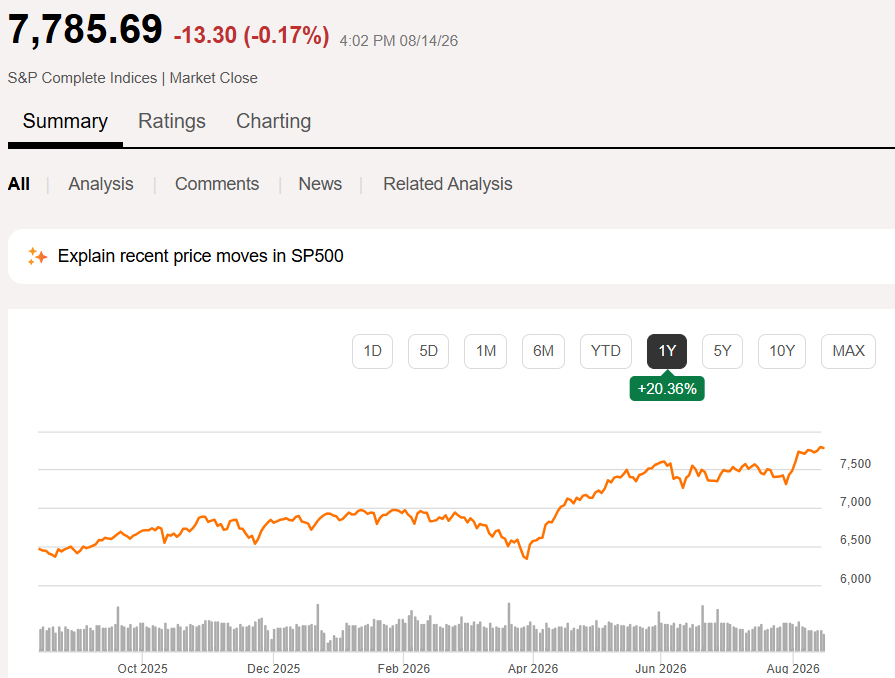
The bank's tech strategists unanimously stated that the S&P 500 index broke through the trading range that has continued for several months, providing support for the year-end bullish target of 8,000 points to 8,540 points. Compared with the index level examined in this research report, this means that there is potential room for growth of about 3% to 10%.
This bullish outlook is based on the index being able to hold above 7,504 points. If it falls below this support level, it means more vigilance is needed.
Seasonal fluctuations remain an important risk factor. Since 1928, the S&P 500 has only recorded a 55% increase from August to October. Meanwhile, in August, the second year of the US presidency, historical estimates showed that the S&P 500 index fell by an average of 0.46%.
Prefer high-quality junk bonds
In the fixed-income market, Bank of America favors BB-rated high-yield bonds and so-called “Fallen Angels (Fallen Angels),” that is, bonds that have been downgraded from investment to high-yield levels.
Over the past 40 years, these securities have created some of the best risk-adjusted returns in the corporate bond market. According to the Bank of America strategist team, the average annual return on BB-rated bonds of various maturities is about 8%.
In contrast, CCC-rated bonds with extremely low credit quality have a high apparent yield, but their gains are often offset by default losses. Bank of America expects the total return on high-yield bonds over the next 12 months to reach an optimistic historical return of 6%.
The bank also warned that major bond indices could overexpose investors to inflation and interest rate risks. For example, the Bloomberg U.S. Aggregate Bond Index (Bloomberg U.S. Aggregate Bond Index) has approximately 88% of its assets allocated to A grade or higher rated securities, while excluding or under-allocating emerging market bonds, preferential loans, and other higher yield categories.
Commodities may have more decentralized value than bonds
The traditional 60% equity +40% bond portfolio has returned 8% this year, but according to the report, since 2022, its inflation-adjusted annualized return has basically been close to zero.
At the same time, the linkage between bonds and stocks is getting stronger. Over the past four years, the monthly correlation coefficient between the US Composite Bond Index and the S&P 500 Index reached 0.58, which weakened the effectiveness of bonds as hedging tools.
As a result, Bank of America turned bullish on commodities and other physical assets. Since 1945, a hypothetical 60% stock +40% commodity portfolio has had an average annual return of 10.8%, compared to an average annual return of 9.2% for a portfolio holding 60% stocks +40% US Treasury bonds.
Over the past five years, the correlation coefficient between commodities and stocks was -0.12, while the correlation coefficient between bonds and stocks was +0.20. This historical performance supports the opinion of experts on the agency's investment committee: in an era of ongoing inflation, supply shocks, and geopolitical instability, commodity type physical assets such as gold, silver, and copper may provide more effective protection than bonds.
Looking for the next round of excess earnings — non-consensus alpha
Bank of America strategists believe that AI capital expenditure has reached an unprecedented level, yet US productivity growth is still only about 2.2%, and they estimate that AI currently contributes only about 0.1 percentage points to annual productivity growth; at the same time, global semiconductors have become the most crowded transaction in the market, and a record 82% of respondents in the July BofA fund manager survey ranked it as the most crowded long. Therefore, Bank of America is not bearish on the AI theme, but rather emphasizes a very clear asset allocation upgrade: from highly concentrated AI/US growth stock trading to “retaining structured AI longs+increasing low-correlation, high cash flow, and undervalued assets” portfolio proliferation.
The most solid fundamentals behind this set of rotation are “spread of profit breadth+compression of valuation differentials+excessive AI congestion premium”. AI infrastructure still has strong orders and profit growth, but the Bank of America strategist team pointed out that hyperscale cloud vendors have already invested about 234 billion US dollars in capital expenses this year, and the market is beginning to worry about the transfer of huge cash flows from hyperscalers (that is, cloud computing giants) to the supply chain related to AI computing power infrastructure, and whether the final return on investment can match the cost of capital.
At the same time, other weighted sectors such as healthcare have shown real capital and profit inflection points: the S&P 500 healthcare index rose 11.2% in the past three months, outperforming the US stock market by about 5 percentage points. In July, US health funds attracted net inflows of US$2.44 billion, and the net overallocation ratio of Bank of America fund managers to the medical sector also jumped to 32% from 14% in June; the market expects the sector to re-enter double-digit profit growth from the fourth quarter of 2026 to 2027.
According to Bank of America strategists, the common characteristics of assets such as biotechnology, regional banks, insurance, international small-cap value, and stocks benefiting from Japan's reforms are not “simply defensive assets,” but rather that valuations have not been completely revalued, profits are improving, and are less correlated with the AI CapEx (AI infrastructure capital expenditure) cycle — making them a more asymmetrical and uncongested source of alpha investment income (alpha) in addition to AI crowded transactions. The so-called “alpha” is defined as the actual return on investment far exceeding the “beta return” — that is, the simultaneous return on investment data that far exceeds that achieved by tracking the benchmark stock index. The simultaneous return achieved by tracking the benchmark index is also known as “beta return” (beta return).
At the cross-asset alpha level, Bank of America strategists say that the best combination in the next few years may no longer be the traditional “60/40,” but closer to the new barbell of “growth technology+cash flow value+real assets+high-quality credit.” Continued inflation, fiscal deficits, and energy and supply chain shocks are weakening the ability of long-term treasury bonds to be a natural hedge against stocks. The frequency of simultaneous declines in stocks and bonds has increased over the past few years, prompting institutions to re-seek alternative diversification tools such as commodities, infrastructure, and inflation-preserving assets. At the same time, AI companies and the government's huge financing needs are pushing long-term real interest rates to a high level, further raising the price of capital scarcity.