
Hitachi Stock Leads 3 Japanese Low Risk Shares For Core Portfolios
Government bond yields in major markets are sitting near recent highs, which puts a spotlight on interest rate risk in portfolios. If a large chunk of your money is in long duration assets, that interest rate sensitivity can be uncomfortable. Our Low Risk Leaders screener focuses on resilient companies with strong balance sheets and low model risk scores. This article highlights three standouts worth a closer look.
The stocks highlighted below are just a starting sample, and the full Low Risk Leaders screen surfaced 55 more companies with equally compelling stories that are not covered here. If you want to identify and analyze potential core holdings with lower model risk scores, head straight to the Low-Risk Leaders screener.
Hitachi (TSE:6501)
Hitachi is a diversified industrial and technology group that helps run critical infrastructure, from power grids and rail systems to data centers and factory automation. It generates the biggest share of its revenue from Energy at about ¥3.5 trillion, followed by Connective Industries at roughly ¥3.4 trillion and Digital Systems & Services at about ¥3.0 trillion, with Mobility contributing around ¥1.4 trillion. The company’s market cap of roughly ¥25.9 trillion puts it firmly in Japan’s large cap tier.
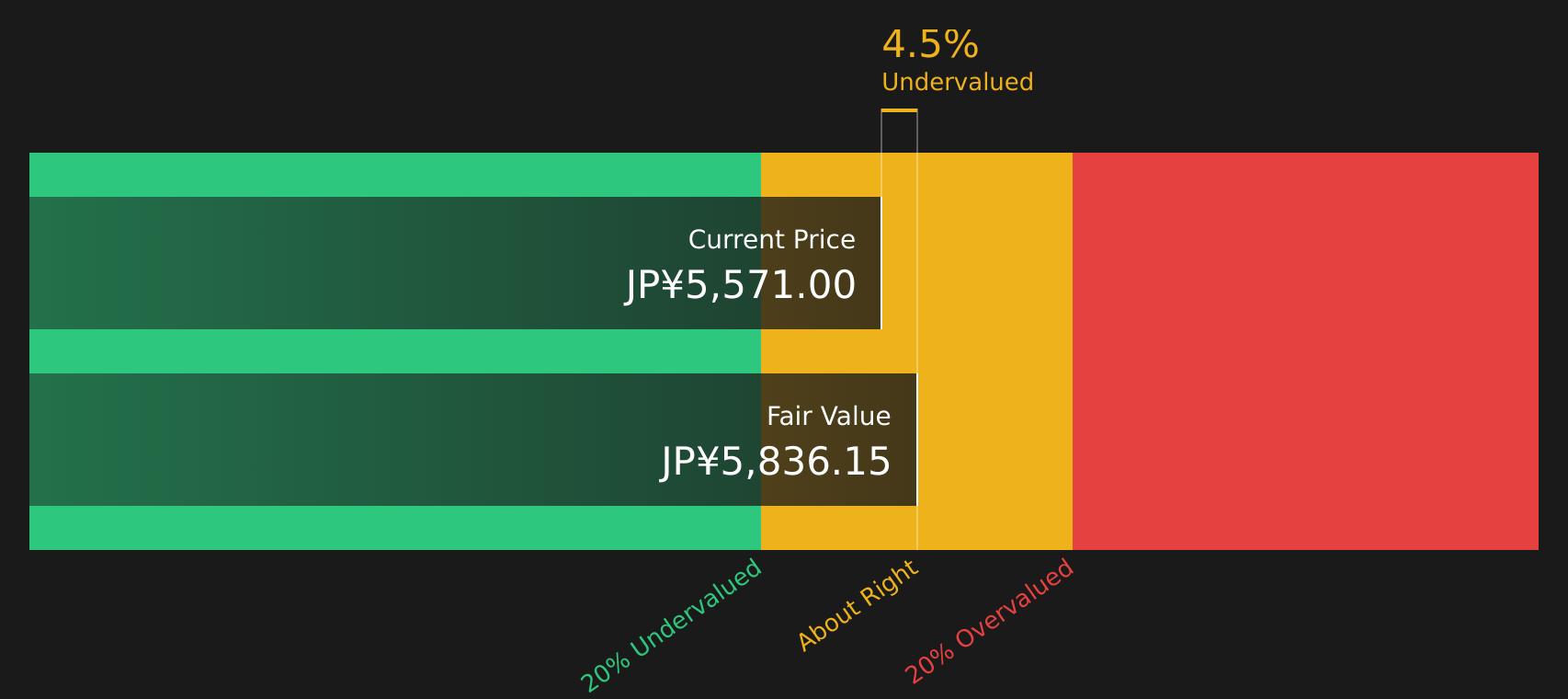
Investors looking for lower risk core holdings may want to keep Hitachi on their radar. The company sits at the intersection of grid modernization, digital transformation and AI partnerships, with fresh deals in 2026 with OpenAI, Google Cloud, Anthropic and Intel that point to a long pipeline of physical AI and storage projects. Earnings growth has outpaced much of the JP Industrials sector and recent results show solid contributions from storage and energy. There are watchpoints around high funding risk, an elevated P/E and governance questions on board turnover and pay, but with the stock trading close to DCF fair value and active share buybacks, the risk reward profile may merit a closer look.
Hitachi’s physical AI and grid projects could be masking a much bigger story around earnings momentum and valuation. Before you decide how it fits in your core holdings, review the analysis report for Hitachi.
Build your own low risk leaders shortlist
Hitachi and the two other stocks in this article all surfaced from a single screener, but the real edge comes when you shape the filters yourself. Use our customisable Screener to combine valuation, future growth, balance sheet and risk metrics around your own rules, or tap into our curated Investing Ideas for ready made starting points.
Keyence (TSE:6861)
Keyence makes sensors, machine vision systems and factory automation gear that help manufacturers improve quality control and efficiency across sectors such as autos, semiconductors, electronics, plastics and healthcare. The company currently reports all of its roughly ¥1,254.8b in revenue from a single segment, Manufacture and Sale of Applied Electronic Equipment, which underlines how focused it is on industrial automation products. Its market cap of about ¥21,259.7b places Keyence among Japan’s largest listed companies.
Keyence combines strong fundamentals with clear exposure to rising factory automation and quality control needs. Earnings have grown about 10% a year over five years and 23.9% over the past year, with net margins at 39.2%, which points to a highly profitable model. Recent quarterly figures show solid revenue and earnings, and the company carries an experienced management team and board. The catch is valuation: the stock trades at a rich P/E, well above both peers and the broader sector, and 100% of liabilities are funded by higher risk external borrowing. That mix of quality, growth and valuation tension is what makes Keyence a candidate for closer analysis by low risk focused investors.
Keyence’s high margins and revenue focus are hard to ignore, yet the rich P/E suggests something may be decoupling from fundamentals. See how the analyst forecasts for Keyence frames that trade off before the next move becomes clearer.

Mitsubishi Heavy Industries (TSE:7011)
Mitsubishi Heavy Industries is a global industrial group that builds and services energy systems, machinery, ships, aerospace and defense equipment, and factory and building equipment. It generates most of its revenue from Energy Systems at about ¥2,175.8b, Aircraft, Defense & Space at roughly ¥1,419.4b, and Plants & Infrastructure Systems at around ¥873.0b, with smaller contributions from other businesses and segment adjustments. The company’s market cap of about ¥14.3t puts Mitsubishi Heavy Industries firmly in the large cap bracket in Japan.
Mitsubishi Heavy Industries operates at the intersection of the energy transition and defense spending, with a record order backlog in cleaner power, carbon capture, and aerospace projects that supports multi year revenue visibility. Earnings growth has been strong, margins have almost doubled to 8%, and recent deals with Nvidia and Entergy on AI data center cooling and lower cost decarbonisation projects show how its engineering base can plug into new demand drivers. The trade off for investors is a relatively high valuation and risks related to currency swings, reliance on a few large defense contracts, and higher working capital needs. That mix of quality, growth exposure, and funding risks may make Mitsubishi Heavy Industries a candidate for further research by low risk focused investors.
Mitsubishi Heavy Industries’ order backlog and AI linked projects suggest the headline story might be only half complete. See how the analyst forecasts for Mitsubishi Heavy Industries aligns with valuation and the one pressure point investors often miss.

Seeking Alternatives Before The Crowd
Fresh stock ideas can move from quiet to flying fast. Use these screeners before momentum is fully caught by the crowd and while the data still matters. Consider acting before conditions change.
- Spot early breakouts in smaller companies that already produce solid profits and cash. Scan 76 profitable AI stocks that aren't just burning cash while these AI leaders are still under the radar for now.
- Target companies with resilient balance sheets before wider attention chases safety. Run the list of solid balance sheet and fundamentals (41 results) and see which stocks still trade like they are being overlooked.
- Track potential momentum in metal producers before prices fully reflect tightening supply. Follow the 9 top copper producer stocks and watch which operators could draw fresh interest next.
This article by Simply Wall St is general in nature. We provide commentary based on historical data and analyst forecasts only using an unbiased methodology and our articles are not intended to be financial advice. It does not constitute a recommendation to buy or sell any stock, and does not take account of your objectives, or your financial situation. We aim to bring you long-term focused analysis driven by fundamental data. Note that our analysis may not factor in the latest price-sensitive company announcements or qualitative material. Simply Wall St has no position in any stocks mentioned.
Have feedback on this article? Concerned about the content? Get in touch with us directly. Alternatively, email editorial-team@simplywallst.com