
LSS6: Beyond the tariff
AS Malaysia enters the sixth phase of its large-scale solar (LSS6) programme, the stakes are higher and the dynamics more complex. Each successive LSS round has increased in scale, but LSS6 also introduces something fundamentally different – battery energy storage.
The programme is therefore no longer simply about adding solar generation; it is also about adding flexibility and reliability to the electricity system.
This becomes increasingly important as Malaysia adds more solar capacity and needs to manage its variability due to changes in the availability and intensity of sunlight.
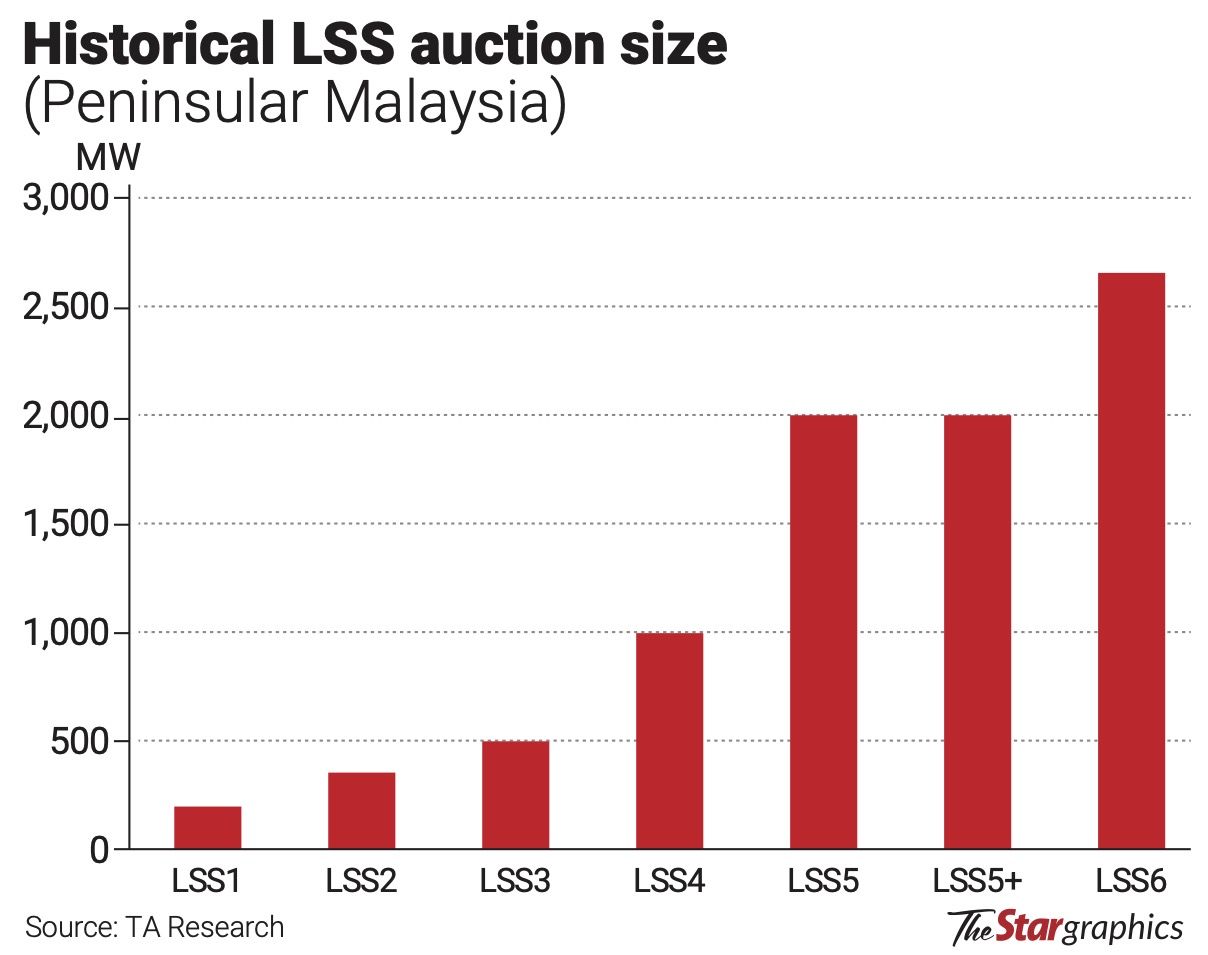
LSS6 will offer 2.65GW of renewable energy (RE) capacity, with most of its solar capacity to be paired with a four-hour battery energy storage system (Bess), meaning the batteries can charge and discharge their rated power for up to four hours.
At 2.65GW, the LSS6 allocation is larger than the 2GW expected under each successive LSS round (from LSS5 onwards), as Malaysia works towards its target of having RE account for 70% of its installed power generation capacity by 2050.
The larger allocation comes as the industry is still working through the delivery of LSS5 and LSS5+, which together involve about 4GW of solar projects scheduled for completion by end-2028. Industry sources say some projects have faced challenges in reaching financial close.
It is not known whether any capacity from projects that did not proceed has been incorporated into the latest round. If any such capacity has been retendered, it could help address any shortfall in planned RE capacity.
Observer says it also highlights lessons to be learnt from projects that did not proceed – particularly whether tariffs, financing structures and project costs were sufficiently aligned, and whether other potential bidders lost the opportunity to take up the capacity.
“Winning an allocation at a competitive tariff is only the first step. Developers still need to secure financing and put together the land, grid connection, engineering, procurement, construction and commissioning (EPCC) arrangements and equity required to take the project to construction,” one industry player tells StarBiz 7.
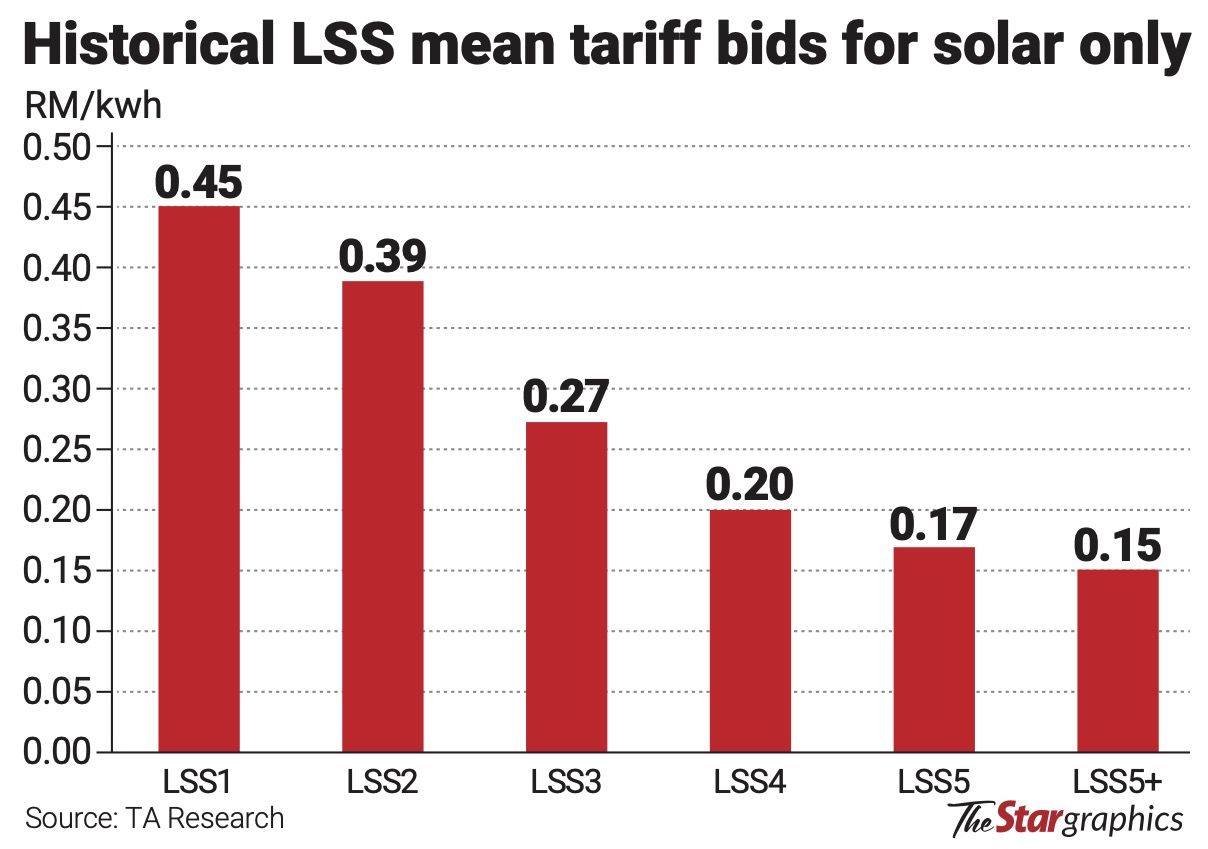
Over the past decade, competitive bidding has played an important role in bringing down the cost of solar generation in Malaysia. LSS tariffs have fallen steadily, from the earlier rounds to an average of about 20 sen per kWh under LSS4, and around 17 sen/kWh and 15 sen/kWh under LSS5 and LSS5+, respectively.
At these levels, solar generation has reached “grid parity” with conventional generation.
LSS6, however, is not directly comparable with earlier rounds, with Bess now part of the equation. In a report, RHB Research says total project capital expenditure (capex) could reach RM13bil to RM15bil, implying capex of RM3mil to RM3.5mil per MW for solar and RM4mil per MW for Bess.
Assuming a 20% to 30% equity contribution, this would translate into about RM2.6bil to RM4.5bil of equity across the programme.
However, the funding requirement goes beyond equity.
Developers also need to account for performance bond commitments, which can add to the banking facilities required to support a project.
While the requirement is not new, larger project sizes mean the absolute financial commitment could be higher.
The same issue extends to EPCC contractors, which may have to support larger performance and warranty obligations as project sizes increase, placing greater demands on their banking facilities and balance sheets.
Delay exposure reduced
According to industry players under LSS6, some earlier structural gaps were addressed.
One developer got some relief on delay penalties.
The liquidated ascertained damages (LAD) rate has been reduced to RM1,000 per MW per day from RM5,000 per MW per day in the previous round. The RM1,000 per MW per day rate was also applied under the earlier LSS1 and LSS2 programmes.
This means for a 100MW project, the revised rate would amount to RM100,000 for each day of delay, with LAD capped at 180 days, or RM18mil. Under LSS5+’s RM5,000 per MW per day rate, the same project would have faced RM500,000 per day, or up to RM90mil over 180 days.
“This is positive, as the previous rate could be particularly punitive as project sizes increased. At least the regulator has listened to industry concerns.
“The lower rate makes the LAD requirement more reasonable as project sizes increase,” says a chief executive officer (CEO) of an RE company.
Shorter moratorium
Another positive development is the shorter shareholding moratorium, which appears to run until the third year after the commercial operation date (COD). Previously, the lock-in period was seven to eight years from the letter of notification, which works out to about five years after COD. This compares with lock-ins of up to seven years in some previous rounds, which constrained capital deployment.
Industry sources say after the moratorium period under LSS6, changes in shareholding remain subject to Tenaga Nasional Bhd (TNB) endorsement and the Energy Commission’s (EC) approval. A CEO of a privately run solar firm says the framework introduced in LSS6 is a ”welcome shift” for the industry.
“This shorter holding period provides clear liquidity timelines for sponsors and private equity partners. It allows developers to de-risk projects during construction and early operations, then recycle capital into future RE rounds under the National Energy Transition Roadmap,” he says, adding that it would make equity raising significantly more attractive to both local and institutional investors.
A senior executive involved in previous LSS programmes agrees, saying the shorter period provides developers with a clearer pathway to refinance or bring in long-term investors once construction risks have reduced and the project has established an operating track record.
“Developers can then recycle part of their capital into future projects while retaining an appropriate interest and remaining accountable for operational performance,” he adds.
The executive says capital recycling should not be viewed as an exit from responsibility.
“It is a normal infrastructure-financing model that allows development capital to be replaced by longer-term capital once an asset is operational and its risks have reduced.
“This could broaden the pool of potential long-term investors, including infrastructure funds and institutional investors, looking for operational RE assets with more predictable cash flows.”
However, attracting such capital will depend on whether returns are sufficiently attractive. If competition remains rational, analysts expect developers to earn returns in the mid- to high-single-digit range.
Building a viable bid
Bess changes the economics of LSS6. In earlier rounds, developers were mainly looking at panel pricing and solar yields. With Bess, there are more variables to price in. The CEO of the privately-run solar firm explains that under LSS6, developers will be managing a dual-asset facility.
They will need to factor in not only the upfront cost of Bess, but also energy losses, battery degradation and future augmentation costs when calculating the project’s overall cost of electricity.
Beyond the battery itself, he says developers will also need to watch the cost of high-voltage electrical equipment and raw materials such as copper, aluminium and electrical steel, particularly as data centre (DC) and grid expansion have increased demand for these components.
On whether banks will have the appetite for solar-plus-battery projects, he notes that “comfort levels are building”.
“Since solar-plus-storage at this scale is a first for Malaysia, credit committees are paying close attention to technology performance risks, vendor warranty structures and battery degradation models.
“However, LSS6 holds a clear bankability advantage over corporate green energy programmes such as the Corporate Renewable Energy Supply Scheme.
“As with previous LSS rounds, LSS6 provides for a structured 21-year power purchase agreement with TNB as the off-taker, which reduces market and payment risks,” the CEO says.
Demand for land
Land could also become a constraint, with previous LSS rounds increasing demand for suitable sites. Based on the capacity offered under LSS6, one industry player estimates that the whole programme could require about 8,000 acres of land, although the actual requirement will vary depending on site characteristics and project configuration.
With the bulk of new generation capacity needed in the southern region, particularly Johor, amid rapid DC growth, competition for suitable sites could add to development costs.
Notably, LSS6 does not have a specific category for floating solar.
While developers could consider floating solar on suitable reservoirs or former mining ponds, as well as degraded or otherwise less-conventional land, such sites are not necessarily cheaper options, an industry player says.
He points out that solar irradiation in the south is generally lower than in the north, meaning the same installed capacity could generate less electricity there.
“Location matters. A lower-priced site may ultimately be more expensive if it is far from the grid once interconnection infrastructure is factored in.”
Despite battery technology being relatively new in Malaysia, investor appetite appears strong.
MyBeST, the EC’s first grid-scale Bess competitive bidding exercise, attracted proposals equivalent to seven times the capacity offered. This suggests competition for LSS6 could be strong.
The bid range for MyBeST exercise could provide an important reference for LSS6 developers as they price the battery component of their bids.
As developers prepare their bids, the industry player says there is an important distinction between being competitive and bidding too aggressively.
“Competitiveness should come from better engineering, procurement, financing and operations. Excessive compression could weaken returns and increase the risk of delayed financial close, underinvestment or non-delivery,” the industry player adds.
TA Research in a recent report noted that since LSS5+ bids were submitted in early 2025, solar module prices are now higher than their trough levels, while battery costs could face upward pressure as China phases out its 6% value-added tax export rebate on Bess products by January 2027.
Creating domestic economic value
LSS6 also provides an opportunity to build domestic capabilities, with a minimum local-content requirement of 20% for participating projects.
The senior RE executive, who has experience in LSS projects, says indicative programme capex of RM13bil to RM15bil could translate into up to RM3bil in spending on locally sourced goods and services.
“If the industry can progressively achieve more than 30% local content, the opportunity could increase to RM4.5bil.”
For now, Malaysia remains reliant on China for solar modules and battery equipment, given China’s dominance of the global solar and battery supply chains. However, the senior executive believes localisation should not be measured solely by the country of origin of solar modules or battery cells.
“The more strategic question is how much of the system’s lifetime economic and intellectual value can be captured in Malaysia.
“This goes beyond manufacturing modules and battery equipment to areas such as mounting structures, cables, transformers, substations, civil and electrical works and EPCC services.”
Beyond these, he sees opportunities for the country to develop higher-value capabilities in battery-pack and container integration, power-conversion systems, thermal management, fire-safety engineering, energy-management software, forecasting, cybersecurity and performance analytics.
He adds that tariff expectations should also be calibrated to reflect the government’s policy direction on local content.
“Higher domestic value creation may, particularly during the industry’s ramp-up phase, introduce additional costs relating to equipment sourcing, local capacity expansion, certification, workforce development and technology transfer.
“The government could therefore consider establishing a transparent minimum sustainable bid tariff or bankability floor based on independently assessed lifecycle costs, financing conditions and a reasonable commercial return for investors.”
He adds that this would not guarantee developer profitability or remove competitive price discovery. “Developers would continue competing above the floor through better engineering, procurement, financing and operational efficiency.
“Its purpose would be to prevent bids that fall below a credible threshold for financial close and long-term delivery.”
The EC had not responded to StarBiz 7 queries at the time of writing.
LSS6 targets commercial operation by Dec 31, 2029. Industry players say the timeline is achievable, but the execution window will be tight.