
Gold Futures Battle Between Fed Rate Risk and Middle East Tensions
Gold Caught Between a Hawkish Fed and a Closed Strait of Hormuz
Gold futures pulled back modestly below 4400 on Thursday, August 13, booking some profit after touching a ten week high, even as the week's inflation data continued to argue against near term Fed tightening. Wednesday's Consumer Price Index showed headline inflation cooling for a second straight month to 3.4% year over year in July, in line with consensus, which pushed the odds of a 25 basis point September rate hike down to roughly 40%, from near 50% earlier in the week. Thursday's Producer Price Index reinforced that disinflation narrative, coming in flat on the month against expectations for a 0.2% rise, with the year over year rate slowing to 4.7% from 5.5% in June, while core producer prices also cooled more than forecast. Lower hike odds pull real yields and the dollar down with them, which is precisely the mechanism that lifted gold to its ten week high this week and continues to underpin the metal on dips, since non yielding bullion becomes relatively more attractive as the opportunity cost of holding it falls.
That said, hike risk has not disappeared entirely, and this is what keeps rallies capped rather than unchecked. At the Fed's July 28 and 29 meeting, policymakers voted 9 to 3 to hold rates steady, and the three dissenters, Cleveland's Beth Hammack, Minneapolis's Neel Kashkari and Dallas's Lorie Logan, formed the first unified hawkish dissent bloc since September 2016, favoring a quarter point hike instead. That underlying hike risk traces back to the Iran war, which began on February 28 and has kept the Strait of Hormuz effectively closed to commercial shipping, a route that normally carries about one fifth of global daily oil production and fed an energy driven inflation shock earlier this year. The same conflict cuts both ways for gold. On one hand, the risk of renewed energy driven inflation is what keeps the Fed's hawks talking and caps how far rate cut optimism can run. On the other hand, the unresolved war itself, alongside stalled Iran and Oman talks over a full reopening, keeps a geopolitical safe haven bid under the metal that has helped it hold above the 4200 to 4385 zone even during risk off sessions. Layered on top of that is a structural buyer that does not trade on the daily headlines. China's central bank extended its gold buying streak to 21 consecutive months, adding roughly 20 tonnes in July, part of an estimated 289 tonnes of global central bank purchases in the second quarter alone, a persistent source of physical demand that has helped absorb supply during pullbacks and put a firmer floor under price than positioning data alone would suggest.
What the Market Has Done
- The market has been steadily trending down since April, with sellers progressively stepping down offers.
- The 4385 area (Daily level 3), a key support level, failed to hold, as sellers were able to break down below it and move price toward the 4000 area (Daily level 4).
- Buyers and sellers battled within a tight range between 4200 and 4000 for about a month, from the end of June to the start of August.
- Buyers were able to take the initiative and overcome sellers, regaining control and breaking out of Auction Block 1, where the battle had ensued.
- Recently, buyers reclaimed the area back above 4385 (Daily level 3).
What to Expect in the Coming Weeks
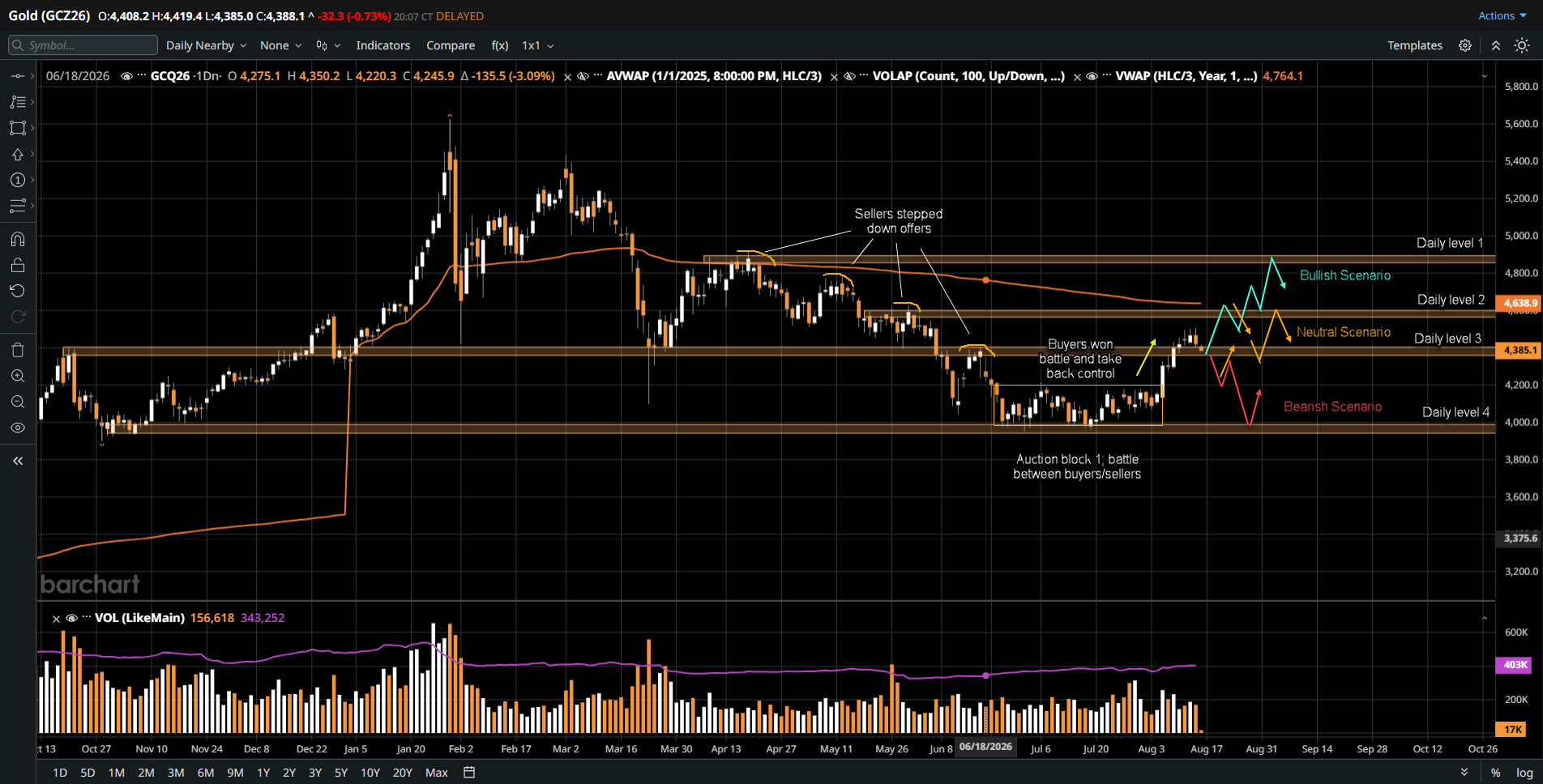
The key levels to watch are 4385 (Daily level 3) and 4200 (Auction block 1 high).
Bullish Scenario
- If buyers are able to step up bids and defend either 4385 or the area above 4200, a move up toward 4600 (Daily level 2) becomes likely, a zone that may be confluent with the yearly VWAP.
- Sellers are expected to respond at that level, but a break and acceptance above it would open the path toward 4875 (Daily level 1).
- A possible trigger for this scenario could be an escalation in the Iran conflict that further delays a Hormuz reopening, or the August 26 core PCE report confirming the disinflation trend that this week's CPI and PPI already pointed to, further pressuring the dollar.
Bearish Scenario
- If buyers do not defend the 4385 area, or fail to quickly reclaim it after a deeper pullback, a move down to 4200 becomes likely.
- If buyers do not respond at 4200, price could move back down to the 4000 area (Daily level 4).
- A possible trigger for this scenario could be the August 19 FOMC minutes revealing broader committee support for a hike beyond the three dissenters, alongside meaningful progress toward a Hormuz reopening that eases oil driven inflation risk.
Neutral Scenario
- If buyers defend 4200 and sellers defend the 4600 area, a two-way auction between 4385 and 4600 would likely develop as the market restores balance.
- A possible condition supportive of this scenario would be traders sitting on their hands into the Kansas City Fed's Jackson Hole symposium on August 27 to 29, where Fed commentary has historically moved markets more than routine data prints, encouraging position squaring rather than a decisive break of either level beforehand.
Conclusion
Technically, gold's recovery back above 4385 keeps the broader structure constructive, with 4200 now serving as the line in the sand for buyers and 4600 standing out as the next major test near the yearly VWAP. Fundamentally, the metal remains caught between two competing forces, a Federal Reserve that may still need to raise rates if Iran war driven energy inflation reignites, and a structural bid from central bank accumulation and safe haven flows that has not gone away even as short term price action turns choppy. How the market reconciles a potentially hawkish Fed with an unresolved Middle East conflict and a stalled Strait of Hormuz reopening will likely determine whether gold consolidates, extends its recovery, or revisits the 4000 area in the weeks ahead. With so much riding on next week's Fed commentary and any Hormuz headlines, which of these two forces do you think will end up driving gold's next major move?
EdgeClear is designed for traders who refuse to guess. We deliver unfiltered tick data via Rithmic, competitive pricing starting at $0.22 per side, and performance analytics that transform your trade log into a roadmap. The serious trader’s next move is clear. Open an Account today.
Disclaimer:
This article is provided for informational and educational purposes only and does not constitute financial, investment, or trading advice. The analysis presented reflects the author’s market observations and opinions at the time of writing and is not a recommendation to buy or sell any futures contract, security, or financial instrument. Futures trading involves significant risk and is not suitable for all market participants. Losses may exceed initial margin deposits, and market conditions can change rapidly.
Any scenarios, levels, or market expectations discussed are hypothetical in nature and are intended solely to illustrate potential market behavior. They do not represent actual trading results and should not be interpreted as guarantees of future performance. Past performance, market behavior, or historical price action are not indicative of future outcomes.
Readers are solely responsible for their own trading decisions and risk management. Always conduct independent research, consider your financial situation and risk tolerance, and consult with a qualified financial professional, if necessary, before engaging in futures or derivatives trading.