
COMEX-LME copper price differences hide a mystery: the market is marking the probability of US refined copper tariff risks
The Zhitong Finance App learned that a specific arbitrage transaction targeting the industrial metal copper is gradually becoming a real-time yardstick for measuring US tariff risk.
Copper is seen as a macroeconomic barometer — an industrial metal widely used in construction, electronics, and transportation — its price has been booming over the past year, and the price of the commodity once hit a record high of nearly $6.90 per pound last year.
The spread between New York Mercantile Exchange (COMEX) futures and London Metal Exchange (LME) spot prices has always been used by physical traders, banks, hedge funds, producers and consumer companies to seize phased price spread opportunities in the two markets and hedge against the risk of price fluctuations. In the past, this arbitrage space was mainly driven by factors such as shocks to Chinese demand or supply disruptions in South America.
However, Société Générale analysts pointed out that this trading logic has now been completely disrupted — the core variable is the new “Section 232” tariff investigation on refined copper being promoted by the US White House, and market participants are increasingly viewing the COMEX premium as a leading indicator for predicting future tariff strength.
Currently, the United States has imposed 50% import tariffs on semi-finished copper products and some copper-containing products. The US Department of Commerce has proposed the phased implementation of a 15% universal tariff on refined copper starting January 1, 2027, and further raised to 30% on January 1, 2028.
Ewa Manthey (Ewa Manthey), commodity strategist at ING, said in an email: “The price difference between COMEX and LME has increasingly become a barometer of the market's tariff expectations for the US. The wider the premium, the higher the market's perceived tariff risk, while also continuing to attract metals into the US.” According to the data, the US imported more than 200,000 tons of refined copper in July, the highest level in a single month in 12 years.
A team of analysts from France Xing, led by Mike Haigh (Mike Haigh), head of fixed income and commodity research, pointed out that as AI infrastructure construction, power grid modernization, and defense spending dramatically boost global copper demand, US policymakers' concerns about the country's dependence on refined copper imports are deepening.
Hagrid said that the “Section 232” investigation reflects America's broader strategic intention — that is, to “ensure access to this material which is seen as critical to economic growth and national security.”
Quantitative calculation of copper tariff probability
In order to turn the price difference into tariff probability, the Societe Generale team constructed a full-link cost model for transporting LME grade copper from European warehouses to the east coast of the United States, and compared this total price with COMEX futures prices.
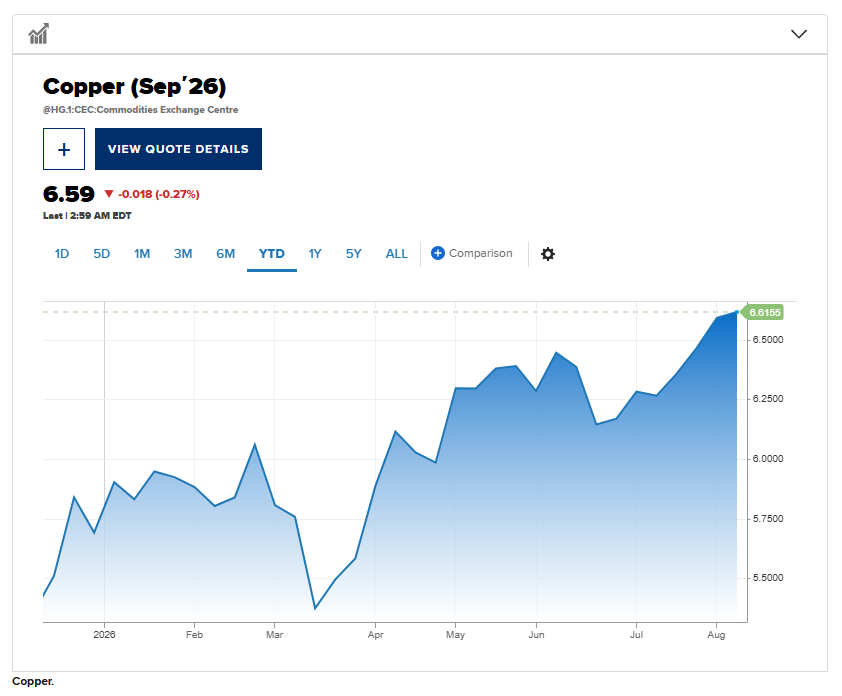
Analysts pointed out that the current level of COMEX's premium over LME's delivery price suggests that the probability that the 15% phased tariff proposed by the Ministry of Commerce will be implemented before January 2027 is 14.6%; the probability of implementing the 30% tariff by January 2028 will rise to 37%.
Natalie Scott-Gray (Natalie Scott-Gray), senior metals demand strategist at StoneX, said that the US “Section 232” ruling on refined copper has been repeatedly delayed and is now the “biggest single catalyst” for the copper market.
In her recent market review, she pointed out that if full tariffs are implemented, it will increase supply constraints outside the US; conversely, if no taxes are levied, COMEX-LME arbitrage space will subside.
Muncie added that broad premiums will still support copper prices in the short term, “especially in the context of continued tight mine supply and increasingly intense competition between the two major economies of China and the US for limited tradable copper resources.” She further stated, “We remain optimistic about the mid-term trend of copper prices, but tariff uncertainty means that market volatility is likely to remain high.”