
Kobe Bussan Stock And 2 Japanese Defensive Shares For Rising Inflation
Japanese inflation is stirring again, with July core CPI expected at 1.8% and wholesale prices staying firm, and that puts fresh attention on the everyday companies sitting closest to households. Rising food and energy costs, a possible Bank of Japan rate hike and a livelier yen can all reshape how these stocks behave. This article walks through three Japanese Domestic Consumer Staples and Utilities stocks that stand out in this shifting backdrop.
The stocks covered below are only a small sample of what stands out. The full screen surfaced 23 more Japanese Domestic Consumer Staples and Utilities companies with equally compelling narratives that are not included in this article. To assess the full investable set, head straight to the Japanese Domestic Consumer Staples and Utilities screener to identify, compare and analyze the companies that best fit your own preferred mix of yield, risk and defensiveness.
Kobe Bussan (TSE:3038)
Kobe Bussan runs the Gyomu Super discount supermarket franchise across Japan, alongside buffet restaurants and delicatessen shops, and also operates solar and woody biomass power plants. The Gyomu Super business is the core, generating about ¥551,058 million of revenue, while restaurants and delicatessen contribute around ¥18,246 million and renewable energy about ¥4,674 million, with only small other and adjustment items. The company is a large domestically focused player with a market cap of roughly ¥619.7b.
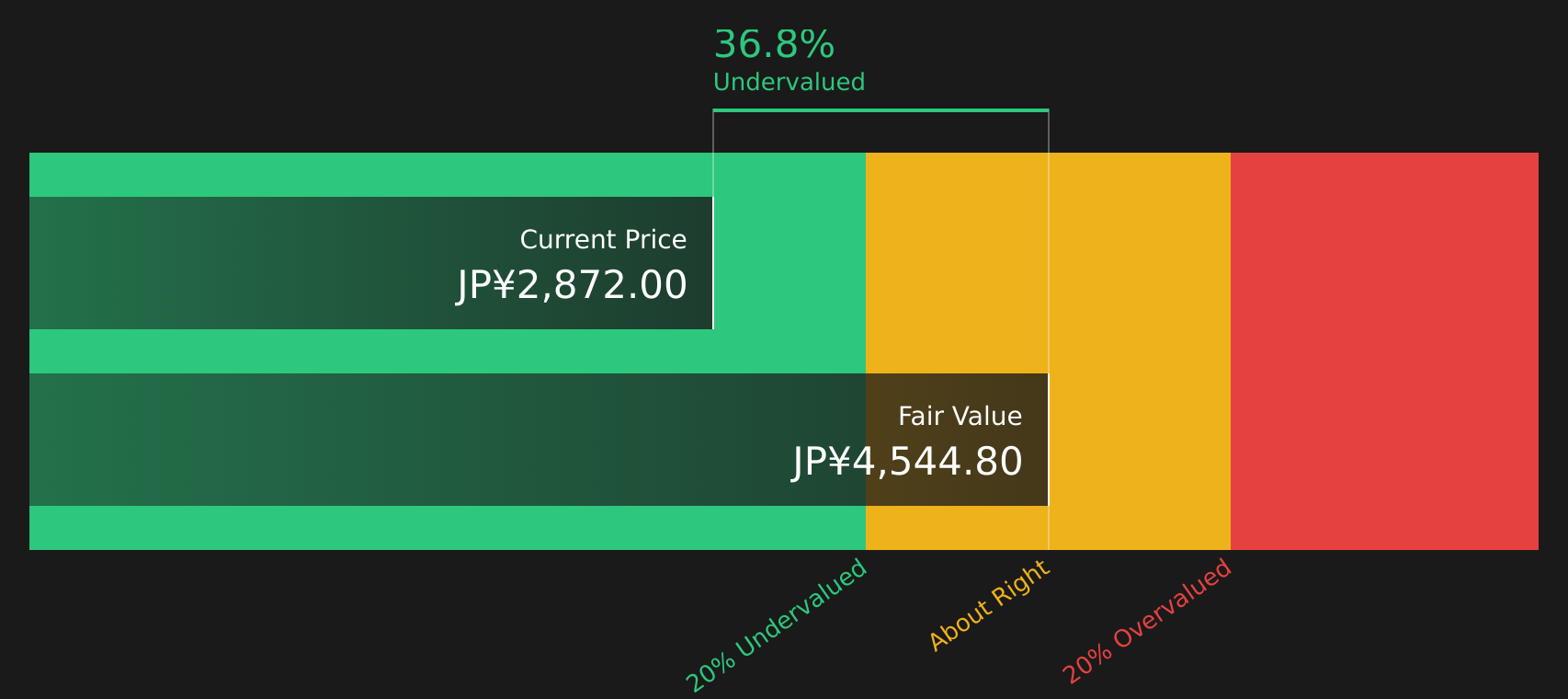
Investors looking at Japanese consumer staples may find Kobe Bussan worth a closer look because it sits at the intersection of household food budgets and a discount format that can have pricing flexibility as inflation bites. Forecast earnings growth around 7% a year, high quality margins and a valuation that screens as well below an estimated fair value suggest an interesting risk reward profile. At the same time, a P/E above sector averages, reliance on higher risk external borrowing and a board with relatively low independent representation mean governance and funding risk deserve attention before any decision is made.
Kobe Bussan’s discount strength, high quality margins and low screening valuation raise a simple question: Is the market mispricing this supermarket and energy mix, or spotting something you are not seeing in the analysis report for Kobe Bussan

Build your own discount and quality shortlist
Kobe Bussan and the other two stocks in this article all surfaced from using our stock screener as a starting point. Use our flexible Screener to mix filters like valuation, quality, balance sheet strength and risks into a shortlist that fits your approach, or tap straight into our curated Investing Ideas for ready made themes and ideas.
United Super Markets Holdings (TSE:3222)
United Super Markets Holdings is a pure-play supermarket group under the Aeon umbrella, focused on everyday groceries and essentials for Japanese households. It generates all of its roughly ¥1,003,074 million in revenue from the supermarket business in Japan, which makes its income stream tightly linked to domestic consumer spending patterns. The company has a market cap of about ¥167.4b, placing it in the mid cap bracket on the Tokyo market.
United Super Markets Holdings sits at the heart of Japan’s supermarket aisles. This positioning makes it directly exposed to rising food prices, wholesale cost pressures and changing consumer budgets as inflation and potential Bank of Japan rate moves play through. Forecast earnings growth is described as very strong and the stock trades on a modest P/S ratio. However, the company is still loss making, has weak current returns on equity and a dividend that is not well covered by earnings or free cash flow. With all revenue coming from domestic supermarkets, a refreshed but relatively inexperienced board and expectations for profitability within three years, investors who focus on Japanese consumer staples have a number of factors to consider.
United Super Markets Holdings sits between strong revenue scale and current losses, which raises a clear question: What are investors missing in the shift from loss making today to the analyst forecasts for United Super Markets Holdings?

Nippon Gas (TSE:8174)
Nippon Gas is a Tokyo based utility that supplies LP and city gas, electricity and related appliances to households and businesses across Japan, as well as offering home remodeling and equipment services. Most revenue comes from LP Gas at about ¥91,017 million and City Gas at about ¥66,063 million, with the Electricity business adding roughly ¥50,272 million. The company is fully domestic with total Japan revenue of about ¥212,531 million and has a market cap of roughly ¥305.6b.
Nippon Gas sits where Japanese inflation and energy costs meet household bills. The stock screens as trading well below an internal fair value estimate and carries high profitability signals, including a net margin around 7% and return on equity above 20%, while still showing only modest forecast growth. As rates and the yen move, its regulated style LP and gas exposure and ability to pass through costs could be helpful. However, an unstable dividend record, high reliance on external borrowing and recent underperformance relative to both the market and gas peers mean investors who want yield, quality and defensiveness may have deeper questions to consider before making a decision.
Nippon Gas appears to be a profitability story hidden inside a value label, with solid margins and returns that raise more questions than answers. Get the full context, including funding pressure and dividend resilience, in the analysis report for Nippon Gas
Seeking Fresh Alternatives Beyond These Stocks
Fresh ideas move first. Markets rarely wait. Use curated stock lists to spot potential breakout momentum while it still flies under the radar for now.
- Spot early movers in high yield by checking which companies in the 37 dividend fortresses still combine income potential with balance sheets that look built to handle pressure.
- Track where growth and financial strength meet by scanning the list of solid balance sheet and fundamentals (41 results) before these under the radar opportunities get fully caught by the crowd.
- Explore potential opportunities by reviewing the 69 high quality undiscovered gems while these under-followed stocks are still dropping clues rather than appearing in front page headlines.
This article by Simply Wall St is general in nature. We provide commentary based on historical data and analyst forecasts only using an unbiased methodology and our articles are not intended to be financial advice. It does not constitute a recommendation to buy or sell any stock, and does not take account of your objectives, or your financial situation. We aim to bring you long-term focused analysis driven by fundamental data. Note that our analysis may not factor in the latest price-sensitive company announcements or qualitative material. Simply Wall St has no position in any stocks mentioned.
Have feedback on this article? Concerned about the content? Get in touch with us directly. Alternatively, email editorial-team@simplywallst.com