
The yen is once again approaching the 160 mark. A former Japanese foreign exchange diplomat warned that the US and Japan “at any time” may join forces to intervene again, and the Bank of Japan may speed up the pace of interest rate hikes
The Zhitong Finance App learned that Japan's former chief foreign exchange diplomat Mitsuhiro Furusawa (Mitsuhiro Furusawa) said that Japan may “anytime” jointly intervene with the yen and hinted that interest rates may be raised faster than expected to stop the yen from falling. Furusawa said that the current level of yen is “clearly too weak”, driving up import costs and harming the economy. He also added that if the yen returns to the level before the joint intervention of Tokyo and Washington last month, the two countries may intervene again.
“This is probably not a matter of intervening when the USD/JPY exchange rate reaches 160 or 162. But it is possible to intervene again at any time, including coordinated action with the US,” he said in an interview on Thursday. Furusawa maintains close ties with current policy makers in Japan and overseas.
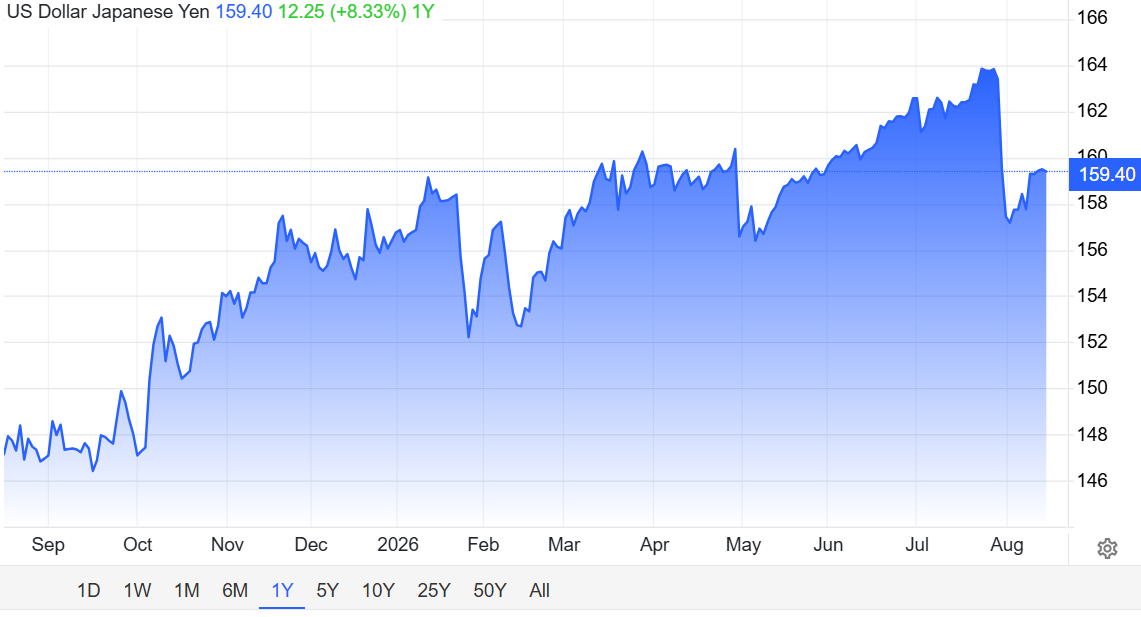
Previously, the coordinated intervention of Japan and the United States pushed the exchange rate of the yen against the US dollar from a 40-year low of 163.99 to around 155.20. Since then, the exchange rate of the yen has fallen back to around 159.40 against the US dollar. Furusawa said that intervention can only buy time, and to reverse the downward trend in yen, more fundamental measures are needed, such as the Bank of Japan speeding up interest rate hikes.
Furusawa said, “Most market participants think the Bank of Japan will raise interest rates in September, and I think it should raise interest rates.” More importantly, however, the central bank should communicate the possibility of speeding up the pace of interest rate hikes.
Since ending a decade-long large-scale stimulus program in 2024, the Bank of Japan has raised interest rates at a rate of about twice a year, including raising interest rates to a 31-year high of 1% in June.
“Based on the Bank of Japan's estimate of the neutral interest rate (that is, the interest rate level that neither suppresses nor stimulates economic growth) between 1.1% and 2.5%, my guess is that the Bank of Japan wants to raise interest rates to around 1.5% to 1.75%,” Furusawa said.
“After September, the next step is likely to be in December or January next year, and then, if the economic growth momentum doesn't weaken, then interest rates will be raised again sometime in the next fiscal year (starting April 2027),” he said.
Hints from US Treasury Secretary Scott Bessent and a series of hawkish remarks from the Bank of Japan have locked in the possibility of raising interest rates in September. According to the data, the market currently believes that the probability of interest rate hikes in September is 76%, compared to only 24% on July 30.
Furusawa said it is important that Prime Minister Sanae Takaichi's administration not prevent the Bank of Japan from raising interest rates and fulfill its promises in terms of fiscal sustainability. Furusawa said, “The ideal outcome would be to adopt monetary and fiscal policies to get rid of the excessive sell-off of the yen, and at the same time let the growth strategy begin to work and strengthen the Japanese economy. This will allow the yen to gradually appreciate over time.”
After leaving Japan's Ministry of Finance, Furusawa served as Vice President of the International Monetary Fund until 2021. Currently, he is the director of the Sumitomo Mitsui Banking Corporation Institute for Global Financial Affairs. Last year, he met Bezent as a member of the Asia-Pacific Economic Cooperation (APEC) Leaders' Advisory Group — ABAC.