
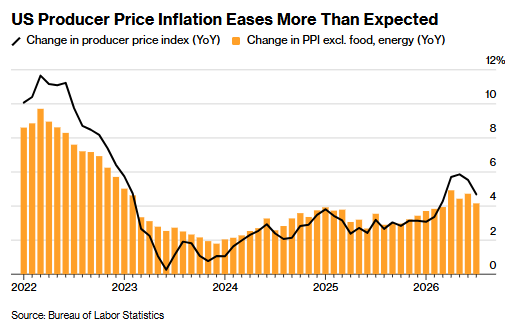
Driven by both energy and food declines, the year-on-year increase in US PPI narrowed to 4.7% in July, echoing the CPI cooling trend
The Zhitong Finance App learned that due to the further decline in energy and food costs, the year-on-year increase in US wholesale inflation in July was lower than market expectations, continuing the downward trend.
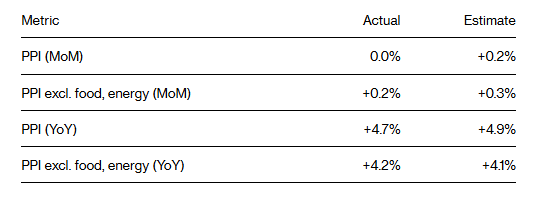
According to data released by the US Bureau of Labor Statistics on Thursday, the producer price index (PPI) remained flat month-on-month in July, lower than the 0.2% increase expected by economists; it rose 4.7% year on year, clearly down from the 5.5% increase in June. The June PPI month-on-month data was also revised up from the 0.3% decline previously announced to a 0.1% decline, which means that the final demand price has not risen for two consecutive months.
Excluding food and energy, core PPI rose 0.2% month-on-month, lower than market expectations of 0.3%; up 4.2% year-on-year. If trade services were further excluded, core PPI rose 0.4% month-on-month.
Chris Rupkey, chief economist at FWDBonds, said: “Taken together, pipeline pressure in the early stages of production did not increase the risk of inflation faced by consumers. The PPI final demand price has not risen for the second month in a row, which is good news for the cost of living crisis facing Americans.”
In terms of items, commodity prices fell 0.7% month-on-month in July, and energy prices fell 3.1%, for the second month in a row. Among them, gasoline prices fell 5.7%; food prices fell 0.9%, the biggest monthly decline since the beginning of the year. However, prices of core commodities excluding food and energy rose slightly by 0.1% month-on-month.
Service prices rose 0.2% month-on-month, with portfolio management fees surging 6.5%. Analysts pointed out that this segment often fluctuates greatly due to reporting requirements at the beginning of the quarter.
Transportation and storage costs fell 1.8% month-on-month, the biggest drop since April 2023, further indicating that the transmission impact of high fuel costs on overall prices is weakening. Meanwhile, an indicator of inflationary pressure in the early stages of production — prices of processed goods that exclude intermediate demand for food and energy — rose the smallest month-on-month since November last year.
However, the report also shows that cost pressure from data centers is still prominent. Prices of electronic components and accessories rose 28% year on year in July, close to the highest level in history; prices of computers and computer equipment rose 9.8% year on year, the biggest increase on record.
Some items in the PPI will be included in the personal consumption expenditure (PCE) price index, which is the preferred inflation index of the Federal Reserve, so they will receive additional attention from the market. In July, these segments showed mixed results: portfolio management fees showed the biggest increase in more than a year, and hospital outpatient expenses also rose sharply; doctor services and hospital hospitalization expenses were relatively moderate; and air ticket prices recorded the biggest drop since the beginning of last year.
The US Bureau of Economic Analysis is scheduled to release PCE price data for July on August 26. After the PPI data was released, economists at Citi, Morgan Stanley, and Jefferies expected the core PCE price index to rise 0.2% month-on-month in July.
Furthermore, margins on wholesale and retail trade services declined slightly in July after jumping in June. This subsection has received close attention as it may reveal the extent to which firms absorb the costs associated with tariffs or pass them on to consumers. Although the US Supreme Court overturned a number of tariffs earlier this year, the Trump administration is still seeking other ways to impose tariffs on imported goods. The White House recently announced tariffs of at least 10% on imports from most major trading partners.
Signs of cooling inflation are increasing, but risks in the Middle East remain
This PPI report follows the Consumer Price Index (CPI) data released earlier. Data released on Wednesday showed that CPI rose only 0.1% month-on-month in July, and falling energy prices helped ease price pressure. However, the overall CPI was still up 3.4% year over year, far higher than the Federal Reserve's 2% target. The core CPI rose 0.2% month-on-month and 2.5% year-on-year, returning to the level before the war began.
Overall, price increases are beginning to decline after the Iran war and Trump administration tariffs fueled inflation earlier this year. Recently, however, the Middle East conflict has once again heated up, causing the market to remain concerned that inflation may become more sticky.
After the PPI data was released, US stock index futures rose, and US Treasury yields declined. Traders have further lowered their bets on the Federal Reserve's interest rate hike in September. Market expectations have changed in recent days. Currently, they prefer the Fed to raise interest rates in October or December. Previously, the market had high expectations that the Federal Open Market Committee (FOMC) would act at the next meeting from September 15 to 16.
Federal Reserve officials will also get more consumer and producer price data and another labor market report before the mid-September policy meeting. Policymakers now need to balance continued inflationary pressure with the recent slowdown in employment growth. A number of key Federal Reserve officials have been pushing for interest rate hikes to push inflation back to the 2% target.
Another government report released on the same day shows that in the week ending August 8, the number of initial jobless claims in the US rose to 209,000, an increase of 9,000 over the previous week. This is higher than the 204,000 expected by the market, but it is still low. Data released last week showed that employment growth was weaker than previously estimated.