
Approaching the 160 red line again! The Takashi government sent a signal to support interest rate hikes and still cannot save the yen. Goldman Sachs says all interventions are “spending money to buy time”
The Zhitong Finance App notes that despite rumors that the government led by Prime Minister Takaichi Sanae supports the Bank of Japan's interest rate hike, the yen is still only “one step away” from the key price of 160 against the US dollar.
On Thursday, the yen was stable and hovered around 159.36 yen against the US dollar. In the past, once the yen approached the 160 mark, it often meant that the government might intervene to support the exchange rate.
According to people familiar with the matter, the next interest rate change is likely to be in September or October. They added that the Bank of Japan's concerns about “the weakening yen pushes up prices” is converging with the government's demand to “strengthen the effects of recent US and Japanese exchange rate intervention”, and the two sides agree on “the need to raise interest rates in the near future.”
Investors said the news had little impact on the yen because the market had already anticipated that the Bank of Japan would raise interest rates. The yen has continued to weaken recently as Japan still has huge interest spreads with the US and is heavily burdened with debt.
Masayuki Nakajima, senior strategist at Mizuho Bank, said: “As a result, the focus of the market has shifted from 'whether the Bank of Japan will raise interest rates in September' to 'how fast will the pace of austerity henceforth be. '”
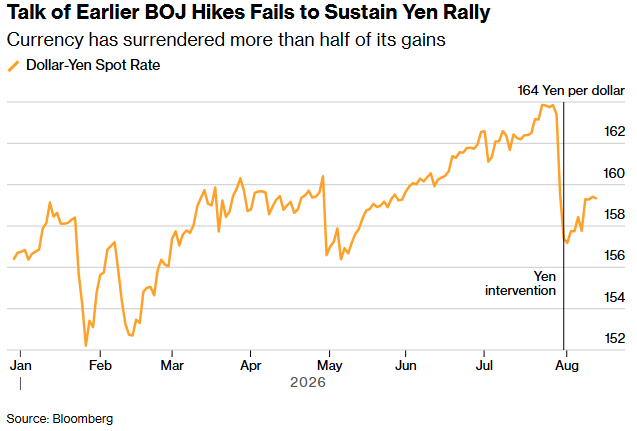
Earlier discussions on the Bank of Japan's interest rate hike failed to maintain yen gains
Meanwhile, Japan's 10-year treasury yield was 2.89% on Thursday, not far from the 30-year high set last month.
The Prime Minister's office said in an email statement: “We believe that specific monetary policy measures, including interest rate hikes, should be decided by the Bank of Japan.”
Dutch International Group (ING) strategist Francesco Pesole said that although he expects the yen to move to the 160 line again, expectations of “loosening US monetary policy” will support the yen in the next few weeks.
He said, “In my opinion, the current problem is that the market's attitude towards the Federal Reserve is still hawkish.”
Shusuke Yamada, head of foreign exchange and interest rate research at Bank of America in Japan, said, “After coordinating the intervention with the US side on July 31, the market's confidence in Japan's determination to 'protect the yen' increased.” “However, the dollar rebounded against the Japanese yen in the past week without any intervention, and that credibility seems to have waned.”
Karen Fishman, a senior foreign exchange strategist at Goldman Sachs, said that Japan has enough cash to carry out a few more rounds of yen buying operations similar to the scale of joint intervention between the US and Japan.
Goldman Sachs estimates that the Japanese government spent about 85 billion dollars in the first two days of last month's operation. This marks the largest two-day intervention in Japan's history, second only to October 2011, when Tokyo intervened after the Fukushima disaster.
Japan's Ministry of Finance said that it will use the Federal Reserve's FIMA repurchase facility to borrow dollars as collateral for US treasury bonds. Japan has about 1 trillion US dollars in foreign exchange reserves, of which about 200 billion US dollars is cash or cash equivalent.
Fishman said, “Realistically, they're far from running out of this money, but I think that just shows — they have enough ammunition to continue to intervene as long as they want.”
However, she warned that intervention was not a sustainable solution; it “boils down to buying time,” and pointed out that after Tokyo's separate interventions in April and May, the yen returned to a 40-year low within a few months.