
The Takaichi Sanae government relented in support of the Bank of Japan's interest rate hike. September 18 may become the fastest action window
The Zhitong Finance App learned that people familiar with the matter revealed that the government led by Prime Minister Sanae Takaichi supports the Bank of Japan's recent interest rate hike, and the next move is likely to occur in September or October.
People familiar with the matter added that the central bank's concern about the weakening yen pushes up prices coincides with the government's desire to enhance the effects of recent US and Japanese exchange rate intervention, and the two sides have reached an agreement on the need to raise interest rates recently.
Although the Bank of Japan has legal independence in monetary policy, it is also required to maintain close communication with the government on economic policy goals. The Takaichi Sanae Cabinet cannot force the Bank of Japan to set a specific interest rate, but it can release signals that may influence its decisions.
The Prime Minister's residence said in an email statement: “We believe that specific monetary policy measures, including interest rate hikes, should be decided by the Bank of Japan.” The statement also added that the central bank should work closely with the government to achieve the 2% inflation target in a “stable” manner. The Bank of Japan declined to comment.
After the news was released, the exchange rate of the yen against the US dollar rose from around 159.46 to 159.18, while the yield on the benchmark 10-year treasury bond rose slightly.
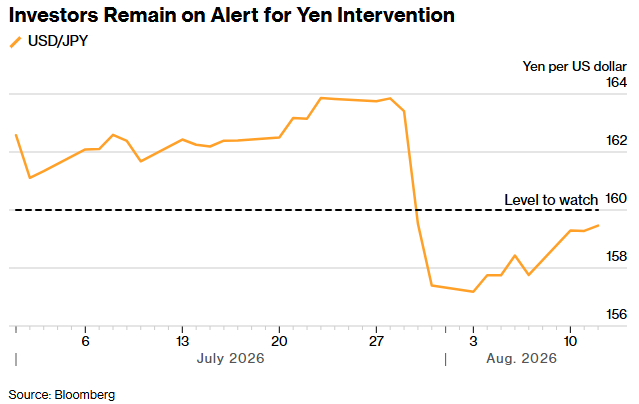
Investors remain wary of yen intervention
The effects of the joint intervention of the US and Japan to buy yen for the first time since 1998 are fading. Currently, the market's expectations for the Bank of Japan to join the support line for the yen are growing — US Treasury Secretary Scott Bessent has sent a signal that this move is necessary.
Bank of Japan Governor Kazuo Ueda mentioned the possibility of speeding up the pace of interest rate hikes when speaking at a press conference after the central bank was put on hold on July 31, citing concerns about the risk of upward pressure on prices. Later in the day, the US and Japan took joint action to intervene in the foreign exchange market to support the yen.
According to one person familiar with the matter, before the July meeting, the government had already expressed support for Ueda's hawkish remarks at the press conference to the Bank of Japan.
People familiar with the matter added that central bank officials still want to evaluate the development of the economy and prices before making a final decision on the timing of the next rate hike, but the possibility of taking action in September has not been ruled out. As of noon on Thursday, Tokyo time, traders expect the probability that the Bank of Japan will raise interest rates at the time of its next decision on September 18 is 74%.
For a long time, Takaichi Sanae was thought to be wary of interest rates rising too high and too fast, fearing that it would stifle an economic recovery that excited global investors. Despite the fact that the Bank of Japan has acted twice since she came to power in October last year, its benchmark interest rate has remained low at 1%.
A third rate hike would mark the fastest pace of austerity for the central bank in 12 months since 1989 (the peak of the country's economic asset bubble).
The huge spread in interest rates between the US and Japan is one of the factors that led to the weakening of the yen. The depreciation of the yen has intensified inflationary pressure and exacerbated the cost of living crisis that voters want Sanae Takaichi to resolve.
Government officials have said in recent weeks that they support the independence of the Bank of Japan, which may be a sign that they are open to further austerity policies. Recently, Minister for Growth Strategy Minoru Kiuchi said in an interview on Monday: “We respect the independence of the central bank.”
The government and central bank signed a joint agreement in 2013, pledging to work together to promote economic growth. The agreement set the Bank of Japan's 2% inflation target.
In the summary of opinions from the central bank's July meeting, a review committee member said that it is even more necessary to maintain flexibility in monetary policy.
A monetary policy committee member pointed out that since the potential CPI inflation rate is close to 2%, “it can be assumed that the pace of policy interest rate hikes will be faster than market expectations”.