Omdia: Middle East smartphone Q2 shipments fell 19% year over year, high-end strategy became the key for manufacturers to break through
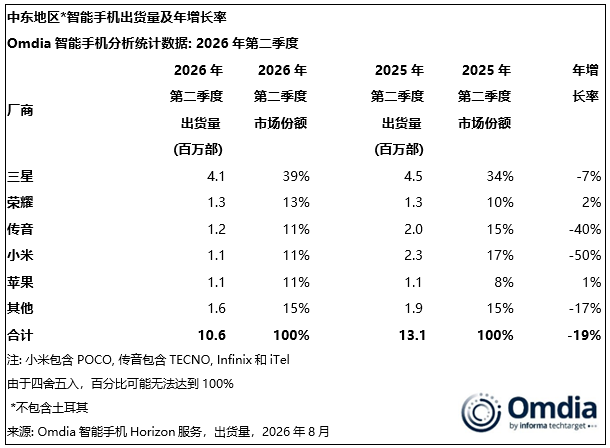
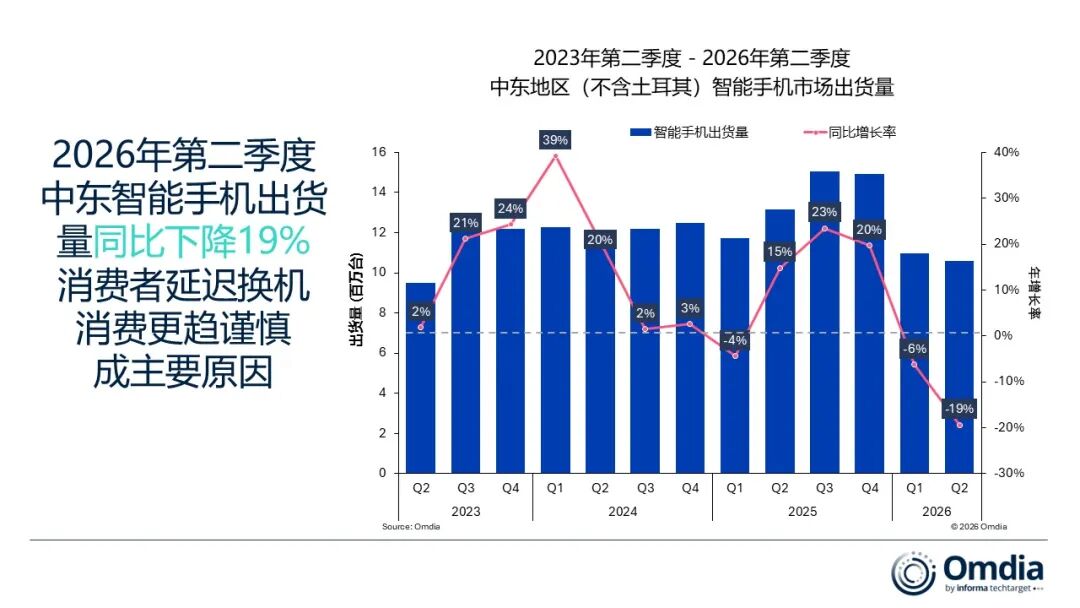
The Zhitong Finance App learned that according to Omdia's latest research, smartphone shipments in the Middle East region (excluding Turkey) fell 19% year-on-year to 10.6 million units in the second quarter of 2026, the biggest quarterly decline since the fourth quarter of 2025. Rising prices, limited supply, and geopolitical uncertainty are driving manufacturers to focus more on improving product value and profitability rather than simply pursuing increased shipments. Meanwhile, as consumer confidence weakens, retailers in the Middle East have adopted more careful inventory management strategies.
High-end strategies reshape the market pattern
In the second quarter of 2026, the Middle East market showed a trend of regional strategic adjustments. Facing the continuous rise in component costs, manufacturers are on the one hand transferring part of the cost to terminal sales prices, and on the other hand, promoting the upgrading of the product structure to high-end by strengthening the layout of middle and high-end products. Smartphone shipments that cost less than $200 fell 42% from the second quarter of 2025, highlighting that vendors focused on the entry-level market are facing severe pricing and supply challenges. The decline was particularly evident in the market, which is dominated by entry-level products. Among them, smartphone shipments in Iraq fell 36% year on year.
At the same time, the mid-tier market has become a core strategic priority for OEMs. Instead of reducing product configurations to maintain shipments, manufacturers continue to maintain high-end product features, including higher memory and storage configurations, stronger imaging systems, larger battery capacity, and AI capabilities. Smartphone shipments of $300 or more increased 16% year over year, with models equipped with 256GB storage capacity accounting for 55% of total shipments, reflecting that OEMs are continuously improving consumers' basic expectations for smartphone configurations.
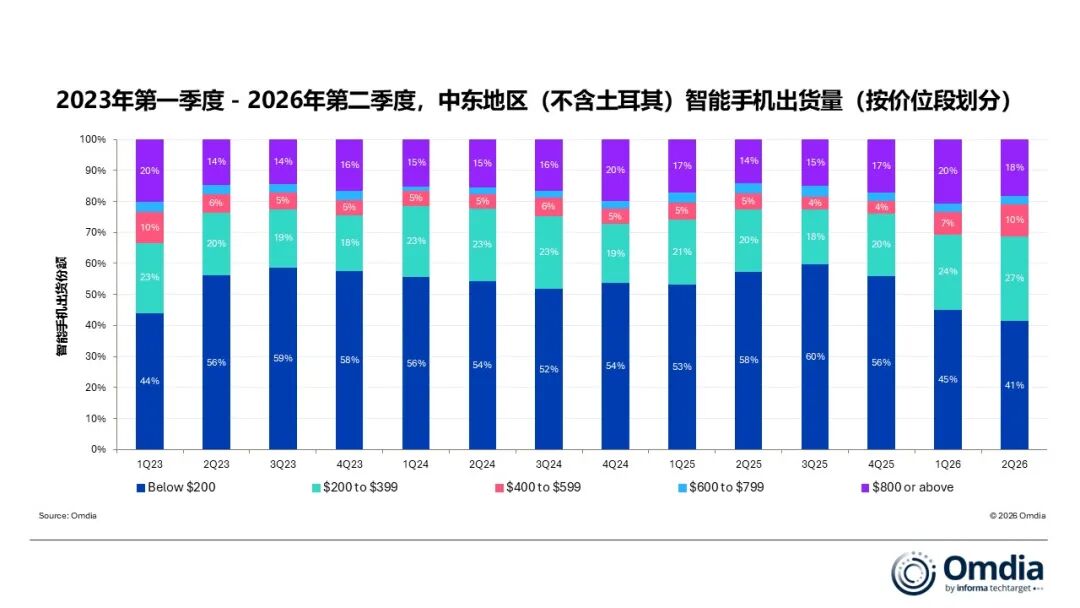
The high-end market also remained resilient, with shipments of 1.9 million smartphones priced at $800 or more, setting the record for the highest shipment in the history of the high-end market in the Middle East in the second quarter. Apple continues to be favored by consumers and is the main driving force behind the growth of the high-end market.
The UAE and Qatar are particularly receptive to manufacturers' high-end strategies. In the UAE, mature retail channels such as Sharaf DG, Emax, and online platforms promote consumers to buy high-value products through financial services such as installment payments, controlling the decline in the local market to 7%. Meanwhile, with a relatively stable economic environment and continued strong high-end market demand, Qatar achieved 2% year-on-year growth.
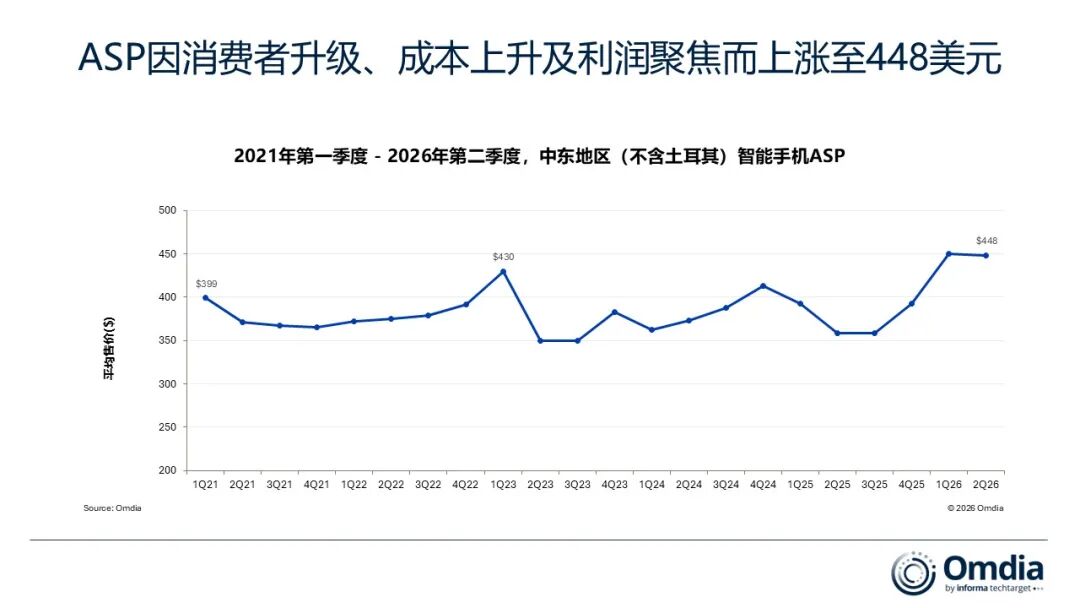
Due to continued pressure on the entry-level market and the resilience of the middle and high-end markets, the average smartphone sales price (ASP) in the Middle East rose 25% year-on-year in the second quarter of 2026 to 448 US dollars, the highest level in the second quarter of previous years.
Omdia Principal Analyst (Principal Analyst) Manish Pravinkumar said, “We are seeing a shift in the Middle East smartphone market driven by both market demand and corporate strategy. While maintaining product competitiveness and brand positioning, manufacturers also recognize that sacrificing part of the shipment volume in the short term is unavoidable. In the context of an increasingly severe business environment, prioritizing profitability and revenue rather than simply pursuing increased shipments and market share has become a key strategy for enterprises, even if this means that short-term performance is affected to a certain extent. This strategic adjustment also reflects that manufacturers have learned lessons from multiple previous cost escalation cycles — simply relying on aggressive price competition not only erodes profits, but also fails to establish a sustainable market foundation.”
Vendor performance reflects differences in strategic positioning
Samsung continues to maintain its leading position in the market with 39% market share. Despite a 7% year-on-year decline in shipments, Samsung achieved a balance between market share and profit by balancing the Galaxy A series, which drives sales, and the Galaxy S26 series, which aims to guarantee profitability.
Honor's shipments increased 2% year over year, making it the second-largest smartphone manufacturer in the Middle East.
Voice communication ranked third and faced great challenges. Continued price pressure and declining consumer purchasing power curtailed demand in the entry-level market, leading to a 40% year-on-year decline in transmission shipments. Manufacturers have long relied on cost-effective positioning, but in a context where component costs continue to rise, there is limited room to absorb cost pressure without affecting market demand.
Apple shipments increased 1% year over year. With steady high-end market demand, perfect ecosystem advantages, and flexible financial service support, Apple successfully withstood overall market downward pressure in the second quarter of 2026.