
AI Stocks With Real Enterprise Revenue Growth Investors Should Watch
Oil prices remain elevated as Middle East risks keep energy markets tight, which keeps central banks cautious and borrowing costs sensitive to every inflation data point. That kind of uncertainty puts a premium on companies at the heart of the AI build out, from chips to cloud and software. This article walks through 3 AI stocks from our screener that many investors are watching closely right now.
The 3 stocks below are just a sample from this AI theme, and the full screen surfaced 31 more companies with equally compelling narratives that are not covered here. To identify and analyze your own highest conviction ideas around chips, cloud and software, head straight into the Artificial Intelligence/ AI Stocks screener.
Docebo (TSX:DCBO)
Overview: Docebo is a Toronto based software company that provides a cloud learning platform, helping businesses design, deliver, and analyze employee, customer, and partner training using tools such as AI powered search, content creation, and integrations with systems like Salesforce and Microsoft Teams. Its suite also supports eCommerce, branded mobile apps, and embedded solutions that other companies can resell.
Operations: Docebo generates all of its $258.9 million in revenue from educational software, with the United States contributing $174.0 million, the rest of the world $71.4 million, and Canada $13.5 million.
Market Cap: CA$800.3 million
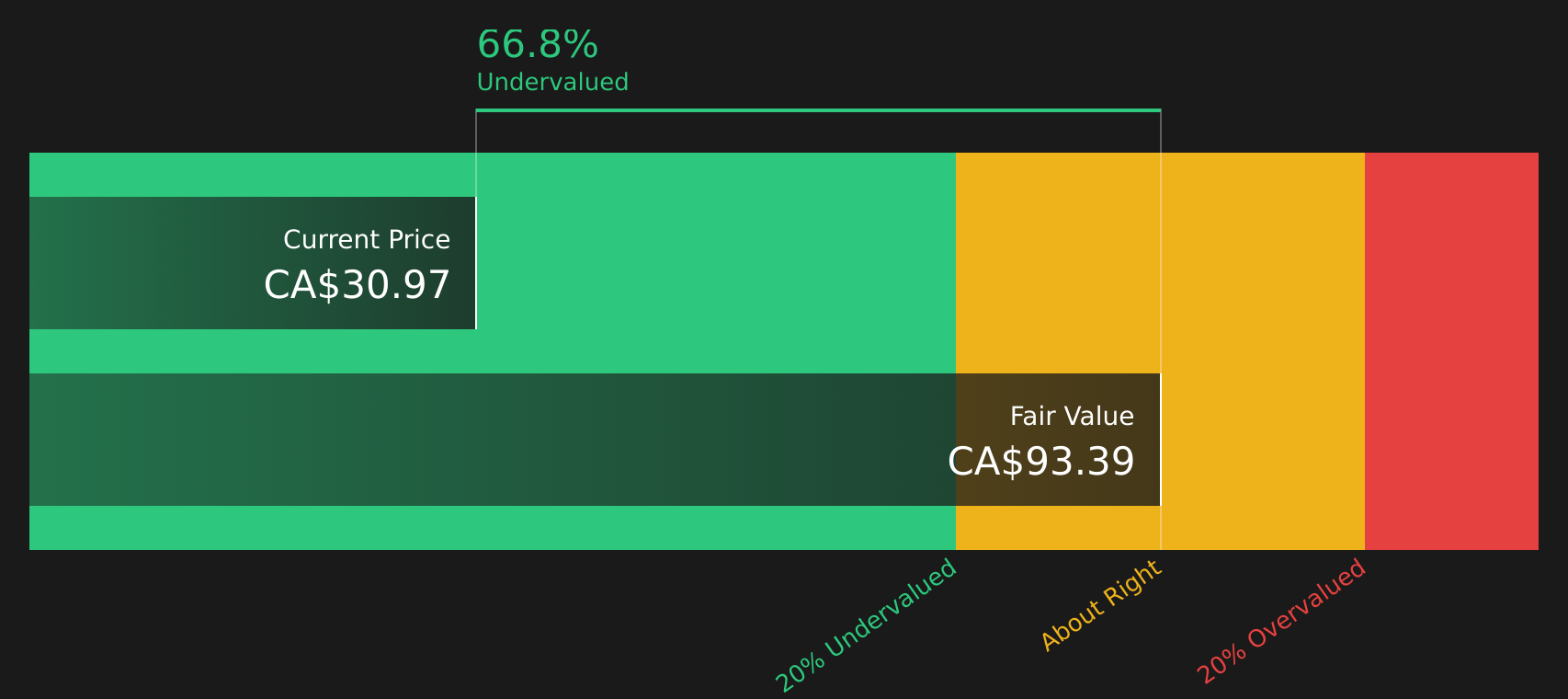
Docebo sits at the crossroads of AI and workplace training, with tools like Harmony search and Creator aimed at making learning more personalized and automated for large enterprises and government clients. Analysts see room for higher earnings over time, and the stock currently trades at a discount to some fair value estimates, which catches the eye of investors who care about price versus fundamentals. At the same time, Docebo carries high debt and negative equity, and recent one off losses and slimmer net income remind you that the balance sheet is not without pressure. Management has leaned into sizable buybacks and fresh guidance, which could be rewarding if the growth story holds up.
Docebo’s AI tools and global footprint are only half the story. The more interesting question is whether the current pricing really reflects that mix of promise and pressure in the 4 key rewards and 3 important warning signs (1 is major!)
Build your own AI training shortlist
Docebo and the other two AI stocks in this article all surfaced from the same custom screen, and you can set up your own filters around pricing, quality, balance sheet strength and risks using our Screener. If you would rather start from pre built ideas, you can jump straight into our Investing Ideas.
Kinaxis (TSX:KXS)
Overview: Kinaxis is an Ottawa based software company that sells cloud subscription tools to help large enterprises plan, manage, and monitor complex supply chains using its Maestro platform. The platform applies AI to tasks like demand forecasting, inventory and order management, and transportation planning across industries from aerospace to consumer products and pharma.
Operations: Kinaxis generates about $603 million from supply chain management software and services, with most revenue coming from the United States at $336 million, followed by Europe at $198 million, Asia at $62 million, and Canada at $7 million.
Market Cap: CA$4.6 billion
Kinaxis provides exposure to AI where it directly ties to business outcomes, with Maestro agents and explainable AI aimed at helping customers make real time supply chain decisions under tighter regulatory and governance scrutiny. The company reports strong SaaS growth, expanding AI usage inside its customer base, and rising demand from sectors that prioritize resilience and transparency. At the same time, the stock carries a relatively rich P/E and faces pressure from heavyweight rivals and in house AI tools, so execution and pricing power play an important role. For a clearer picture of how those strengths and risks fit together, the full analyst work on growth, margins, and valuation provides additional detail.
Kinaxis is where high stakes supply chain decisions meet AI. Yet the real story sits in how growth, margins, and valuation fit together. The analysis report for Kinaxis could surface one twist investors are missing.

Quantum eMotion (TSXV:QNC)
Overview: Quantum eMotion is a Montreal based cybersecurity company that develops quantum based hardware and software products that secure encryption keys and sensitive data for sectors such as AI data centers, energy storage, finance, government, defense, and healthcare.
Market Cap: CA$697.6 million
Quantum eMotion sits at the intersection of quantum security and AI infrastructure, with products like eShield Q and eFlux Q now being tested in GPU clusters, edge data centers, and quantum secured energy storage platforms for high profile clients. Yet the company remains very small in scale, with only CA$10,600 in Q1 2026 sales and a loss of CA$3.59 million, and earnings are forecast to decline over the next few years. The P/B multiple is high and insiders have been selling, which increases the need for careful risk sizing. For investors who can tolerate those early stage risks, the mix of experienced governance, live pilots, and a potential quantum resilient chip platform makes Quantum eMotion a high risk, high potential AI security play that may warrant closer attention.
Quantum eMotion’s tiny revenue base and large loss sit beside GPU pilots and quantum ready security hardware that could reshape its story. The real question is how those pieces fit together in the 1 key reward and 4 important warning signs (2 are major!)

Seeking Alternatives Before The Crowd?
Fresh stock stories can move from quiet to breakout quickly, while attention, momentum, and pricing keep shifting. Do not get caught reacting after the best entries drop. Consider acting in advance.
- Scan for income ideas that aim to keep paying while markets move. Use the curated 4 dividend fortresses and see which cash generators still look under the radar for now.
- Hunt for potential future category leaders early. The hand picked 8 high quality undiscovered gems could surface companies that larger investors have not fully focused on yet.
- Target resilient balance sheets before stress shows up. The focused list of solid balance sheet and fundamentals (12 results) helps you spot companies where fundamentals still look steady while it matters.
This article by Simply Wall St is general in nature. We provide commentary based on historical data and analyst forecasts only using an unbiased methodology and our articles are not intended to be financial advice. It does not constitute a recommendation to buy or sell any stock, and does not take account of your objectives, or your financial situation. We aim to bring you long-term focused analysis driven by fundamental data. Note that our analysis may not factor in the latest price-sensitive company announcements or qualitative material. Simply Wall St has no position in any stocks mentioned.
Have feedback on this article? Concerned about the content? Get in touch with us directly. Alternatively, email editorial-team@simplywallst.com