
As Hurricane Season Brings Rising Storm Risks, Farmers Insurance® Calls Out the Coverage Myths That Can Cost Homeowners and Business Owners Most
Backed by claims insights, Farmers® is calling out the coverage gaps customers often discover too late—and sharing practical tips for preparing now and navigating storm damage before filing a claim.
WOODLAND HILLS, Calif., August 12, 2026 /PRNewswire/ -- As communities prepare for hurricane season, Farmers Insurance® is encouraging homeowners and business owners to look beyond storm prep and focus on something just as important: understanding how their insurance coverage works. While standard policies may cover certain types of hurricane-related damage, many people may not realize one of the costliest risks, flood damage, is often not included and may require separate flood insurance. To help consumers make more informed decisions – including insurance protection for floods – Farmers is sharing practical guidance in its resource, Farmers' Hurricane Season Insurance Guide for Homeowners and Business Owners.
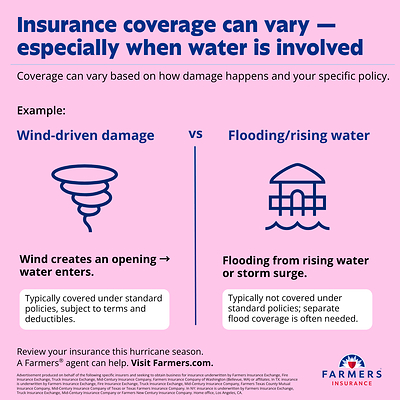
Insurance coverage can vary—especially when water is involved
In general, homeowners and businessowners policies may provide coverage for certain types of hurricane-related damage, such as wind damage or water damage that results from a wind-created opening. However, coverage can vary by policy, location and situation. In higher-risk coastal counties, for example, wind coverage may be excluded from a homeowners policy and require separate coverage. Flood damage, including damage from rising water or storm surge, is typically not covered under standard homeowners or businessowners policies and usually requires separate flood insurance.
"Insurance can feel complicated, especially when severe weather is involved," said Jeff Hinesly, Flood Director at Farmers Insurance. "We want to make it simpler. One of the biggest misunderstandings we see is people assuming flood damage is included in their homeowners or business policy. In most cases, it is not, and that's something customers should understand before a storm is in the forecast."
Flood damage: the important coverage distinction
Farmers is addressing some of the most common misunderstandings that can leave customers exposed during hurricane season:
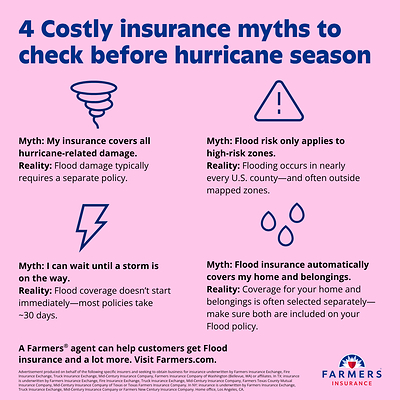
Myth: If I have homeowners or business insurance, all hurricane-related damage is covered*.
- Reality: Some hurricane-related damage may be covered, depending on the policy and cause of loss. For example, wind damage and water damage that enters through a wind-created opening may generally be covered, while flood damage from rising water or storm surge is typically not covered under standard homeowners or businessowners policies. Flood insurance is usually purchased separately.
Myth: If I'm not in a high-risk flood zone, I probably don't need to worry.
Reality: Flooding is not limited to high-risk zones. According to FloodSmart.gov, nearly one-third of National Flood Insurance Program (NFIP) flood claims from 2014 through 2024 came from areas outside high-risk flood areas1.
Myth: I can wait until a storm is coming to add flood coverage.
- Reality: Although some private insurance carriers offer waiting periods as short as 7-days, there's typically a 30-day waiting period between the purchase of an NFIP flood policy purchased through carriers like Farmers and when coverage becomes effective. This means waiting until a hurricane is imminent may be too late for coverage to be in place before the storm arrives.
Myth: If I have flood insurance, my home and everything inside it is covered.
- Reality: Flood policies may treat coverage for the building and coverage for personal belongings as separate choices. Consumers who want items inside their home—such as furniture, clothing or electronics—covered for flood damage should review whether contents coverage is included and, if not, ask about adding it. This can be especially important when flood insurance is purchased to satisfy a loan requirement, when some consumers may focus on only purchasing the required building coverage to help keep closing costs down.
"Hurricane season is no time for assumptions," Hinesly added. "The best time to understand your coverage is before you need it."
*Coverage varies by policy, state and individual circumstances. These are general examples of what may or may not be covered, and consumers should review their policy documents and talk with their insurance agent to understand their specific coverage, exclusions, limits and deductibles.
For homeowners: confidence starts with clarity
Insurance policies can be a little like storm forecasts: there are a lot of details, and the fine print matters. To help avoid surprises later, homeowners may want to research key questions in their policy and talk them through with an insurance agent who knows what to look for, including:
- Understanding the difference between wind-related damage and flood-related damage
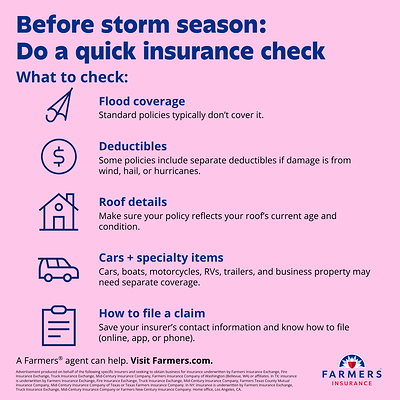
- Asking whether wind, named storm or hurricane deductibles apply, whether flood or storm surge damage is excluded, and whether separate flood coverage may be needed
- And documenting belongings before severe weather strikes
Farmers also encourages customers to keep contact information current and maintain records for valuable belongings and recent home updates so their information is easier to access if they ever need to file a claim.
Fallen trees can create a costly chain reaction
During a hurricane, downed trees and large limbs are a common source of damage—and the financial impact can extend well beyond the roofline. Depending on the policy and cause of loss, homeowners insurance may help cover damage to the home, personal belongings inside, and other insured structures such as fences, decks, detached garages or sheds. Rain damage that enters through an opening created by a fallen tree or large limb may also be covered, depending on the policy and circumstances.
Coverage may also help with tree removal when the tree damages an insured structure, though limits typically apply. Landscaping losses, including damage to trees, shrubs, bushes or lawns, may be subject to separate limits and may only be covered for certain causes of loss. Because these details can vary widely, customers should review how their policy treats fallen trees, debris removal, other structures, personal property and landscaping before severe weather arrives.
For business owners: the damage isn't always just physical
For business owners, hurricane risk is not only about property damage. A storm can also disrupt operations, interrupt income, damage inventory, and delay reopening.
Business owners should consider reviewing:
- Whether flood coverage is in place
- What triggers business interruption coverage on a Businessowners Policy (BOP) (also known as business income insurance)
- Property values, equipment lists, and inventory records
- Outdoor property or equipment exposure
"For many business owners, the biggest challenge after a storm is not just repairing damage — it's the lost income and recovering from the downtime," said Juan Escalera, Head of Commercial Property and Large Loss Claims at Farmers. "Understanding how your coverage works ahead of time can make a real difference in speeding up recovery."
One step ahead: what customers can do now
Farmers encourages customers to take a few simple steps before hurricane season intensifies:
- Review current policies and ask questions about exclusions, limits, and deductibles.
- Understand the difference between flood damage and other storm-related damage.
- Consider whether separate flood coverage is needed.
- Keep policy, contact, and lender information (especially after refinancing) up to date on your insurance policy.
- Document property, belongings, equipment, and inventory before a loss happens.
- Talk with an insurance agent who can help explain how coverages work, identify potential gaps, and discuss updates that may better reflect current needs. Farmers Insurance agents can be a helpful resource.
After the storm: document first, then act
When damage happens, it's natural to want to clean up quickly—but taking a few minutes to document what can be seen can make a meaningful difference during the claims and recovery process.
What helps:
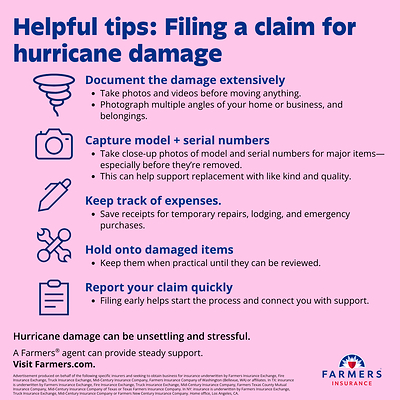
- Take photos and videos of damaged areas before moving or repairing anything.
- Capture multiple angles of the home, business, and affected belongings.
- Keep receipts and records for temporary repairs, lodging, or emergency purchases.
- Hold onto damaged items, when practical, until they can be reviewed.
- Report a claim as soon as possible so the process can begin and a claims representative can guide next steps.
These steps can help provide a clearer picture of the damage as claims representatives review a policy and assess next steps.
Documenting damage does not determine coverage, but it can help a claim to be reviewed with the most complete information available.
One conversation. A clearer picture of coverage.
Insurance decisions don't have to be complicated—but it's important to have a full picture.
Farmers Insurance agents work with homeowners and business owners to review coverage across multiple needs—not just a single policy—including:
- Homeowners insurance, which may cover damage from risks like wind, but typically does not include flood damage
- Flood insurance options, which are separate from standard policies and can help cover damage caused by rising water
- Car insurance, specifically Comprehensive coverage, which may help cover certain storm-related vehicle damage, such as damage from hail, falling objects, flooding or wind-driven debris, depending on the policy
- Business insurance solutions, including property and liability coverage, as well as business interruption protection depending on the situation
They can also help customers think beyond the basics. Storms don't just impact homes and buildings—they can affect the things people often forget about, like boats, motorcycles, and other recreational vehicles that may be exposed to wind and water damage during severe weather.
Farmers tools and support that could help make recovery easier
Farmers offers digital tools and agent support to help customers prepare, respond, and recover.
Customers can report a claim, view claim status, access policy documents, and use the Farmers mobile app to manage insurance needs and stay connected to their agent.
The best time to understand insurance coverage is before it's needed. To learn more about what's typically covered, what's not, and ways to prepare, visit Farmers' Hurricane Season Insurance Guide for Homeowners and Business Owners.
Source:
1FloodSmart.gov, "What Is My Flood Risk?" citing National Flood Insurance Program flood claims from 2014–2024, https://www.floodsmart.gov/flood-zones-and-maps/what-is-my-flood-risk.
About Farmers Insurance
"Farmers Insurance®" and "Farmers®" are tradenames for a group of insurers providing insurance for automobiles, homes and small businesses and a wide range of other insurance and financial services products. Farmers Insurance Exchange, the largest of the three primary insurers that make up Farmers Insurance, is recognized as one of the largest U.S. businesses on the 2026 Fortune 500 list. For more information about Farmers Insurance, visit Farmers.com.
Advertisement produced on behalf of the following specific insurers and seeking to obtain business for insurance underwritten by Farmers Insurance Exchange, Fire Insurance Exchange, Truck Insurance Exchange, Mid-Century Insurance Company, Farmers Insurance Company of Washington (Bellevue, WA) or affiliates. In TX: insurance is underwritten by Farmers Insurance Exchange, Fire Insurance Exchange, Truck Insurance Exchange, Mid-Century Insurance Company, Farmers Texas County Mutual Insurance Company, Mid-Century Insurance Company of Texas or Texas Farmers Insurance Company. In NY: insurance is underwritten by Farmers Insurance Exchange, Truck Insurance Exchange, Mid-Century Insurance Company or Farmers New Century Insurance Company. Home office, Los Angeles, CA.
Contact: |
External Communications |
Farmers Insurance |
|
818-965-0007 |
|

 View original content to download multimedia:https://www.prnewswire.com/news-releases/as-hurricane-season-brings-rising-storm-risks-farmers-insurance-calls-out-the-coverage-myths-that-can-cost-homeowners-and-business-owners-most-302850150.html
SOURCE Farmers Insurance
