
Storage prices are still rising, and stock prices have “entered winter” ahead of schedule. Can Samsung and SK Hynix's “cash back” break the cycle curse?
The Zhitong Finance App learned that the rise in memory chip prices has begun to show signs of slowing down, and investors' concerns about the “peak of the cycle” are increasing day by day. This time, the two largest storage giants, Samsung and SK Hynix, may have found a new defensive strategy: giving more cash back to shareholders.
Last Friday, SK Hynix announced that it will announce the details of the shareholder return plan in the third quarter, while paying a dividend of 375 won per share. The industry generally expects that its larger counterpart Samsung Electronics will soon follow suit. This expectation has already driven Samsung's stock price to rise 4.1% on Tuesday. Samsung stated in its second quarter earnings report on July 30 that the company's board of directors and management are actively discussing specific measures for this year's shareholder return policy, including the payment of a special dividend.
As AI demand continues to squeeze the supply of memory chips, both companies have achieved strong cash inflows. As the rise in memory chip prices begins to slow down, stock repurchases and dividends are expected to be the next round of stock price catalysts, and provide a line of support and defense for stock prices when the market generally expects profit growth to reach its peak.
“Considering the sharp rise in stock prices and market discussions about the storage cycle peaking, buybacks will play a key role in supporting stock prices and may even attract more institutional investors to refocus on memory chip stocks,” said Jun Bei Liu (Jun Bei Liu), co-founder and chief portfolio manager of Ten Cap Investments. “From now on, repurchases and special dividends are expected to become a regular operation for storage companies.”
Is the “Death by Seeing the Light” spell reappearing? Historical rules and current dilemmas of memory chip stocks
This shift to returning cash to shareholders coincides with investors once again facing an “old problem” with memory chip stocks: before memory chip prices actually fell, storage companies' stock prices had weakened.
According to Jibang Consulting's estimates, the price of traditional DRAM contracts will rise 58% to 63% in the second quarter of 2026, while the increase in server DRAM will slow to 13% to 18% in the third quarter. Judging from historical rules, memory chip stocks often weaken when their performance is still at a record high, because the market will price future profit revisions in advance — this comes sooner than the earnings data “peaked.”
Storage companies' valuations are under pressure due to concerns about peaking profits
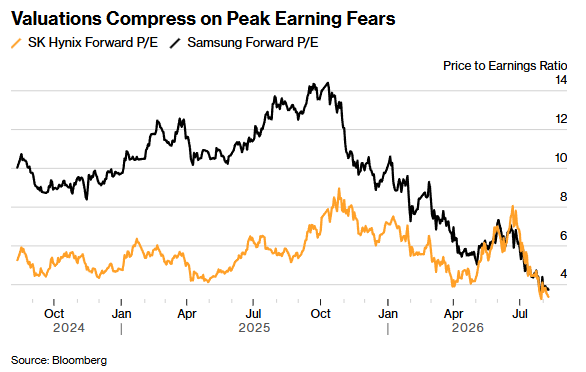
The facts also confirm this pattern: since hitting a high point during the year in June, the stock prices of SK Hynix and Samsung Electronics have dropped by about 50% and 34%, respectively, even though both companies recorded record profit levels during the same period. Analysts believe that the contrast between “high performance growth and dividend restraint” has made the market speculate that management is not optimistic about the long-term sustainability of this round of AI storage dividends. This is an important factor in the sharp decline in stock prices.
With 100 billion dollars in cash on the account, why are shareholders' returns “heavy thunder and a little small”?
The other side of the problem is that the two companies have too much cash. According to LSEG data, the combined net cash reserves of Samsung and SK Hynix are expected to reach 263 billion US dollars by the end of this year, more than double Nvidia's 102 billion US dollars, and at the same time exceed the sum of the remaining six of the US tech giants. The brokerage estimates that Samsung's free cash flow this year is about 200 trillion won (about 145 billion US dollars), while SK Hynix's free cash flow is expected to reach about 100 trillion won.
Storage company's free cash flow hits record
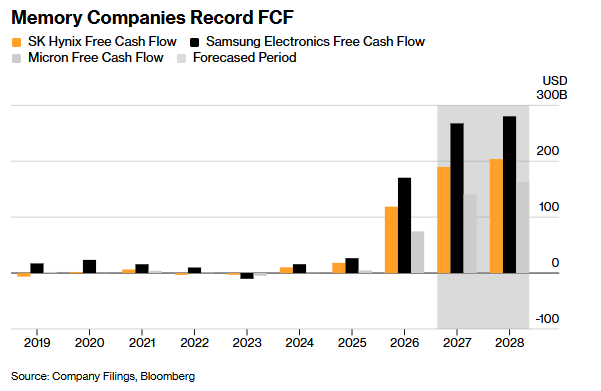
With plenty of cash in hand, the dividends seemed “stingy.” Currently, both companies plan to use 50% of free cash flow for shareholder returns. This ratio is in stark contrast to Micron Technology, a major US memory chip manufacturer — Micron promised to increase shareholder return to 100% as early as June of this year. The huge gap has caused many investors to feel dissatisfied.
The pressure on Wall Street is heating up. J.P. Morgan previously lowered SK Hynix's target share price and clearly stated that “a clear position on capital allocation is essential to restore market confidence.” Richard Claude, the fund manager of asset management agency Junley Henderson, even publicly shouted that sticking to a 50% free cash flow rebate ratio would greatly reduce the efficiency of corporate balance sheet capital utilization. He called on SK Hynix to increase shareholder return ratio to 80% or more.
It is in this context that the release of SK Hynix's Q3 shareholder return plan, as well as Samsung's potential follow-up, has been given meaning by the market far beyond routine announcements.
Long-term supply agreements strengthened: this time, the cycle has a “buffer”
Unlike previous cycles, storage vendors now have a “new brand” in their hands — long-term supply agreements (LTAs). This type of contract is expected to make earnings more sustainable, thus breaking the “one year to earn and three to lose” cycle.
According to the disclosure, SK Hynix has now signed long-term supply agreements with about 10 customers; Samsung expects that the multi-year contract will eventually cover 60% to 70% of its planned production capacity. By the end of June, Micron had also signed 16 long-term supply agreements.
Such agreements can significantly increase demand visibility and effectively smooth out sharp profit fluctuations that have caused investors a great headache in the past. With more stable revenue expectations, the market has more reason to value storage companies based on “normalized cash flow,” rather than just chasing short-term price fluctuations.
Currently, there are no clear signs that this memory chip boom cycle is coming to an end. According to South Korea Customs data, chip exports increased 45% year-on-year in the first 10 days of August, indicating that demand is still strong. This means that even if the rise in memory chip prices slows down, the tight supply pattern will still provide producers with sufficient cash to create room.
From “price games” to “cash back”, the storage investment logic is changing
For a long time, investors loved and hated the memory chip industry because of its strong cyclicality. Today, with the long-term structural support of AI demand, Samsung and SK Hynix are trying to send a “sustainable profit and shareable cash” signal to the market through a shareholder return mechanism.
“As the storage cycle matures, return on capital is expected to be the next major catalyst,” said Maxon Viso, chief investment officer at Dubai's Arkevium Capital. “In the early stages of the cycle, stock prices mainly followed rising spot prices and expanding profit margins. Once these profit revisions are fully reflected in positions and valuations, the driving effect of simple performance exceeding expectations on stock prices will weaken. At that point, investors will begin to focus on a more real question — how much cash the company actually returned to them. ”
Morgan Stanley analyst Sean King also recently released a report saying that the focus of the storage stock market is shifting from price cycles to capital returns, and stock buybacks, free cash flow, and long-term supply agreements (LTAs) are expected to become the next wave of stock price catalysts. This analyst, previously viewed as a “bearish ambassador” for warning of short-term storage pullbacks, now judges that the most drastic adjustment in the storage market is nearing its end, and the current valuation has provided an “attractive tactical entry into the market.”
Kim described this wave of adjustments as “a small wave in the AI supercycle.” He maintains a bullish long-term stance on Samsung Electronics and SK Hynix. It is expected that the profits of the two companies will increase by 25% to 50% in 2027. Continued expansion of AI capital expenditure and the rapid advancement of Agentic AI will jointly support the fundamentals of the industry.
Simply put, whether buybacks and special dividends can actually be a “stabilizer” against the downturn of the cycle will largely depend on whether the two companies can come up with a more sincere plan than “50%.” At least at this point, these two giants are using real money to respond to market anxiety about the “peak of the cycle.”