
From “can be used” to “can be sold”: Deshit-B (02526) report begins platform-based revaluation of medical AI
The Zhitong Finance App learned that to determine whether a medical AI company has actually crossed the commercial watershed, it is necessary not only to look at model parameters, number of products, or volume of press conferences, but also to answer three more practical questions: Has AI capability become a revenue entity? Can the same technical base continue to produce new specialty tasks? Can the model pass a high level of supervision and actually enter the clinical workflow?
The 2026 interim results released by Dech-B (02526) on August 7 gave clear answers to these three questions.
During the reporting period, the company achieved total revenue of 108.7 million yuan, an increase of 21.0% year on year; gross profit of 80504 million yuan, an increase of 14.0% year on year; comprehensive gross margin remained at a high level of 74.1%. Among them, model service revenue reached 94.541 million yuan, a year-on-year increase of 101.1%, accounting for 86.9% of total revenue.
If 2025 is still a verification period for Deshi's business model transformation, then model services account for nearly 90% of revenue, which means that the company has already crossed a critical point: the medical imaging model is no longer just a technical base or additional product function, but has become a core business driving revenue growth.
Revenue chassis replacement: model service contribution exceeds total net increase
The gold content of Deshi's revenue growth in the current period is first reflected in the incremental structure.
In the same period last year, the company's technology licensing revenue was 46.96 million yuan, accounting for 52.3% of customer contract revenue; in the first half of 2026, the adjusted model service revenue increased to 94.541 million yuan, accounting for 86.9% of total revenue. The model service added about 47.58 million yuan in half a year, while the company's overall net revenue increased by about 18.89 million yuan. The former is 2.5 times that of the latter.
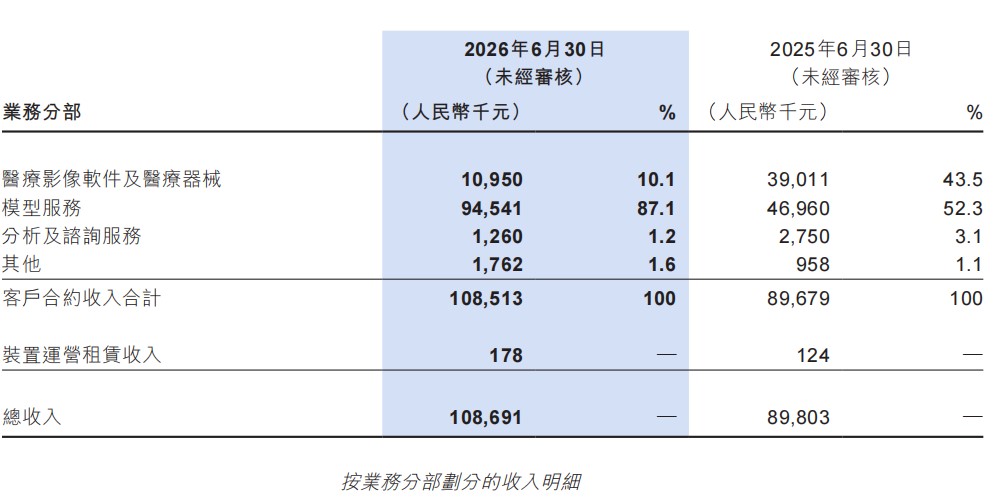
(Screenshot source: Deshi Technology 2026 Interim Results Report)
This means that the model service not only contributed to the company's overall revenue growth, but also effectively absorbed short-term fluctuations caused by delays in budget approval, bidding, and acceptance of some medical imaging software and medical device projects. Deshi's revenue base has shifted from equipment and software sales to model capability output.
The “Technology License” was renamed “Model Service” and did not in itself change the substance of the contract or the method of revenue recognition. What is really worth paying attention to is that the business content has been expanded to three complementary delivery models: model and technology licensing, iMedMaaS® cloud service, and SCTI localized storage and calculation training to promote all-in-one delivery.
Each of these three models adapts to the needs of different medical institutions for data security, private deployment, model training, and computing power resources. As a result, Deshi is no longer just a ready-made algorithm, but a complete set of production services that transform hospital image data and doctors' professional experience into specialist AI capabilities.
Although the old and new categories are not exactly the same caliber, model service revenue in the first half of 2026 has already exceeded 84.34 million yuan in technology licensing revenue for the full year of 2025, which still intuitively reflects the rapid expansion of related business volume.
The real core asset is not the 158 models, but the production model system
If we only think of moral standards as a company with 158 specialist models, we still underestimate the capabilities shown in this interim report.
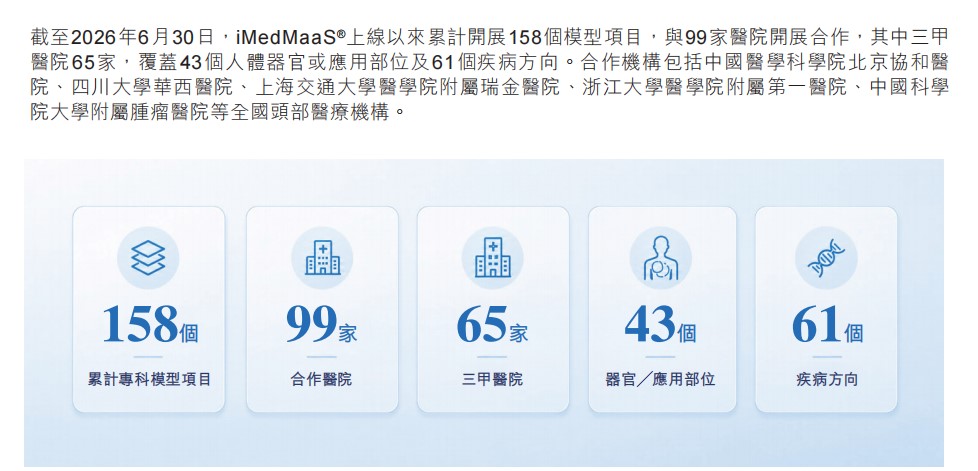
(Screenshot source: Deshi Technology 2026 Interim Results Report)
Traditional medical imaging AI often follows the development method of “one disease, one model”: every time a disease type is entered, data must be re-collected, labeled, trained, and clinically verified. This model has a long R&D cycle, large professional investment, and is difficult to fully reuse between different projects.
Deshi is solving the problem that medical AI cannot be produced on a large scale.
The company uses the iMediimage® medical imaging base model to provide reusable image understanding and reasoning capabilities; completes data processing, professional labeling, manual correction, multi-person review and quality control through iMedStudio™; relies on iMedMaaS® to carry out specialist model training, customization, evaluation, publication and deployment; and DoctorBench® evaluates model capabilities, safety, and application boundaries.
iMedloop™, released in July 2026, further connects these capabilities, penetrates data access, intelligent labeling, quality control, model training, unified evaluation, publication and deployment, and application feedback to form a full-process platform from medical imaging data to application of model results.
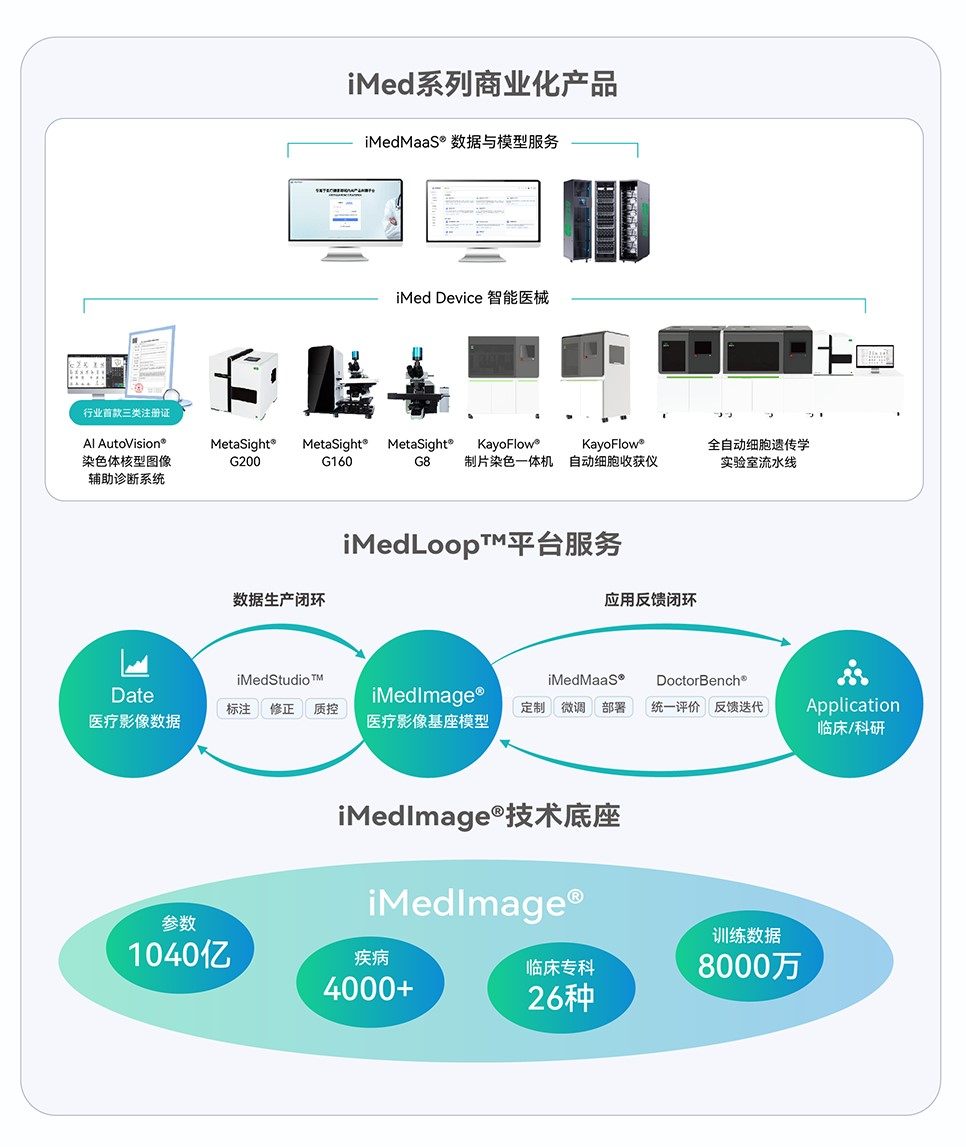
(Screenshot source: Understanding Deshi Technology's 2026 Interim Results)
As of the announcement, more than 3,000 professionals have participated in the iMedloop™ related system, and approximately 28.95 million labeled samples have been collected. DoctorBench® covers three types of tracks: language models, multi-modal models, and clinical task agents, 25 medical scenarios and tasks, and approximately 12,920 test items. iMediimage® ranked first overall in the limited set of questions and the scope of participation disclosed by the company, and all eight scenarios entered the top three.
Together, these data point to a fact that is more important than the “number of models”: Deshi has organized the originally scattered data, tools, experts, and engineering processes into a medical imaging AI production line.
From project collaboration to regulatory products, a closed clinical loop begins to take shape
By the end of June 2026, Deshi had carried out a total of 158 model projects and cooperated with 99 hospitals, including 65 top three hospitals, covering 43 human organs or application sites and 61 disease directions.
These project collaborations are not equivalent to 158 commercial products or 99 paying customers. Their deeper value lies in the continuous accumulation of task definitions, labeling standards, evaluation methods, deployment procedures, and clinical feedback for different specialties. Each time a project is completed, the platform not only adds a model, but also adds a set of professional experience that can be reused for subsequent tasks.
For medical AI to truly generate clinical and commercial value, it must also cross the critical threshold of regulatory entry.
On May 19, 2026, Deshi AI AutoVision® chromosome karyotype image assisted diagnostic software obtained a Class III medical device registration certificate from the State Drug Administration. This product is used to assist in the cutting, counting, identification, arrangement and suspected abnormal detection of G band karyotype images in peripheral blood and amniotic fluid samples.
The importance of this three-category certificate is not only that an approved product has been added, but also that it has verified that Deshi can transform the medical imaging base model into a supervisory medical device, opening up a complete path of “underlying model - specialist development - clinical verification - registration declaration - commercial delivery”.
Single-point algorithms can be caught up, but high-quality medical data, clinical collaboration experience, regulatory registration capabilities, and hospital deployment systems require long-term accumulation. Deshi has already completed the integration of these high-threshold links into the same production platform.
The platform's flywheel rotates, and growth no longer depends on a single product
Deshi's future growth space should not be estimated using the static method of “158 models multiplied by revenue from a single model”. There is no one-to-one correspondence between model projects, diagnostic tasks, and revenue contracts; simple multiplication instead masks the true value of the platform's business model.
A more reasonable way to observe is to see if the two types of multiplexing can occur simultaneously.
Horizontal is the multiplication of tasks. iMediimage® provides common underlying capabilities, and iMedStudio™, iMedMaaS®, and DoctorBench® provide a standardized toolchain. New specialty tasks can reuse existing model capabilities, data governance methods, evaluation systems, and deployment experience, thereby expanding the range of organs, diseases, and imaging modes that the platform can handle.
Vertical is institutional reuse. Healthcare organizations can start with model training or technical licensing and gradually extend to local deployment, system access, model iteration, and additional tasks. The three models of cloud service, technology licensing, and local all-in-one computers also provide multi-level entrances for organizations of different sizes and with different data security requirements.
More importantly, practical application will also feed back underlying capabilities: compliance data, test results, deployment experience, and doctor feedback generated after the specialist model enters clinical practice can continue to be used for model improvement and subsequent task development, thus forming a closed loop of “base model - specialist model - service and product - actual application feedback - model iteration”.
The richer the application, the more mature the model and engineering system; the stronger the base, the more efficient the development and delivery of new tasks. This kind of circular accumulation is the core platform effect that distinguishes Deshi from single-point medical AI product companies.
Policies and investments resonate, and the industrialization window is opening
The external environment for medical imaging AI is also changing.
The “Implementation Opinions on Promoting and Standardizing the Development of “Artificial Intelligence+Healthcare” applications issued by the five national departments clearly states that by 2030, hospitals above level 2 will promote the widespread application of artificial intelligence technology such as intelligent assisted diagnosis of medical imaging. This establishes a clear demand-side timeline for medical imaging AI.
The data supply side is also improving at an accelerated pace. In June 2026, the National Health Insurance Administration issued the “Basic Specification for Medical Insurance Video Cloud” to promote the exchange of imaging test data across agencies and regions. By the end of June, the National Health Insurance Video Cloud Index had accumulated close to 440 million pieces of data. The former opens up application requirements, and the latter builds a data foundation. Medical imaging AI is moving from a single-hospital pilot to a more systematic infrastructure construction stage.
Deshi is also continuing to invest in this industry window. In the first half of the year, the company's R&D costs reached 64.118 million yuan, an increase of 67.4% over the same period, which is equivalent to about 59% of revenue for the same period. Among them, computing power services cost 457.92 million yuan, accounting for about 71.4% of R&D costs. It mainly invests in infrastructure model upgrades, data governance, professional workflow construction, unified evaluation, and core product research and development.
The company's loss during the period increased to 558.83 million yuan, mainly related to increased R&D investment, listed expenses, increased sales and administrative investment, and other revenue reductions. Judging from the management structure, Deshi currently shows the development characteristics of “rapid growth in core business in parallel with high investment in platform construction”, rather than loss of momentum on the revenue side.
By the end of the period, the company held about 655 million yuan in cash and cash equivalents, with a net current asset value of about 701 million yuan, and a balance ratio of about 13%, providing sufficient financial space for continuous R&D, product registration and commercial expansion.
Conclusion: Deshi is selling the productivity of medical imaging AI
The most important information in this interim report from Deshi is not only that model service revenue doubled year over year, it also accounts for nearly 90% of total revenue. It is also that several key links surrounding the commercialization of medical imaging AI have already begun to operate simultaneously:
The base model can continuously incubate specialist tasks, the data platform can support specialized production, the three types of certificates verify supervisory level product transformation capabilities, and various service models provide a real revenue interface for model capabilities.
As a result, the identity of Desi has also become more clear. It is not only a major medical model company, but also a provider of chromosomal diagnostic equipment and software. It is building a medical imaging AI research and production acceleration platform connecting data, experts, models, supervision and clinical applications.
Medical AI solved “whether models can be used” in the first half, and the answer in the second half was “can models continue to be produced, delivered on a large scale, and generate revenue”. Model services account for nearly 90% of revenue, indicating that Deshi has taken the lead in entering the next stage.
When more specialist tasks, medical institutions, and regulatory products are connected to the same platform, Deshi's output will no longer be isolated AI tools, but the underlying productivity required for intelligent medical imaging. This is the long-term value behind the company's interim report that deserves more attention.