
M-REITs hold their ground
AS we are just entering the peak second-quarter 2026 (2Q26) results season, the early set of results among listed Malaysian real estate investment trusts (M-REITs) shows that the sector has been one of the most resilient, delivering not just growth in revenue but also growth in distributable income and, hence, dividends to shareholders.
Early this year, the sector was abruptly impacted by a change in the tax treatment for income earned by M-REITs, whereby investors are now required to include M-REIT distributions as income in their Malaysian income tax returns and are subject to their respective progressive tax rates.
This resulted in a knee-jerk reaction, with selling pressure among M-REITs intensifying.
The Bursa Malaysia REITs Index (BMRI), which rose to a high of 1,015.46 points on Feb 19, fell to a low of 910.24 points by April 6, down by more than 10%.
Since then, the BMRI has recovered and rallied to a high of 971.99 points by mid-May, but selling pressure resumed, with the index last seen at 919.97 points.
The BMRI is down 2.5% year-to-date (y-t-d), underperforming the broader market as measured by the FBM KLCI, which is up 4.1% y-t-d.
As most listed M-REITs have announced their respective 2Q26 earnings, it is an opportune time to gauge whether investors’ concerns about the tax treatment of M-REIT dividends justify the sector’s underperformance relative to the broader market.
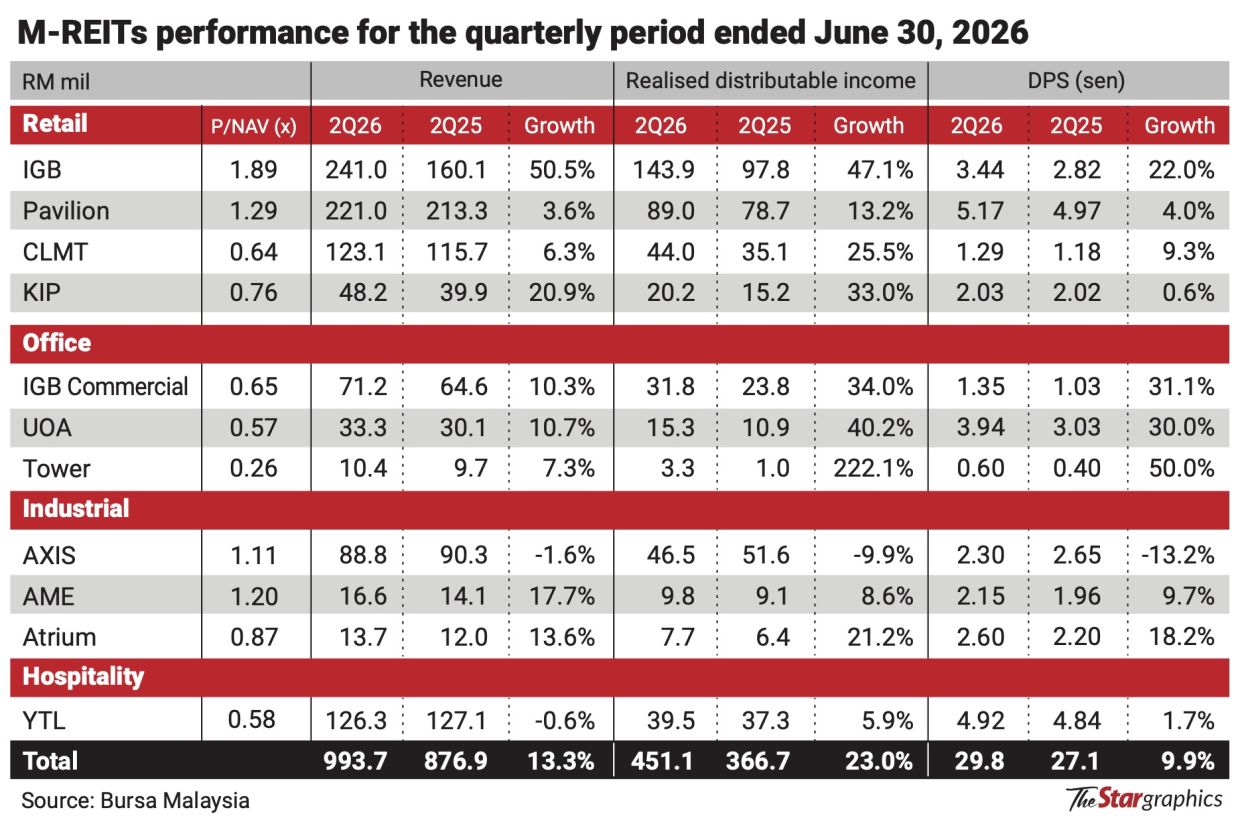
For this analysis, only revenue, realised distributable income and dividend per share for the latest reported quarter are compared with the corresponding period a year earlier.
The reported earnings may not be accurate as they include unrealised gains, which, depending on the financial year-end, may also include fair value changes in investment property portfolios.
Based on the data compiled, M-REITs posted decent top-line growth of 13.3% year-on-year (y-o-y), led by strong growth from companies like IGB-REIT, KIP-REIT and AME-REIT, whose revenue expanded by 50.5%, 20.9% and 17.7% y-o-y, respectively.
In terms of realised distributable income, growth was even stronger, rising 23% y-o-y to RM451.1mil in 2Q26 from RM366.7mil a year earlier.
IGB-REIT again led the growth, with realised distributable income rising 47.1% y-o-y, followed by UOA-REIT with a 40.2% increase.
IGB Commercial-REIT and KIP-REIT were the next strongest performers, with realised distributable income rising 34% and 33% y-o-y, respectively.
Higher dividends
Dividend growth was a natural result of higher realised distributable income, as M-REITs are mandated to distribute at least 90% of their income to unitholders.
Hence, it does not come as a surprise that, except for Axis-REIT, all M-REITs reported higher dividends per unit in 2Q26 compared with the same period last year.
Overall, dividends per share jumped by 9.9%, led by Tower-REIT’s 50% increase to 0.6 sen from 0.4 sen a year ago.
IGB Commercial-REIT saw a 31.1% y-o-y increase to 1.35 sen, while UOA-REIT’s dividend per share rose 30% to 3.94 sen, as shown in the accompanying table.
Mitigating tax impact
The growth in revenue, realised distributable income and dividends declared by M-REITs shows that the sector remains resilient.
The sector’s underperformance y-t-d following changes in tax treatment should be viewed as a temporary setback.
Growth in dividends can offset the tax impact for unitholders who are in the higher tax brackets to a certain extent.
After all, M-REITs have always been regarded as defensive investments, backed by income-producing real estate assets that generate recurring cash flows.
While market sentiment may fluctuate in the short term, quality real estate assets have historically demonstrated their ability to preserve and grow value over the long term, making M-REITs an attractive investment for income-focused investors.
This is clearly demonstrated by the latest quarterly results of listed M-REITs.
Staying relevant
In general, the M-REIT sector thrives on healthy occupancy levels, strong tenant retention, positive rental renewals and proactive asset enhancement initiatives despite a challenging business environment, especially in the retail and office segments.
It is a well-known fact that there is an oversupply in these two segments, but M-REITs in both categories have shown resilience in not only growing the top line but also efficiently managing their cost structures.
This is reflected in the strong realised distributable income-to-revenue margin, averaging 45.4% in 2Q26 against 41.8% a year earlier.
IGB-REIT commanded one of the highest margins at 59.7%, while AME-REIT also recorded a strong margin of 59.1%.
At the lower end of the ranking is YTL Hospitality-REIT, with a realised distributable income-to-revenue margin of 31.2%.
Still attractive
As M-REITs are typically valued based on their income distributions and yields, the sector’s performance in 2Q26 shows that it continues to offer attractive distribution yields relative to many alternative investment options available today.
Coupled with the stability of recurring rental income and portfolios of quality real estate assets, M-REITs provide investors with an appealing combination of income, resilience and long-term capital appreciation.
Interestingly, while top retail and industrial M-REITs trade at premiums to their net asset values (NAVs), some M-REITs in the two segments continue to trade below their respective NAVs while providing attractive dividend yields based on the latest quarterly results.
CapitaLand Malaysia Trust (CLMT) and KIP-REIT are two retail-based M-REITs that continue to trade at discounts to their NAVs.
YTL Hospitality-REIT also trades at a significant 42% discount to its NAV, while Tower-REIT, UOA-REIT and IGB Commercial-REIT, which are all office-based M-REITs, were last seen at 0.26 times, 0.57 times and 0.65 times NAV, respectively.
In conclusion, while tax policy changes have dented market sentiment towards the sector, strong fundamentals will prevail.
With resilient portfolios, disciplined cost management, prudent capital management and consistent distributions, M-REITs will continue to deliver sustainable long-term value to unitholders.