
The US labor market is fatigued! The number of non-farm workers unexpectedly fell by 23,000 in July, and the May/June data was drastically revised, and expectations of the Fed's interest rate hike cooled down
The Zhitong Finance App learned that the number of new non-farm payrolls in the US unexpectedly turned negative in July, and the number of new non-farm payrolls in the previous two months was drastically lowered, indicating that the US labor market is facing new challenges after showing resilience beyond expectations earlier this year. While this weak employment data raises investors' concerns about the US labor market, it may also cause the Federal Reserve to face complicated interest rate decisions when trying to find a balance between employment and inflation.
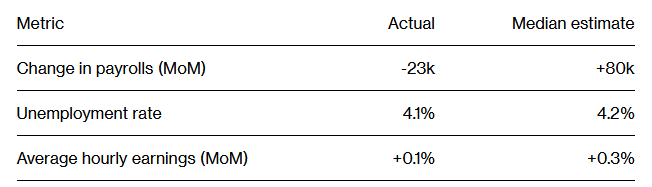
According to data released by the US Department of Labor on Friday, the number of non-farm payrolls fell by 23,000 in July, far below the 80,000 increase expected by the market. Meanwhile, the number of new non-farm payrolls was lowered from 129,000 to 63,000 in May, and the number of new non-farm payrolls was lowered from 57,000 to 20,000 in June; after the revision, the total number of new jobs added in May and June was 103,000 lower than before the revision.
The unemployment rate fell from 4.2% in June to 4.1% in July, the lowest level since June 2025, below market expectations of 4.2%. The labor participation rate continued to decline, from 61.5% in June to 61.4% in July. Although the unemployment rate is still in place, it is largely due to a large number of workers leaving the labor market rather than the solid employment situation itself.
In terms of wage growth, the average hourly wage increase in July was 0.1% month-on-month, lower than market expectations of 0.3% and June 0.3%; the year-on-year increase was 3.2%, lower than market expectations of 3.5% and June's 3.5%.
Specifically, the decline in non-farm payrolls in July was mainly driven by layoffs in government departments, the leisure and hospitality industry, and the retail industry. Private sector employment increased by 30,000 for the second month in a row, with the healthcare and social assistance industry as the main driving force.
Local government employers have cut nearly 60,000 jobs, almost all from the education sector. Since many teachers temporarily leave the employment statistics list during the summer vacation and return again at the beginning of the new school year, employment data in this field usually fluctuates greatly during the summer. At the same time, the number of jobs in the federal government has also declined.
The number of people employed in the leisure and hospitality industry fell to its lowest level in nearly a year, with restaurants and bars cutting staff, indicating that the FIFA World Cup, which ended on July 19, did not boost employment growth as many forecasters had previously anticipated.
The number of people employed in manufacturing and construction continues to rise. Many economists point out that the data center construction boom may be an important driver of the increase in labor demand in the construction industry in 2026, even if housing construction is still limited by a high-interest rate environment.
The number of people employed in the financial activity sector fell to its lowest level in four years. The industry is an important source of white-collar employment, and these jobs are considered one of the most vulnerable to the spread of artificial intelligence (AI).
This latest employment report shows that the US labor market may be beginning to weaken under the influence of rising prices and the uncertainty brought about by the Middle East War. Although consumer demand has shown resilience up to now, prompting some employers to continue their recruitment plans, signs of a cooling in the labor market are showing signs.
It is worth mentioning that this weak non-farm payrolls data may prompt the Federal Reserve to postpone plans to raise interest rates. After the data was released, the US dollar index DXY fell nearly 30 points in the short term to 99.67. The increase in futures on the three major US stock indexes increased. Spot gold rose by about 40 US dollars to 4351.43 US dollars/ounce in the short term; spot silver rose more than 1 US dollar to 64.72 US dollars/ounce in the short term. Two-year US Treasury yields, which are more sensitive to short-term adjustments to the Federal Reserve's monetary policy, fell 8 basis points to 4.16% on Friday; 10-year US Treasury yields fell 6 basis points to 4.62%.
According to US interest rate futures market pricing, interest rate hikes are expected to be only 28 basis points by December, lower than the 32 basis points before the release of non-farm payrolls data. Following the release of the July Non-Farm Report, investors are turning their focus to the July US Consumer Price Index (CPI) data to be released next week to assess what actions the Federal Reserve may take in September.