
Bullish sentiment has risen to extreme levels since 2021! Bank of America splashes cold water on the back of a rebound in US stocks: investors should reduce their exposure to risky assets
The Zhitong Finance App learned that Bank of America strategists warned that investors' bullish sentiment has reached an extreme level, and now is the time to start reducing exposure to risky assets. A team of Bank of America strategists led by Michael Hartnett said in a report that the bank's “long and short sentiment indicator” has risen to the highest level since 2021, from 9.4 to 9.7. The strategist pointed out that the widening range of gains in the stock market, the massive inflow of high-yield bond capital, and the narrowing of credit spreads are the main reasons that are fueling investors' optimism.
However, the Bank of America strategist team favors defensive assets, believing that such assets can help protect portfolios from potential negative surprises in the economy, monetary policy, and artificial intelligence (AI) fields. Hartnett said, “We are still in the 'summer retraction/rotation' camp, not the 're-add position' camp.” He advised investors to reduce risk asset allocation or switch to some defensive assets, long-term assets, and the US dollar.
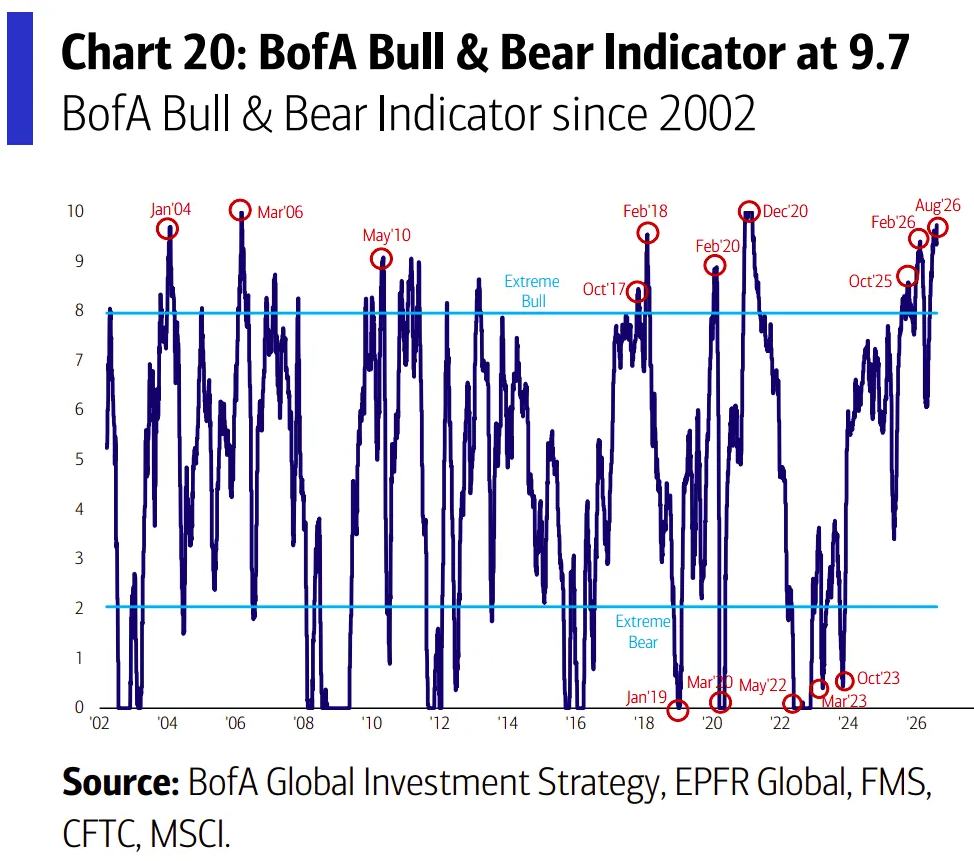
When the Bank of America issued this warning, strong financial reports boosted investors' confidence in the future of AI and promoted a dramatic reversal in US technology stocks. As a result, investors re-poured into technology stocks that had previously been sold off. US stocks hit record highs this week. Investors are awaiting the upcoming US non-farm payrolls report for July to find new clues about the Federal Reserve's next policy actions.
The second-quarter earnings quarter performance of US stocks far exceeded expectations, making investors once again believe that huge AI investments will not only continue, but have also begun to bring returns to some industry giants. According to the data, the backlog of cloud business orders from hyperscale cloud service providers surged more than 150% year on year, totaling about 1.7 trillion US dollars, and the growth rate far exceeded the 80% increase in capital expenditure during the same period. J.P. Morgan pointed out that this significant gap indicates that the potential return on revenue from AI infrastructure investment is exceeding market expectations, and that the pressure on tech giants to absorb valuation may be nearing its end.
However, after this strong earnings season, the exact figure of profit growth also made some investors cautious. According to the latest internal report from Goldman Sachs's sales and trading department, the EPS growth rate of the S&P 500 index constituent stocks in the second quarter was as high as 45% year-on-year — but if the fair value change benefits of equity investments held by large technology companies were excluded, this figure would fall almost to 26%.
In other words, about half of the “record” profit growth came from tech giants' book revaluation of their venture capital portfolios rather than a substantial expansion of the entity's operating profits. AI infrastructure-related stocks contributed about one-third of the S&P 500's overall EPS growth, further highlighting the high concentration of profit growth. These numbers mean that the profit base on which current valuations are based is far weaker than it appears.
Furthermore, during this earnings season, technology stocks still had a 90% chance of exceeding expectations under high expectations, while analysts continued to raise profit forecasts. However, at the same time as profit expectations were raised, technology stock valuations experienced significant compression — after the July market adjustment, the forward price-earnings ratio of the S&P 500 information technology sector fell to about 20 times, close to the lowest level in the past year. It is at the 1st percentile of the historical valuation range, lower than the average of about 23 times over the past ten years.
In response, J.P. Morgan pointed out that the forward price-earnings ratio of large market capitalization technology stocks (excluding semiconductors) is currently more than 2 standard deviations below the historical average since 2018. If the valuation is fixed to 1 standard deviation level below the historical average, there is room for growth of about 30%; if it returns to near the long-term average, the potential upward space may reach about 56%.
Notably, large-scale deleveraging that occurred during the technology stock adjustment period last month caused quick trading funds such as hedge funds to close large numbers of short positions. Currently, these funds have reflowed back and are beginning to buy into the technology sector. According to data from Goldman Sachs Group's Prime Brokerage division, last week, the speed at which hedge funds increased their holdings in the information technology sector reached the fastest level since December 2022. The Goldman Sachs team said that the “Big Seven” have received capital purchases as a whole, but the current overall position level is still low, which means there is still room to further increase positions in the future.
Although many major Wall Street banks have pointed out that the multi-month deleveraging process in the US stock technology sector is nearing its end, macro risks are still accumulating. For example, Goldman Sachs derivatives expert Lee Coppersmith warned that with the end of the earnings season, the market's attention will shift back to interest rates, inflation, and economic growth. The volatility of US Treasury bonds has begun to accelerate again, and real yields are still close to cyclical highs.
The team led by Société Générale strategist Alain Bokobuza pointed out that the second round of US tariffs, the accelerated growth of AI and infrastructure capital expenditure cycles, increased oil price fluctuations, and the continued huge fiscal deficits in advanced economies all indicate that the market's expectations for inflation are “much lower.” Société Générale expects the core PCE to remain above 3% this year, and suggests allocating inflation-protected bonds (TIPS), copper, and gold as inflation hedging tools.