
KOSPI plummeted and destroyed retail confidence! South Korea's “Ant Army” returns to US stocks with $4.6 billion, and the escape of capital threatens to put pressure on the Korean won once again
The Zhitong Finance App learned that the sharp decline in the Korean stock market is disrupting the South Korean government's efforts to push the “Army of Ants (that is, retail investors)” to return to the local market, causing Korean retail investors to pour into the US market on the largest scale in six months, and once again increasing the risk of putting pressure on the Korean won over a long period of time.
According to data from the Korea Securities Depository, in July, when the benchmark stock index Korea Composite Stock Price Index (KOSPI) recorded the biggest monthly decline since the worst period of the 2008 global financial crisis, the scale of purchases of US stocks by Korean retail investors reached 4.6 billion US dollars. This is far higher than the average monthly average of US$2.7 billion in 2025. It is worth mentioning that in 2025, the scale of investment in US stocks by Korean retail investors has more than tripled compared to the previous year.
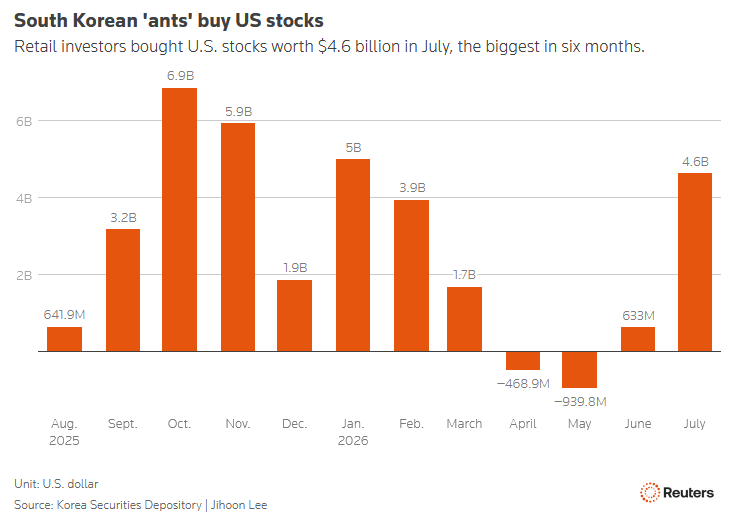
According to the data, the purchasing power of Korean retail investors in US stocks in July surpassed investment in local stocks for the first time since February, which highlights the rapid decline in investors' confidence in the Korean local market. Analysts said that this reversal may reactivate the pattern of Korean retail capital flows overseas over the years, thereby dragging down the won, while also challenging policymakers trying to expand participation in the domestic capital market.
KOSPI's collapse weakens the attractiveness of the local stock market
Small retail investors in South Korea are known locally as “ants” because of their group investing behavior. For a long time, they have preferred the US market over the Korean stock market. Because the performance of the South Korean stock market is usually closely related to the performance of the country's export-oriented giants, including electronics, shipbuilding, and manufacturing companies.
However, over the past few months, this trend has changed for a while. As KOSPI continued to rise, a large amount of retail capital flowed into the Korean stock market. The artificial intelligence (AI) boom and tax incentives introduced by the government — encouraging investors to sell overseas stocks and buy domestic Korean stocks — are driving this change. The South Korean government has been trying to improve shareholder returns by promoting corporate governance reforms for many years, which is also appealing to retail investors.
However, the recent sharp sell-off in South Korea's stock market has exhausted the patience of retail investors. KOSPI fell 33% from the June high as the market began to worry about the continuation of the AI investment boom and competitive pressure brought about by Chinese competitors. Chip giants Samsung Electronics and SK Hynix, which account for most of the weight of the benchmark stock index, dragged KOSPI's market value to evaporate 2257.8 trillion won (about 1.59 trillion US dollars), contributing to the index's decline of about 76%. Furthermore, leveraged exchange-traded funds (ETFs) linked to chip stocks and actively traded have amplified market fluctuations. In contrast, the NASDAQ index remained generally stable over the same period.
Kwon Ah-min, a foreign exchange analyst at Seoul NH Investment Securities, said, “Due to the strong performance of the Korean domestic stock market, capital outflows have slowed down. However, as KOSPI plummeted, capital outflows accelerated again, reinforcing investors' view that the US market was the right choice.” “They are tired of the Korean domestic market.”
The appreciation of the won boosts overseas investment
Notably, the strengthening of the won has further boosted overseas investment by Korean retail investors. In July, the won rose 8% against the US dollar to a nine-month high, the best monthly performance since November 2022. This trend in the Korean won was partly driven by SK Hynix going public in the US to raise 26.5 billion US dollars and repatriate some of the funds to South Korea.
However, the appreciation of the won has reduced investors' motivation to repatriate funds from overseas assets, and may also stimulate new purchases of overseas assets, especially when investors expect the US interest rate environment to continue to support the US dollar.
According to data from the Korea Financial Investment Association, the deposit size of the “Reflow Investment Account,” which was launched by the Korean government in March and aims to encourage the return of funds through tax incentives, experienced a monthly decline for the first time in July. Although part of the capital is flowing into funds holding Korean assets, such as the Direxion Daily MSCI South Korea Bull 3X ETF last month, larger capital is flowing to US stocks and funds focused on investing in the US market. In August alone, as the US stock market hit a new high and KOSPI continued to fluctuate, Korean retail investors bought a net share of 278 million US dollars in overseas stocks.
Meanwhile, according to data from the Korea Financial Investment Association, domestic stock trading account deposit balances, which measure domestic stock demand in South Korea, had fallen to 102.8 trillion won as of Monday, the lowest level since mid-February, and far below the historical high of 140 trillion won set in early June.
Bank of America analysts stated in a report: “If the Korean stock market continues to lag behind the US stock market, we are concerned that the outflow of retail capital from South Korea may occur again.” “In other words, there is very limited space to create a stable portfolio capital flow environment conducive to the continued appreciation of the won.”