
MetalsFocus: The silver mine merger and acquisition boom has not changed the overall outlook for future mineral silver supply
The Zhitong Finance App learned that MetalsFocus released a weekly precious metals report stating that after five consecutive years of downturn, merger and acquisition activities in the global silver mining industry suddenly accelerated between 2024 and 2025. The amount of M&A transactions disclosed in two years reached 14.3 billion US dollars, while the cumulative transaction volume for the previous five years was only 244 million US dollars. Despite the increase in the number of transactions, the sharp rise in total transaction size was mainly driven by a small number of high-value transactions, with the six largest transactions accounting for more than 90% of the total transaction volume.
This wave of mergers and acquisitions has mainly promoted ownership integration of existing silver mining capacity, rather than providing financial support for the construction of additional mineral and silver production capacity. Although the industry's profit margins have reached record highs and the ability to generate cash flow has increased significantly, capital continues to favor mine assets in production that have completed risk release rather than investing in greenfield development projects. This has made silver supply respond relatively moderately to rising silver prices.
The initial wave of mergers and acquisitions mainly revolved around the integration of a small number of low-cost silver mines in Mexico. First Majestic (First Majestic) acquires Gatos Silver (Gatos Silver), whose core asset is 70% interest in the Cerro Los Gatos (Cerro Los Gatos); Coeur Mining (Coeur Mining) buys SilverCrest Metals (SilverCrest Metals) and its recently put into operation Las Chispas (Las Chispas); Pan American Silver (Pan American Silver) acquires MAG Silver Mining, which includes 44% of its interest in the JuaniciPio Silver Mine (JuaniciPio), transferred a total of about 18 million to 21 million ounces of equity ownership of the annual silver production.
Value of completed transactions*
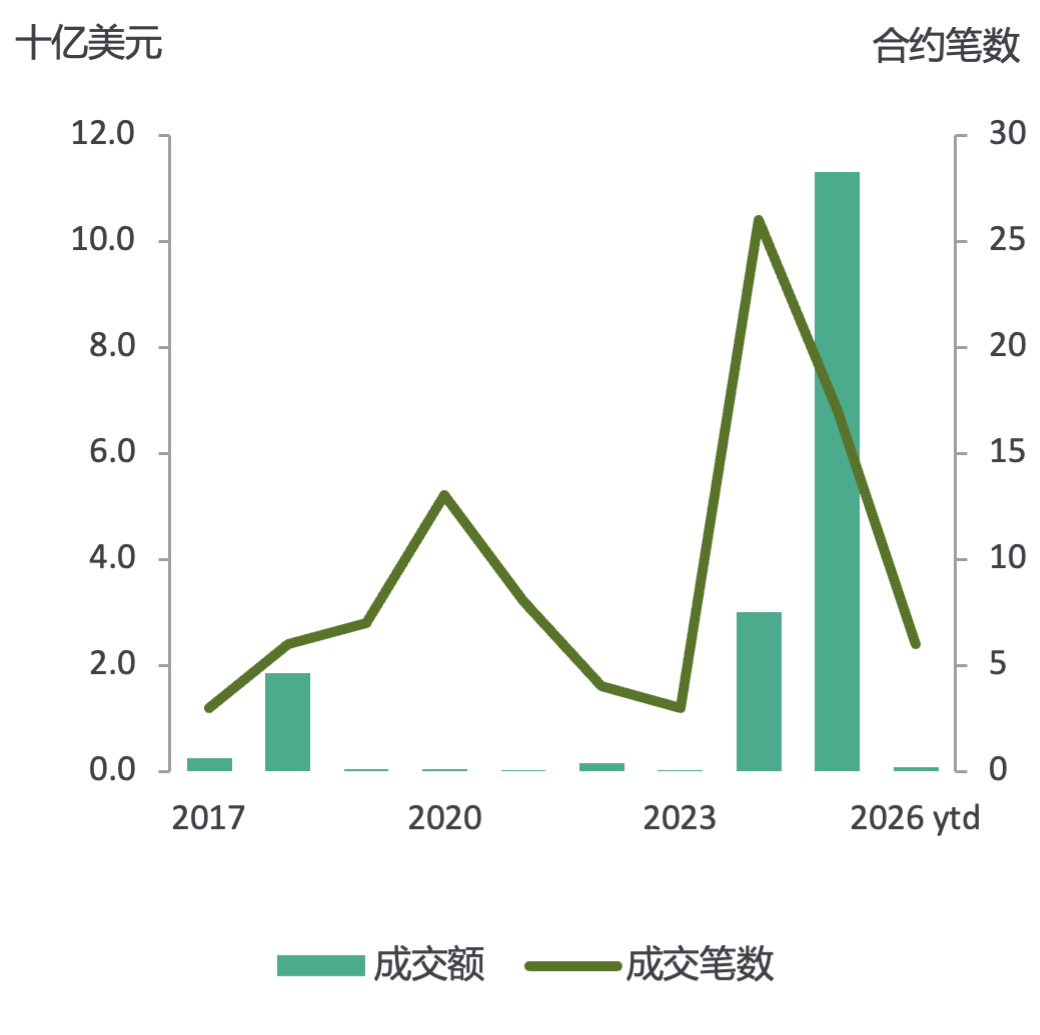
*Annual transaction data is aggregated according to the year the deal was announced.
Since 2026 transactions are only recorded when completed, 2026 data cannot be directly compared.
Data source: Bloomberg, S&P
These acquired mines have many characteristics in common: they are all in the commercial production stage, have high profit margins, and still have considerable potential for brownfield exploration. At the same time, most of the risks in metallurgical processes, infrastructure construction, license approval, and production capacity climbing have been mitigated. As a result, the assets acquired by the acquirer have completed the transformation from mineral resources to operating assets that generate stable cash flow.
Despite the scarcity and excellent quality of these acquired assets, the relevant transaction gave the target company a nominal premium unaffected by the closing price, which was not abnormally high, but ranged between 16% and 22%. To a certain extent, this stems from the relevant transaction structure design: all three transactions are highly dependent on equity payments, so that shareholders of the target company can continue to share the future benefits of the acquired mine even after the transaction is completed, including the value-added potential brought about by subsequent exploration and the increase in value brought by the acquirer through integrated operations and market revaluation.
The shareholders of the former Gatos Bank and Silver Crown Metals received large shares of First Majestic Bank and Kohl Mining respectively, which meant that such transactions were closer to strategic integration than simple direct acquisitions. The use of equity consideration also helps bridge the differences in valuation between the parties to the transaction, so that the buyer does not have to pay the full expected collaborative value in advance when the transaction is completed.
The sources of synergy brought about by different exchanges vary. After acquiring Gatos Bank, First Majestic Bank not only increased the company's silver production capacity and free cash flow generation capacity, but the merged entity also improved liquidity and strengthened balance sheet strength, while complementing underground mines in Mexico, which have local operational expertise and synergy effects. The logic of Kohr Mining's acquisition of Silver Crown Metals is based more on factors such as obtaining immediate free cash flow, strengthening the balance sheet, and expecting to obtain higher capital market valuations after expanding the size of the company. In contrast, the direct mine-level synergy brought about by Pan American Banking's acquisition of MAG Silver Mining was relatively limited, as the Juanisipio mine is still operated by Fresnillo (Fresnillo). The value of this transaction is mainly reflected in the optimization of asset portfolios and financial enrichment by incorporating low-cost production capacity, mineral reserves, exploration potential and free cash flow.
In 2025, silver mining companies are also increasingly using mergers and acquisitions to increase their exposure to the gold business. Although the companies involved in the mineral banking business have disclosed a total of $11.3 billion, most of the transaction amount did not mean an increase in market exposure to mineral silver production capacity. Of this, about $7 billion came from Kohr Mining's acquisition of New Gold (New Gold), and the latter's core assets were Rainy River Gold (Rainy River) and New Afton Copper and Gold (New Afton). Similarly, Discovery Silver (Discovery Silver) acquired Newmont's Porcupine gold mine (Porcupine) in January 2025 for up to $425 million. This move also enabled the company to directly complete the transformation from a silver developer to a Canadian gold producer.
In October 2025, Fresnillo agreed to acquire Probe Gold (Probe Gold) for approximately US$560 million to include a large-scale gold development project in Canada. It also marks the first time that the company has expanded its business outside of Latin America. The above transactions reflect that silver mining companies are turning more widely into gold business exposure, with the aim of quickly obtaining immediate production capacity and cash flow, expanding the scale of business operations, or diversifying geographically.
Global silver production (classified by mineral primary metals)
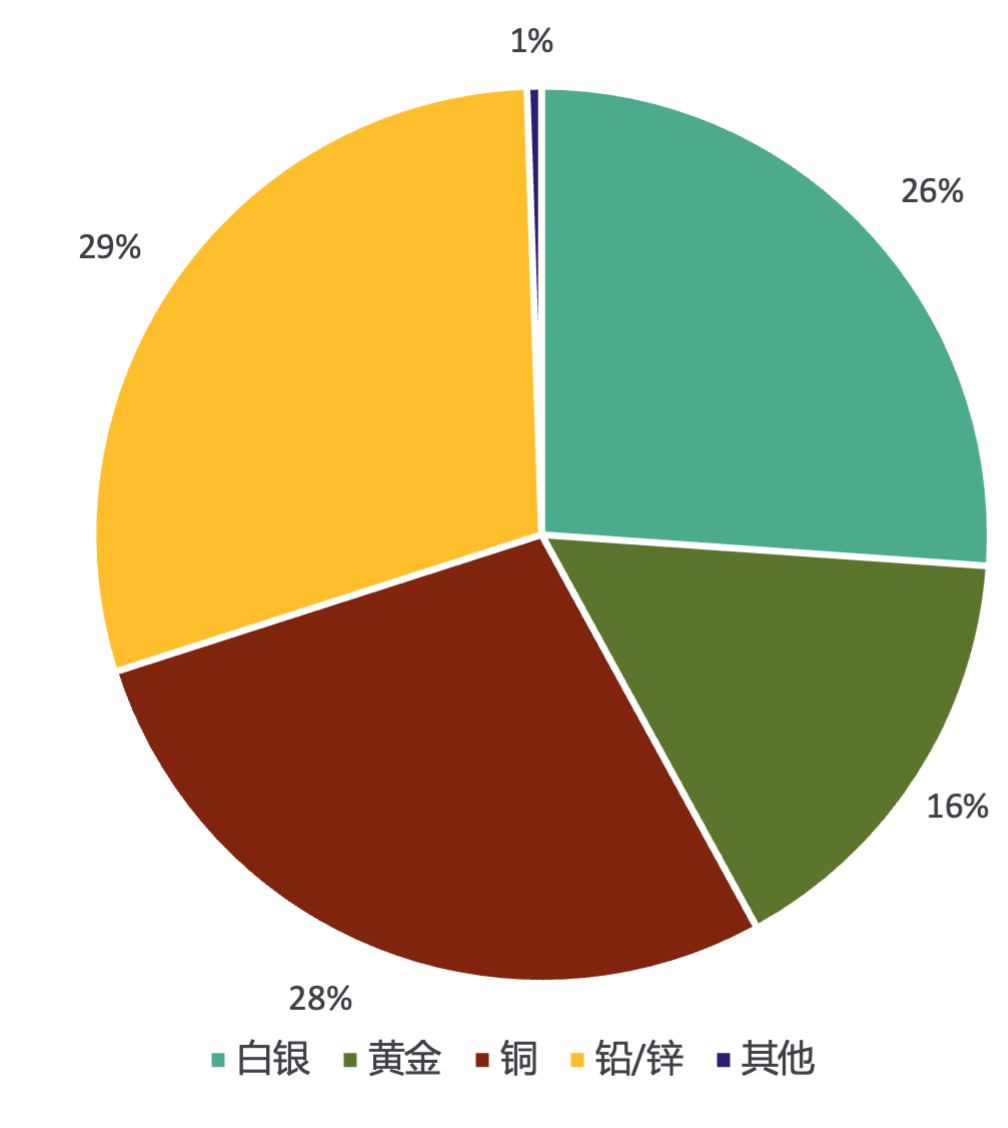
Data source: Metals Focus
Entering 2026, mining companies' mergers and acquisitions are continuing, but the scale of transactions has shrunk markedly, and the nature is different. Up to now, the total amount of mergers and acquisitions disclosed is approximately US$590 million, of which US$352 million is the initial and deferred consideration paid by Orezone Gold (Orezone Gold) for the acquisition of the Casa Berardi gold mine owned by Hecla Mining (Hecla). Hecla Mining chose to sell gold assets and refocus its business focus on its North American core silver asset portfolio. This strategy is in stark contrast to the previously described approach of Cole Mining, Discovery Banking, and Fresnillo to expand their gold business layout through mergers and acquisitions in 2025. Meanwhile, most major silver-related transactions in 2026 revolved around discontinued assets or non-core assets, including the sale of San Martin (San Martin) by First Majestic Bank and the acquisition of Del Toro Silver by Sierra Madre Gold and Silver Company (Sierra Madre).
Currently, the focus of merger and acquisition activities has gradually shifted to asset portfolio optimization, stock asset redevelopment, integration of primary mining enterprises, and diversified targeted business layout. Producers are still clearly willing to pay premiums for mature, stable mines that can continue to generate cash flow, especially those with the potential for further expansion. Therefore, mergers and acquisitions in recent years have focused more on production mines or projects with more clear development paths, rather than development targets that are still in the early stages.
The operating cash flow of mineral silver miners reached a record high in 2025, with a year-on-year increase of about US$4.9 billion. In comparison, capital expenditure increased by only about $1.2 billion. Most of the incremental capital was not invested in new project development, but was used to repay debts, carry out mergers and acquisitions, and improve shareholder returns.
Record silver mining margins are not expected to quickly translate into rapid increases in supply. The bank expects global mineral silver supply to increase by about 123 million ounces within five years, but only about 40 million ounces of this increase comes from mineral silver mines. Therefore, the recent merger and acquisition boom focuses more on releasing value under the current production capacity pattern, without changing the overall outlook for future mineral silver supply.