
Memory chips really are “cash generating machines”! SK Hynix's $28 billion credit bond market deleveraging liquidation smashes a good opportunity to “rise in equity and debt”
The Zhitong Finance App learned that the unprecedented global AI investment boom is actively driving global tech giants to raise billions of dollars by issuing bonds, but at least for a major chip manufacturer, the way it participates in the credit market is not limited to issuing bonds and financing. Some media quoted information revealed by people familiar with the matter as reporting that as cash flow reserves continue to increase, South Korean chip giant SK Hynix (SK Hynix) is expanding the scale of investment in domestic companies' credit bonds. Many credit analysts and market participants estimate that SK Hynix has bought 10 trillion to 40 trillion won (about 7 billion to 28 billion US dollars) of related bond assets this year, with the upper limit of the range also including commercial paper.
The credit spread of Korea's three-year corporate bonds above AA level once widened to about 70.5 bps in mid-July, reaching a high level of about two and a half years. At the time, one reason was that capital had previously flowed from the bond market to the hot stock market; then, the stock market also experienced a non-fundamental sell-off due to forced deleveraging by leveraged ETFs. In other words, the Korean stock and bond market is experiencing a continuous misalignment where “debt first became cheaper due to capital siphon — and then the stock market became cheaper due to the equalization mechanism.”
On the one hand, Samsung and SK Hynix were mechanically smuggled by leveraged ETFs and margin deposits, but on the other side, SK Hynix generated huge amounts of cash due to the AI storage boom, which in turn became an important marginal buyer in the Korean credit bond market. The influx of huge capital similar to the allocation of SK Hynix bonds will directly increase actual purchases of Korea's high-rated credit bonds, help reduce credit spreads and improve liquidity in the secondary market.
At the same time, the Korean stock market side, which has the title of “AI computing power investment trend vane,” has the conditions to return from “liquidity discounts” to the fundamental value of AI semiconductors as the scale of leveraged ETFs shrinks and forced sales decline. Global investors have recently re-bought Korean stocks. In particular, net foreign purchases once reached 7.2 trillion won in a single day on July 31 (Friday) during the final stage of deleveraging, and the size of leveraged ETFs has dropped from a peak of about 50 billion US dollars to 17 billion US dollars, which is evidence that this kind of chip laundering has begun to take effect.
AI storage profits did not deteriorate at the same time, but at the same time left behind low stock risk premiums and broad high-grade credit spreads — meaning that there is room for a positive return to the average on both sides. Valuation may be repaired on the stock side, and credit spreads may narrow on the credit bond side. If the yield on Korean treasury bonds stabilizes or falls at the same time, then it is easier for the price of corporate bonds to actually rise, resulting in a “rise in stocks plus a rise in bonds”; however, if South Korea's risk-free interest rate continues to rise, even if the credit spread narrows, the total yield on corporate bonds will not necessarily fall; the price of bonds may simply outperform rather than absolutely rise.
From an AI storage leader to a major buyer in the Korean bond market, SK Hynix's cash spill
According to people familiar with the matter, SK Hynix also recently announced new internal recruitment matters. In the future, it will be responsible for managing, formulating strategies and hedging the company's capital, including fixed income investments. The scope of investment ranges from government bonds and corporate bonds to short-term debt instruments. This further indicates that the company's activity in the bond market is increasing.
Globally, it is not unheard of for companies to invest in credit markets in stages when they have additional cash to allocate, but this type of activity is still particularly prominent in markets usually dominated by institutional investors. Even though SK Hynix continues to increase capital expenditure, its investable capital has accumulated significantly. By the end of the second quarter, the company's cash and cash equivalents surged nearly 62% from the previous quarter to 88 trillion won.
When asked about related investment activities, a SK Hynix spokesperson said, “The company is evaluating various operating methods to ensure stable and efficient capital management.” The spokesperson gave no further details.
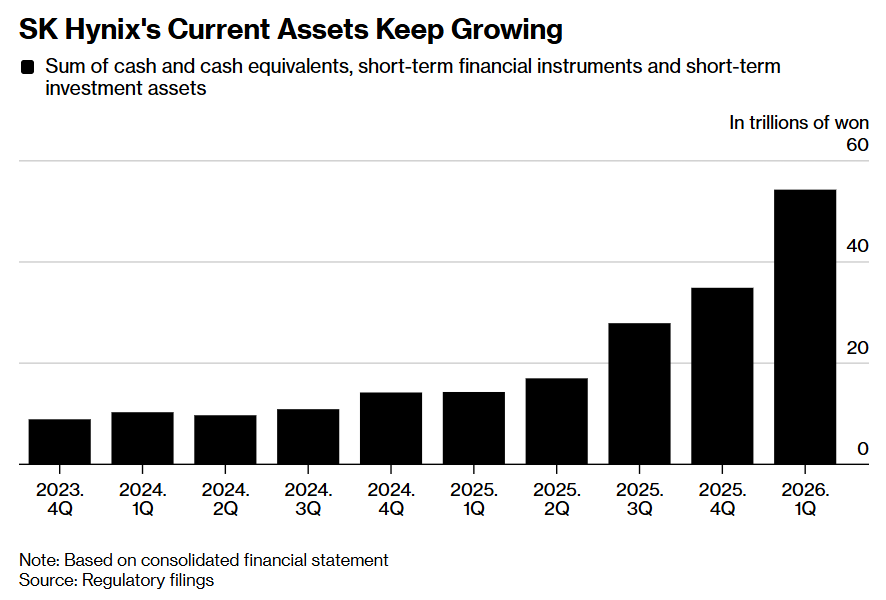
As shown in the chart above, SK Hynix Gao's current asset size continues to grow. Note: Based on consolidated financial statements. Source: Regulatory Documents.
Market demand for the company's high-bandwidth memory (HBM) storage system chips continues to surge, while SK Hynix also raised 26.5 billion US dollars through a record US Depositary Receipt listing last month (that is, entering the US stock market through US stock ADR). Even though the company's stock price has fallen from its June high, it has accumulated a cumulative increase of about 460% over the past 12 months.
Zhao Yongjiu, a fixed income analyst at New Han Young Securities, said, “Normally, companies will deposit additional funds in banks. It's not common for an average business to have such a huge amount of surplus cash. Now that the capital is so large, they are hiring more employees who can manage the huge scale of the investment.”
In April of this year, SK Hynix stated that it plans to continue to expand shareholder returns through dividends, share repurchases, and cancellation of shares in 2026.
According to media reports, citing information revealed by people familiar with the matter, the company has purchased a wide range of bonds, including bonds issued by financial institutions and government-related securities.
The person familiar with the matter mentioned above said that starting around April, SK Hynix's bond subscription scale has expanded markedly. The size of a single order is usually between 100 billion and 300 billion won. They are mainly purchased for investment-grade bonds, which are rated higher than AA and are generally short-term bonds with a term not exceeding about three years.
SK Hynix management stated in a public regulatory document that did not disclose the type of investment in detail that as of the end of March, the company's total short-term investment assets were 14.9 trillion won.
Kim Sang-in, a senior credit analyst at South Korean securities giant Shinhan Securities, said, “Without the inflow of funds from SK Hynix, the local credit market may have experienced a liquidity crunch. “Considering the huge cash flow from expected profits, SK Hynix seems to be mainly holding cash or bonds with an optimistic investment rating if it wants to manage these funds in a stable manner.”
Deleveraging has caused price misalignment, and South Korea's memory chip duo ushered in a fundamental counterattack window
Memory chips — critical to South Korea's exports and the South Korean economy. Korea is home to SK Hynix and Samsung, the two largest memory chip manufacturers in the world. Among them, SK Hynix, the global HBM hegemon, has been Nvidia's core HBM storage system supplier in recent years. Another South Korean storage giant, Samsung, is the world's largest supplier of DRAM and NAND memory chips, and has also recently become Nvidia's HBM supplier, especially the GB200/GB300 series HBM storage system supplier for Nvidia's current flagship AI computing power cluster product, which dominates AI chips.
As breakthrough AI application tools such as AI agents penetrate into various industries around the world, bringing about sky-level “AI inference terminal computing power requirements,” this means that the future prospects for AI computing power infrastructure construction such as AI chips, HBM storage systems, enterprise-grade SSDs, and high-performance networks and power equipment will still be a sea of stars. Furthermore, the end-side AI boom will also bring consumer electronics-grade DRAM and NAND storage demand to a new round of growth curve.
SK Hynix's capital of up to 28 billion US dollars has entered the Korean credit market. What is most noteworthy is not “how much debt it has bought”, but rather that the company has already developed an extremely rare balance sheet state — AI stores cash generated from the supercycle, and even exceeds the speed at which companies can effectively invest in productive assets in the short term.
According to official data for the second quarter, SK Hynix's cash and cash equivalents reached 88 trillion won, an increase of 33.6 trillion won over the previous month; debt was only 18.6 trillion won, corresponding to net cash of about 69.4 trillion won, and the company continued to raise capital expenditure to more than 40 trillion won this year. In other words, even while building M15X, Yongin Cluster, Advanced Packaging, and HBM production capacity while expanding production at a historical level, the company still has huge liquidity that needs to be “docked” through corporate bonds and short-term bonds of up to three years.
This is not a high-leverage expansion common at the top of a normal cycle; it is closer to the full spillover effect of “profit - cash flow - ability to reinvest.” In fact, Samsung and SK Hynix are expected to have a total net cash of about $263 billion by the end of the year, and the market has already begun to require the two companies to further transform the AI cash flow into shareholder returns.
The South Korean stock market's previous sharp decline due to forced deleveraging of leveraged ETFs, margin, and momentum capital has formed a significant divergence from the fundamentals of corporate cash flow; this is the core of Goldman Sachs's so-called “the fundamentals of market pricing are more pessimistic than reality.”
From the perspective of AI system engineering, the biggest difference in this round of storage supercycles is the physical bottleneck of HBM/server DRAM/enterprise SSDs being upgraded from ordinary cycle products to AI computing power systems. Musk rarely commented on the storage market during the SpaceX earnings call for the second quarter of 2026. In the conference call, he said that the storage supply is growing by about 20% every year, but the demand growth rate is 200% or even higher. There is a serious imbalance between supply and demand, and price increases are a basic law of economics. Guo Luzheng, CEO of SK Hynix, said earlier in a July conference call that 2027 may be the tightest supply year in the history of the global storage industry, and that the state where customer demand exceeds the company's supply capacity may continue beyond 2030.
Recent research shows that the rebalancing mechanism of single-stock leveraged ETFs has significantly increased the volatility of Samsung and SK Hynix, so the previous retracement of the 39% to 40% KOSPI index in the Korean stock market cannot be interpreted in equal proportion as the collapse of the storage profit cycle. Therefore, if the shortage of DRAM/HBM supply and demand continues, and mechanical deleveraging has removed the weakest chips, then Samsung and SK Hynix are changing from “high-valuation cycle stocks” to AI infrastructure core assets “mistaken by liquidity, yet have scarce supply+pricing power+huge net cash.”