
An intervention of nearly 100 billion dollars can only buy a week of restitution? The results of the joint intervention between the US and Japan shrunk by nearly half yen and then hit the 160 mark
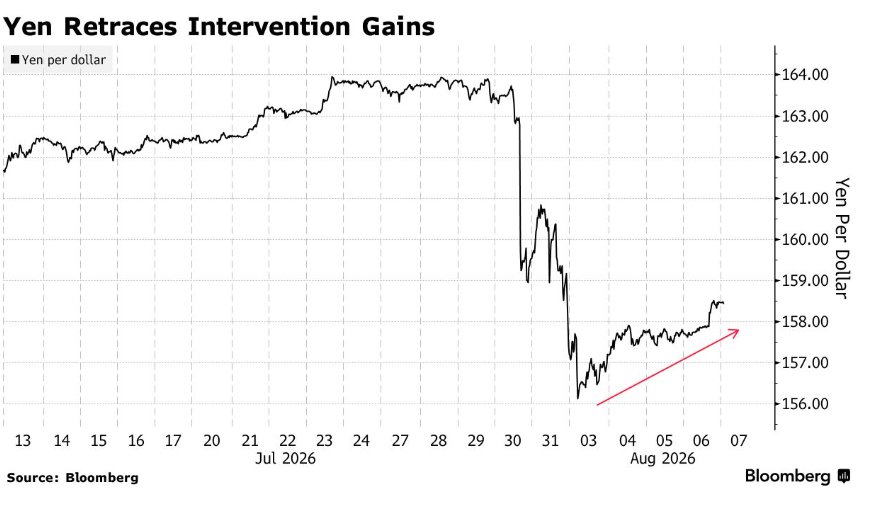
The Zhitong Finance App learned that as the yen, which global foreign exchange traders are focusing on recently, is about to end this week's trading, the recent increase driven by joint foreign exchange market intervention by the US and Japanese governments has returned to nearly half. This has prompted foreign exchange market traders to speculate that at least the Japanese authorities may once again intervene. During the Asian session on Friday, the yen traded around 158.45 against the US dollar, clearly far from the strong level of 155.23 hit on Monday. Last week, before Japan and the US implemented their first joint purchase of yen since 1998, the yen was once close to 164 against the US dollar, near a low of nearly 40 years.
This rapid decline highlights the limitations of foreign exchange market intervention in reversing the long-term downward trend of the yen. The huge spread of interest rates between Japan and the US, the Japanese government's high debt burden, and the high energy prices brought about by the uncertainty of the geopolitical situation in the Middle East continue to weigh on the yen. Meanwhile, as oil prices rise and expectations of the Federal Reserve's monetary policy tightening heats up, the US dollar index recorded its biggest one-day increase in two weeks on Thursday, reflecting market optimism that tension in the Middle East will ease.
Foreign exchange officials from the US and Japanese governments have previously warned investors that they are determined to continue defending the yen if necessary.
The reason why this round of yen intervention shows the characteristics of US-led and Japan-US collaboration is essentially because the problem has been upgraded from “Japan alone stabilizes its currency” to a problem of the US dollar system and global financial stability: if Japan alone buys yen on a large scale, it usually needs to sell its huge US dollar assets, especially US treasury bonds, to raise dollars, which may in turn push up US bond yields and tighten US financial conditions; at the same time, extreme depreciation of the yen and huge Japanese yen arbitrage transactions may also deleveraging risky assets such as the global stock market when a sudden reversal is triggered.
Direct coordination and even intervention by the US Treasury can use the credibility of US dollar issuers and core participants in the global foreign exchange market to form a stronger “policy signal effect,” while reducing the pressure on Japan to sell US bonds. In other words, the US is not simply backing up the yen for Japan, but is preventing the yen crisis from devouring the US financial market through US debt, arbitrage trading, and global liquidity.
An intervention of up to 87 billion US dollars was difficult to change the fate of interest spreads, and the yen quickly rebounded
Moh Siong Sim, strategist at OCBC Bank, said, “There is a high possibility of another intervention, especially as the dollar is once again approaching the 160 key mark against the yen.” But he added, “For the intervention to be truly effective, we need the Bank of Japan to push forward interest rate hikes faster, or a turning point in the macro-environment conducive to the Fed's easing of monetary policy.”
Although the Bank of Japan kept the benchmark interest rate unchanged last week, the overnight index swap shows that the probability that the Bank of Japan will raise interest rates before September is about 60%. Japan's highest-ranking foreign exchange official, Jun Mimura, said that the authorities will coordinate responses to fluctuations in the foreign exchange market in conjunction with monetary policy.
“A week has passed since the initial round of intervention triggered a sharp depreciation of the dollar against the yen, but the market's focus has turned back to US Treasury yields, seeing this as a catalyst for the strengthening of the dollar. Foreign exchange traders also saw that for the second time, the market failed to lower the dollar below 155 against the yen, making the foreign exchange intervention strategy led by US Treasury Secretary Scott Bessent seem more like a one-time action.” Markets Live strategist Mark Cranfield from Bloomberg Strategists said.
The Japanese government said that during the spring Golden Week holiday, the government interfered in the foreign exchange market three times to support the yen; this went beyond the recent pattern of two consecutive moves, and the additional round of intervention was clearly aimed at maximizing the psychological impact on the speculative forces of the yen.
Analysis by financial institutions based on Bank of Japan accounts shows that the relevant government authorities under the coordination of the US Treasury may have used about 34 billion US dollars to intervene in the foreign exchange market on July 31 to support the yen. The day before that, the Japanese government authorities under the coordination of the United States may have invested 53 billion US dollars; if confirmed, this is likely to be the largest single-day foreign exchange intervention in the human community's recorded history.
First Eagle Investments' portfolio manager Idana Apio said that the intervention “can buy enough time to form a more credible fiscal or monetary policy mix, or deliver firmer exchange rate support information to investors.” “But I don't think intervention alone can be successful,” she added.
Since the policy formulation policy led by Federal Reserve Chairman Kevin Walsh still makes it difficult for Wall Street strategists to determine their next steps, traders also remained cautious before the US non-farm payrolls data was released on Friday. The implied market volatility of the USD/JPY one-week period continued to rise on Friday. This period also covers non-farm payrolls data and the inflation report released next week.
Charu Chanana, chief investment strategist at Saxo Markets, said: “Joint intervention is still possible. US Treasury Secretary Scott Bessent's 'whatever the cost' phrase and the US Treasury's instructions to Wall Street banks to prepare for future action all suggest that last Friday's intervention was not necessarily just a one-off act.”
The real enemy of the yen is not speculators, but the Bank of Japan's policy dilemma
The primary reason why it is difficult for the yen to continue to strengthen is that foreign exchange market intervention changes short-term supply and demand, while interest spreads change daily position earnings. The Federal Reserve's policy interest rate is still 3.50% to 3.75%, and the Bank of Japan's interest rate is only 1%. The difference between the two is about 250-275 basis points; investors can continue to obtain positive dividend returns by borrowing low-interest yen and holding dollar assets. Joint purchases between the US and Japan once pushed the dollar from around 164 to 155.20 against the yen, but as of August 7, it had rebounded to 158.45, indicating that the intervention forced bears to close their positions for a short time, but did not eliminate the economic incentives to re-establish short positions.
The market is not unanimous that the Bank of Japan will not re-adopt the interest rate hike policy until 2027 — a Reuters survey shows that most analysts still expect the central bank to return to 1.25% during the year — but even a 25 basis point rate hike is not enough to fundamentally reverse the current pattern of interest rate spreads.
The deeper constraint is that the Bank of Japan cannot raise interest rates as quickly and drastically as an ordinary high-inflationary economy. The International Monetary Fund predicts that Japan's total government debt will still be about 203% of GDP in 2026, while the Bank of Japan holds Japanese treasury bonds on a large scale for a long time; if policy interest rates and treasury bond yields rise too fast, government interest burdens, bank and insurance institution bond book losses, and liquidity pressure on the treasury bond market may all expand simultaneously.
As a result, Japan needs to keep its fiscal and financial system stable while curbing imported inflation and depreciation of the yen. As a result, the pace of interest rate hikes often lags behind the degree of tightening required for the exchange rate. Interventions can buy time for policy adjustments, but they cannot replace a credible set of policies that can continuously reduce interest spreads, stabilize fiscal expectations, and attract capital flows back.
Furthermore, rising oil prices and Middle Eastern risks are simultaneously strengthening safe-haven demand for the US dollar and worsening the trade terms of the energy importer Japan; the resilience of the US economy and the high yield on US bonds have also quickly refocused the exchange rate from official intervention to return on US dollar assets. As a result, the medium term state of the yen is more likely to repeatedly trigger intervention and deterrence around 158-160, but it is difficult to achieve continuous unilateral appreciation. A rise in the probability of another joint intervention around the critical 160 point mark will cause shorting the yen to face the final risk of a sudden reversal of hundreds of points; but only if the Bank of Japan significantly accelerates interest rate hikes, the Federal Reserve shifts to easing, energy prices fall, or a large-scale return of Japanese capital can the yen escalate from a “policy-backed rebound” to a true trend appreciation.