
The sound of gunfire from Hormuz boosted oil back to $83! Energy channel risk premiums are heating up again, and crude oil bulls have regained pricing power
The Zhitong Finance App learned that after Iran attacked a “hostile target” in the Strait of Hormuz, the international crude oil pricing benchmark, Brent crude oil futures prices continued to rise; at the same time, Iran's Tehran side is seeking to ban ships from the US and other hostile countries from entering this critical waterway in the preliminary management agreement with Oman of the Strait of Hormuz.
Brent crude oil futures rose again above the key technical bullish point of $83 per barrel, having surged nearly 4% on the previous trading day; the North American crude oil pricing benchmark, West Texas Intermediate (or US WTI crude), was close to $78 per barrel. According to the semi-official Fars news agency, the attack occurred on Thursday night local time, after an explosion occurred near Qeshm Island in the Strait of Hormuz.
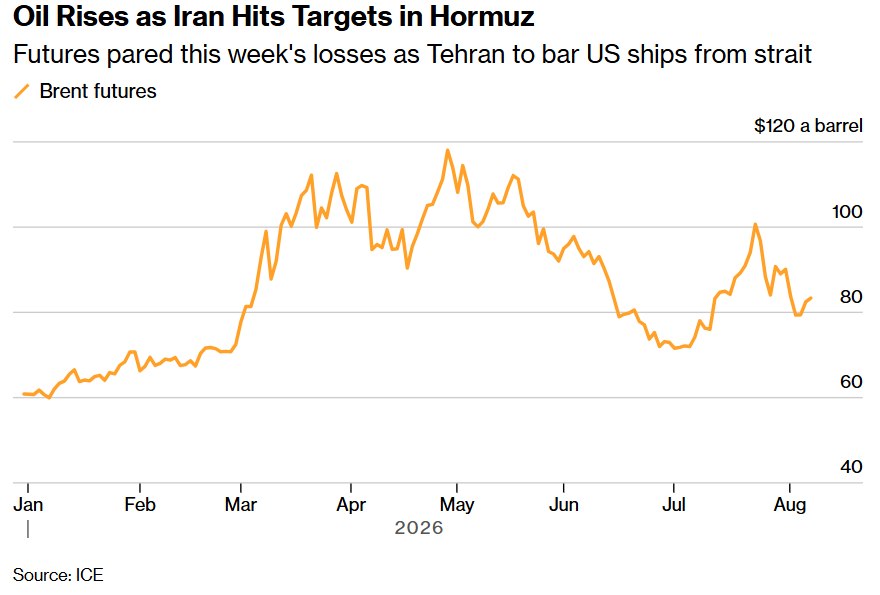
As shown in the chart above, as Iran attacks hostile shipping targets in the Strait of Hormuz, oil prices have risen again — Tehran plans to ban US ships, and crude oil futures have narrowed significantly this week's decline.
As of Friday morning of this week, the situation in the Middle East showed a state of contradiction where “negotiations are still progressing, and waterway risks are escalating at the same time.” The new navigation arrangement discussed by Iran and Oman proposes to restrict US and Israeli ships from entering the Strait of Hormuz, and may impose fines equivalent to up to 20% of the value of the goods, while the Omani side is considering about 3% of the transit fee; the US insists on resuming free and barrier-free navigation before the war, and the core conditions between the two sides are still far apart.
Meanwhile, after the explosion near Qeshm Island, Iran claimed to have attacked “hostile targets” in the strait; the Houthis also launched large-scale missile and drone attacks on pro-Saudi forces in Yemen, and extended the threat to Saudi oil tankers, the Gulf of Aden, and Red Sea routes. Iran also warned that if the US resumes large-scale attacks, the Gulf countries' oil fields, power grids, water resources, and transportation facilities may all be retaliated against, which means that the geopolitical risk in the Middle East continues to expand from a single strait blockade to a large-scale regional threat covering energy production, refining, and transportation nodes.
Iran plans to ban the passage of ships between the US and Israel, and crude oil bulls will regain pricing power! Energy channel risk premiums are heating up again
As market optimism about the full reopening of the Strait of Hormuz and the restoration of energy transportation in the Persian Gulf subsides, crude oil has recovered some of the losses from earlier this week. Under the proposed Iran-Oman agreement, Tehran also plans to ban Israeli ships from crossing the strait and require hostile countries to pay compensation before they can use this waterway.
Rob Haworth, senior investment strategy director at Bank of America Asset Management Group, said: “The agreement to reopen the Strait of Hormuz is still out of reach, and investors are in a state of uncertainty. As it stands, shipping volumes are still low, and the path to a lasting agreement is still unclear.”
Although US President Donald Trump once again stated that he believes the war will end “soon” and that the straits issue is “progressing smoothly,” the parties to the conflict still have huge differences over the terms of reaching an agreement. The US insists that ships can pass freely and return to pre-war conditions; Iran is promoting the establishment of a charging mechanism.
The Middle East conflict appears to be growing. The Iran-backed Houthis said they launched a “large-scale” attack on pro-Saudi government forces in Yemen. Earlier this week, the armed group said it attacked a Saudi tanker in the Gulf of Aden and threatened shipping activities in the northern Red Sea.
In terms of specific price trends, Brent crude oil futures for October delivery rose 1.4% to $83.61 per barrel as of 8:15 a.m. Singapore time. West Texas Intermediate crude futures for September delivery rose 1.2% to $78.24 a barrel.
The reopening of the strait will not make up for the gap in refined oil products, and the refining end takes over the right to energy pricing
In the short term, international oil prices will maintain the typical pattern of “diplomatic news suppressing prices and military upgrades driving up”, and the direction is far weaker than volatility. Brent crude oil fell to 79.36 US dollars per barrel on August 4 due to the cease-fire and the expected resumption of flights, and rebounded to 83.48 US dollars on August 7 due to the Hormuz traffic conditions dispute and security incidents; WTI rebounded from 75.77 US dollars to 78.84 US dollars during the same period. These data all indicate that the crude oil market is not currently forming a stable one-sided bull market, but rather that risk premiums are continuously being re-evaluated for the actual traffic volume of the strait, the availability of insurance, and the probability of a US-Iran agreement.
As long as shipping in Hormuz remains significantly below pre-war levels, there is strong geographical support under oil delivery; if the attack extends to oil fields, ports, or key waterways, oil prices may still jump rapidly upward, but once an unconditional free passage agreement is reached, the crude oil risk premium will also return faster than refined oil products.
Even if crude oil falls back due to negotiations, diesel and aviation coal prices are more likely to “fall slowly and rebound quickly,” and refining profit margins will remain sticky at a high level. According to some senior energy industry analysts, the price of refined oil products on the refining side is likely to be more resilient than crude oil in the next few weeks. Among them, diesel and aviation coal are generally better than gasoline.
The core reason behind the reopening of Hormuz is that the first solution to the reopening of Hormuz is “whether crude oil can be shipped out”, but it is impossible to immediately restore lost refinery production capacity, refined oil product stocks, and logistics networks; Russian diesel exports have been drastically reduced, the export of Middle Eastern products has been blocked, and Chinese exports have been restricted, compounded by long-term high refinery loads and maintenance delays, which together form a structural bottleneck that is more difficult to fix than crude oil supply. In July, the 3-2-1 cracking spread in the US once reached a record high of 64.58 US dollars per barrel, and the European diesel cracking spread exceeded 60 US dollars. European gasoline's premium over crude oil was about 41 US dollars; BP's global refining profit index averaged about 42 US dollars in the third quarter so far, significantly higher than the 30 US dollars in the second quarter and 12 US dollars a year ago.
Currently, the more definitive logic is not simply to increase crude oil, but rather to increase the scarcity of refined oil products and the cash flow elasticity of high-quality refining assets, highlighting that refined oil prices are more resilient than crude oil, and that refining profit visibility is superior to oil price trends, but the risk of asset price reversal is also highly concentrated on the single switch of peace agreements. During this period, US refiners were often able to use flexible raw material sources and export capacity to fill global diesel and gasoline gaps. Pure refiners such as Phillips 66 and Valero are generally more sensitive to profit differences than comprehensive oil companies; ExxonMobil, Chevron, and Saudi Aramco used “upstream oil price+downstream profit” to form a more balanced geographical hedging.