
Global travel boom+World Cup dual engine, Airbnb (ABNB.US) handed over the “strongest in recent years” report card, and AI strategy upgraded to the next ace
The Zhitong Finance App learned that thanks to the continued rise in the global travel boom, homestay and experience giant ABNB.US (ABNB.US) handed over an impressive report card. The company's second-quarter revenue exceeded market expectations and raised its full-year performance outlook for the second time in the year, which drove its stock price to soar sharply in after-hours trading.
According to financial reports released on Thursday, Airbnb achieved revenue of 3.61 billion US dollars in the second quarter, up from 3.1 billion US dollars in the same period last year, and also better than analysts' average expectations of 3.57 billion US dollars. Earnings per share reached $1.37, a significant increase from $1.03 in the same period last year.
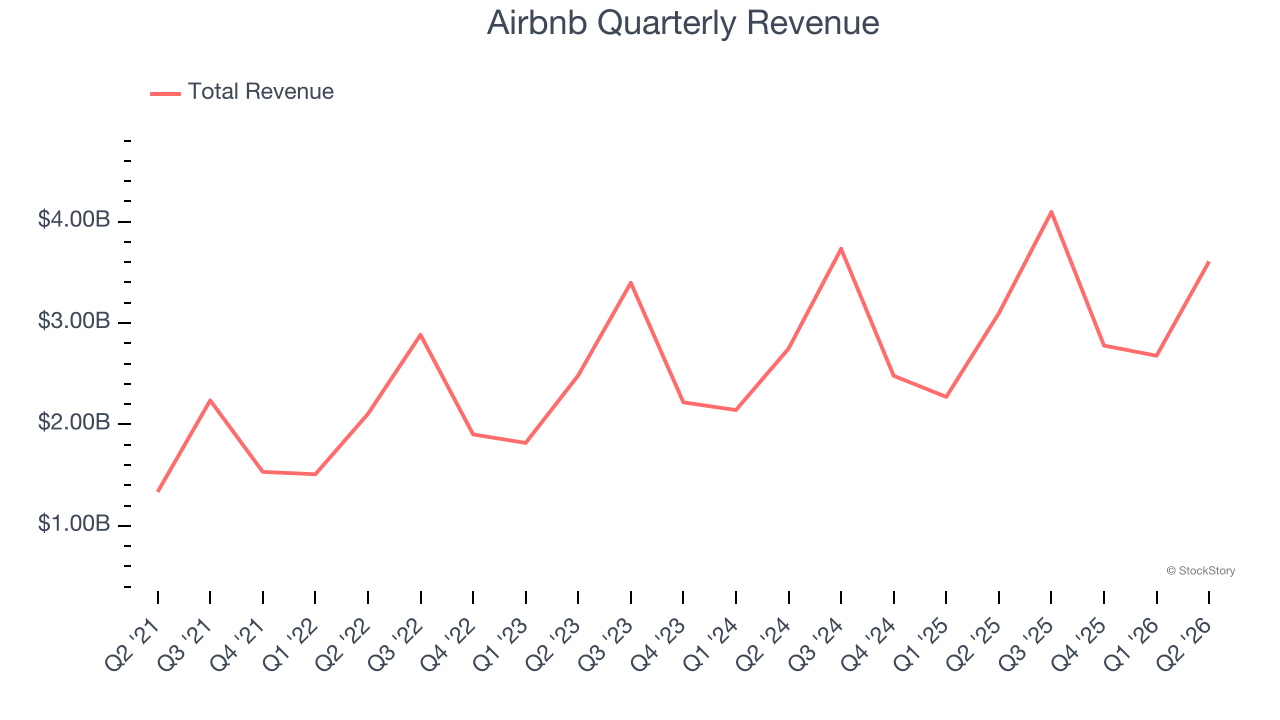
Based on strong global travel demand, particularly driven by strong US and European markets, Airbnb announced an increase in its revenue growth forecast for the full year 2026. The company currently expects the annual revenue growth rate to reach “at least medium double digit percentage (mid teens)”, which is further optimized compared to the “low to medium double digit” guidelines given in May, and is significantly higher than analysts' previous average expected increase of 14%. At the same time, Airbnb also raised the full-year adjusted profit margin forecast for profit before tax, interest, depreciation and amortization (EBITDA) from the previous “at least 35%” to “at least 35.5%.”
In a letter to shareholders, Airbnb said, “The increase in revenue and profit margins reflect the strong demand for the platform, the return on our investment in talent, technology, and marketing, and strong execution of the product roadmap.”
Looking ahead to the third quarter, the company expects its core indicator of business volume, “overnight and experience bookings” to achieve “low double digit” growth, which is higher than Wall Street's forecast of 8.2% increase.
After the financial report was announced, the company's stock price surged by about 12% during after-hours trading.
North America recorded the fastest growth in the past three years, and the World Cup effect was prominent
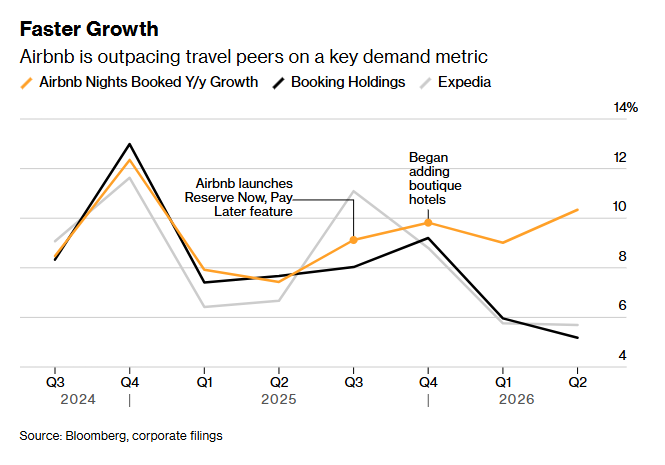
Looking at the breakdown, Airbnb's global night and experience bookings jumped 10% in the second quarter to 148.3 million, exceeding analysts' expectations. The North American market performed particularly well, achieving the fastest growth in nearly three years, and achieved a “high single digit” percentage increase in quarterly bookings. This was mainly due to the FIFA World Cup events held in the US, Canada, and Mexico, which attracted a large number of first-time Airbnb users.
The company pointed out that in addition to North America, core markets such as France, the United Kingdom, and Australia are also showing an accelerated growth trend. Furthermore, strong growth in emerging markets such as Brazil and India helped offset some of the pressure on long-distance international travel caused by the war in Iran, while demand in the Middle East region is also recovering steadily.
CEO Brian Chesky said in a conference call, “We have handed over one of our strongest results in recent years, and the number of new customers trying out Airbnb has reached a new high in many years.”
Currently, Airbnb is accelerating the transformation from a single short-term housing rental platform to a comprehensive travel platform integrating accommodations, experiences, and services. Since last year, the company has introduced boutique hotel properties in some cities with strict short-term rental regulations. This strategy has proven to be effective and has expanded to more than 20 destinations including New York, Paris, London, Madrid, Rome, and Singapore. Cesky said that through the hotel business, some bookers successfully converted into repeat customers and began trying to book homestays. Currently, the growth rate of night between hotels is about three times that of the core housing business, although it still accounts for a single digit share of the total number of nights.
In addition to hotels, Airbnb is also offering additional services such as resort passes, private chefs, and car rentals. As the business landscape expands, Cesky revealed the possibility of accelerating expansion through mergers and acquisitions: “We have plenty of cash and can also generate a lot of cash flow. The entrepreneurs are happy to be part of Airbnb, so I think there are plenty of (mergers and acquisitions) opportunities ahead.”
Cesky also outlined a grand blueprint for the company's transformation: after becoming a one-stop travel platform, Airbnb will move from “travel” to “life” and explore “other ways to connect with people” on the platform in the third phase. This path also means it will compete more directly with traditional online travel giants such as Booking (BKNG.US) and Expedia (EXPE.US), and the latter's latest earnings report this week also expresses optimism about the travel market.
New AI features will be launched at the end of the year, and everything from customer service to search will be fully upgraded
Artificial intelligence (AI) will be the focus of Airbnb's next phase of experience upgrades. Chesky revealed during the earnings call that the company plans to gradually launch a number of AI-powered in-app features later this year.
These features include tools to help users compare listings before booking, and AI voice customer service support on the phone. Chesky said that currently supporting text AI customer service agents in more than 50 languages have helped the company reduce the cost of supporting a single reservation by about 16% year over year.
Cesky also said that this month, Airbnb will also begin testing the new AI search switching function on the homepage. Users will be able to conduct natural language conversational searches and receive listing feedback including personalized titles and visual elements generated by AI.
Cesky emphasized that AI search responses will be “as lengthy as possible” because trips are highly visual and personalized, and it is expected that “much higher conversion rates” can be achieved through this. However, he also said that the traditional search box that users are familiar with will remain the default experience. The company does not want to impose AI search on everyone, and it will take time to cultivate user habits.