
“Sell America” deal reignited! The Federal Reserve lost trust, finance ministers rarely interfered with the yen, and global capital collectively fled US debt and dollars
The Zhitong Finance App noticed that after Washington introduced a series of economic policy decisions in the past two weeks, global bond and foreign exchange investors are discussing whether it is time to resume last year's “shorting America” transactions.
First, Federal Reserve Chairman Kevin Walsh's preference for scarce communication has raised doubts about the Fed's commitment to fight inflation, especially given the unusually large number of officials supporting immediate interest rate hikes.
US Treasury Secretary Basent then approved US support measures for Japan to boost the yen — the first such concerted effort in nearly 30 years. Although the intervention was carried out through the euro and was intended to avoid disrupting the US debt market, it still has the potential to put pressure on the dollar.
As concerns about fiscal conditions, trade wars, and the ongoing conflict in the Middle East may also support inflation, some in the market are beginning to re-evaluate their preferences for US Treasury bonds and the dollar, as people worry that US policies are once again becoming difficult to interpret.
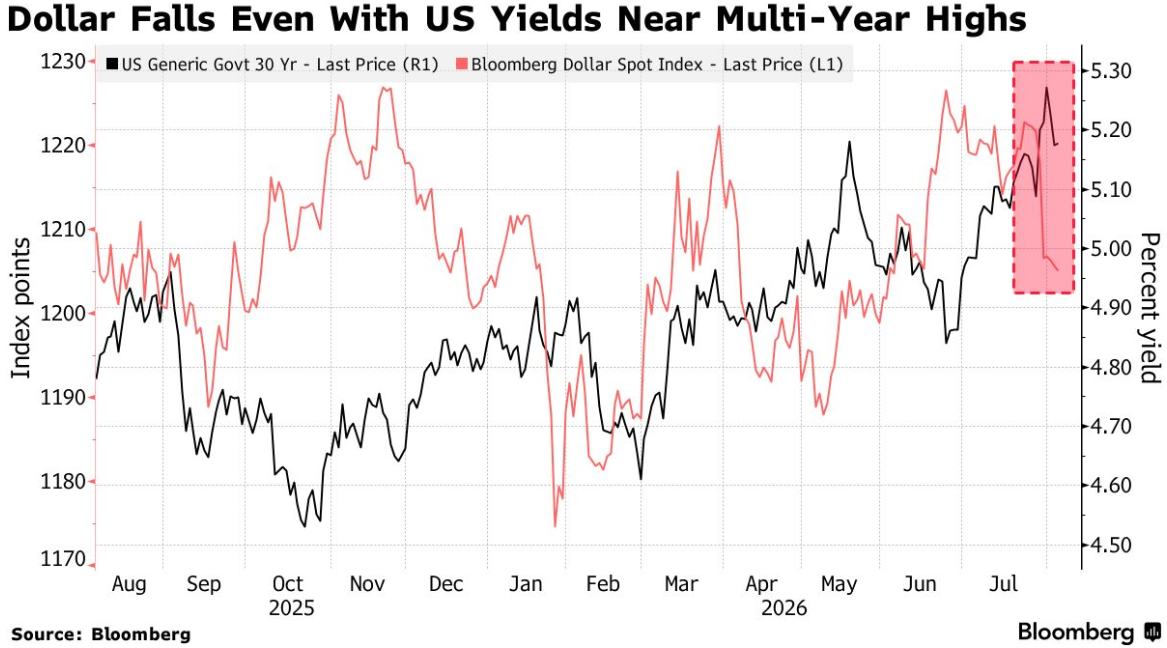
The yield on 30-year US Treasury bonds has risen to more than 5%, the highest level since 2002, although some gains have been recovered since the Federal Reserve meeting; at the same time, despite higher US bond yields (which usually support the dollar), the dollar weakened against almost all Group of Ten (G10) currencies over the past month.
Rajeev de Mello, global macro portfolio manager at Gama Asset Management, said: “Bezent and Walsh are a double blow to the global market, and investors cannot ignore it.” He is selling off US Treasury bonds and dollars, partly because of policy uncertainty.
He said, “They have to start incorporating policy risk into the dollar and US Treasury yield curves; in fact, they are doing that now. This is the 'Trump administration premium. '”
The “shorting the US” deal gained momentum in April of last year when US President Trump announced additional tariffs that triggered simultaneous sell-offs in the US dollar, stock market, and US Treasury bonds. Although that wave of markets quickly subsided, it challenged the assumption that the US could indefinitely rely on the dollar's reserve currency status and deep capital market to finance its widening fiscal deficit.
This time, the situation is more delicate. The US stock market remains resilient, and the rise in technology stocks has pushed the S&P 500 index to a record high. The flow of capital also shows that the market still has confidence in the US. As of May, foreign investors held $9.4 trillion in US Treasury bonds, up 4% year over year, according to US government data.
However, in the field of bonds and foreign exchange, some global investors have warned that without a more clear inflation strategy, the Federal Reserve may lose control of the debt market; and any direct US effort to support the yen would weaken the dollar. If Japan, the largest foreign holder of US government debt, is forced to sell a portion of its holdings of more than $1 trillion to finance the intervention, this could also affect US Treasury bonds.
Carol Lai, fund manager at Saxo Financial Singapore, said: “This confusing set of information is not helpful for capital flows into the US.” The company has a medium-term bearish position on the dollar.
She said, “The truth is that now Bezent has joined in and thinks the yen should probably be stronger, which will help our dollar logic — that is, we are bearish on the dollar.”
The Bloomberg Dollar Spot Index has declined about 2% since its June high.
Strategist Skylar Montgomery Koning said, “In a context where US bond yields are already under pressure due to concerns about the Fed's anti-inflationary credibility under Walsh, Washington is motivated to limit mandatory bond sell-offs.”
Bessent defended America's support for the yen, saying that the weak yen poses a risk that Asian currencies will generally depreciate. He told the media on Tuesday that Washington “will do whatever it takes” to support Tokyo in ways that benefit the US economy and stabilize the global market.
When asked about the reported use of the euro to buy yen during Friday's intervention, Bessent said that US officials maintain close ties with European partners and told them that the move was “just a redistribution of our foreign exchange reserves.”
The intervention raised questions about the dollar's prospects.
Steve Bryce, global chief investment officer at Standard Chartered Bank's Group Wealth Management, said “investors hate uncertainty,” he expects the dollar to fall by about 3% to 4% over the next 12 months, and pointed out that government actions and other factors are weakening the structural advantage of the US market.
American exceptionalism
Admittedly, no one thought that the dollar's dominance in the foreign exchange market with daily trading volume of $9.5 trillion would come to an end, and no one thought that US Treasury bonds would shake as the global benchmark risk-free asset.
Lotfi Caroui, a multi-asset credit strategist at Pacific Investment Management, wrote in a report that US assets are still generally attractive to foreign buyers. One sign is the lack of significant collaborative sell-off.
He said that only about 2% of trading days and rolling five-day cycles this year saw simultaneous sell-off of 10-year US bonds, credit spreads on US investment-grade corporate bonds, and the US dollar. “If people really lose faith in 'American exceptionalism', we expect this type of sell-off to occur much more frequently.”
But the problem is that the pace of their purchases has not kept up with the growth in US borrowing. The US Treasury raised its estimated borrowing demand for the current quarter to $739 billion this week, and market participants expect officials to continue to adopt a short-term debt issuance strategy in the coming months.
Allianz Investors, which manage 598 billion euros (about $690 billion) of assets, favors deals with steeper yield curves, particularly going long on 5-year and 7-year treasury bonds and shorting 30-year treasury bonds, because they think the Fed's slightly dovish stance may put pressure on long-term treasury bonds.
Ranjeev Mann, senior portfolio manager at the investment management company, said, “The risk is that as far as any rate hike cycle is concerned, the Federal Reserve may end up falling behind the curve,” and “you may see the degree of anchoring at the long end of the curve loosens a bit. And, as we all know, America faces major fiscal challenges.”
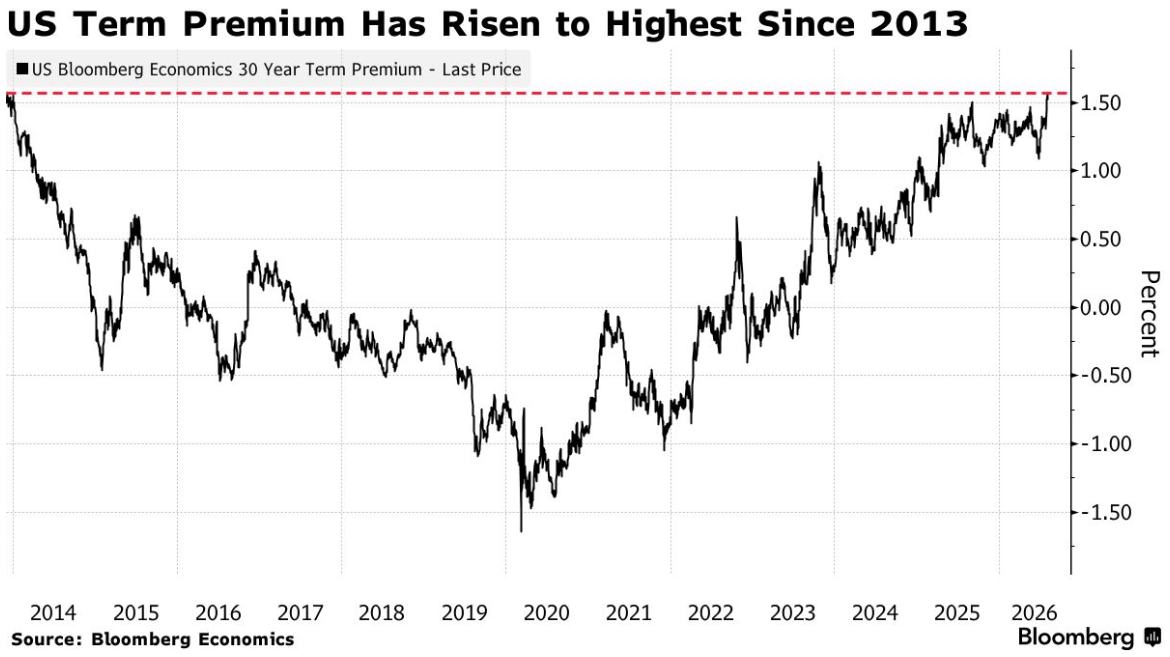
These concerns are being reflected in the price. According to the data, the term premium on 30-year US bonds (that is, the additional yield required for investors to hold long-term bonds) rose to 1.56% this week, the highest level since 2013.
Ronald Temple, financial adviser and chief market strategist in the asset management business, said in an interview this week: “The background of trust in America as a safe haven asset is changing, and there are many questions surrounding this. Over the next few years, you'll see the dollar return to depreciation.”