
AI empowers e-commerce! Shopify (SHOP.US) Q2 revenue surged 34% year over year, Q3 performance guidelines exceeded expectations and drove stock prices to jump
The Zhitong Finance App learned that Canadian e-commerce platform Shopify (SHOP.US) announced better-than-expected second-quarter revenue and third-quarter performance guidelines, indicating that the company's investment in artificial intelligence (AI) is attracting more merchants to use its e-commerce service system, which is expected to ease investors' previous concerns about emerging AI tools increasing competition in the small business market — these AI tools are already putting pressure on Shopify's stock price.
According to financial reports, Shopify's second-quarter revenue was US$3,583 million, up 34% from US$2,680 billion in the same period last year, higher than market expectations of US$3.445 billion; total commodity transaction volume (GMV) was US$115.567 billion, up 32% from US$87.837 billion in the same period last year. In terms of profit, gross profit was US$1,708 million, up 32% from US$1,302 million in the same period last year; operating profit was US$488 million, up 68% from US$291 million in the same period last year; and net profit was US$1,502 million, up 66% from US$906 million in the same period last year.
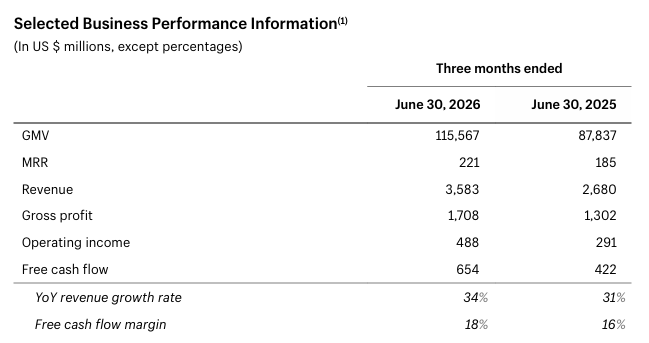
Meanwhile, Shopify expects third-quarter revenue to achieve a “low 30% growth rate”, higher than market expectations of 27%. If this target is met, it would mean Shopify's revenue growth rate of more than 30% for the sixth consecutive quarter. Boosted by this news, as of press release, Shopify's US stocks surged more than 20% before the market on Wednesday.
Shopify's operating expenses for the second quarter were $1,220 million, up 21% from $1,011 million in the same period last year, slightly lower than market expectations. Prior to Shopify's earnings report, the market had anticipated that rising artificial intelligence (AI) costs might squeeze the company's profit margins. However, when it announced its first-quarter earnings report in May, Shopify said that AI has been able to help it complete more than half of its code writing work.
Despite the escalation of geopolitical tension and rising energy prices due to the war in the Middle East, which put pressure on consumer shopping budgets, consumer demand is still showing resilience thanks to a strong job market and rising wage levels.
Through partnerships with OpenAI, Google, and Microsoft, Shopify can help retailers on the platform reach more consumers through AI chatbots or search features, thereby driving demand growth. Shopify's AI tools — such as the Sidekick AI Assistant — also continue to be used by small and medium businesses. These businesses are increasingly reliant on AI to complete all kinds of tasks faster and at a lower cost.
Shopify's president Harley Finkelstein said, “It's been an extremely strong quarter. We support all types of businesses, and with AI, we're expanding the scope of business that all companies can achieve.” Shopify makes a profit by extracting a percentage of transaction revenue from the sales of the platform's merchants and selling subscription service packages to merchants. The company said that merchants of all sizes, product categories and regional markets all achieved steady growth this quarter.
Chief Financial Officer Jeff Hoffmeister said, “On the basis of strong growth in the second quarter of last year, GMV's growth has further accelerated, and merchants of all sizes, channels, and regions have achieved steady results. At the same time, we continued to increase our operating leverage, which ultimately achieved a profit margin of 18% on free cash flow. The model we have been working to build is to achieve broad, continuous, and growing compound growth guided by financial discipline.”