
Omdia: Global video surveillance market to grow 4.3% to $27 billion in 2025
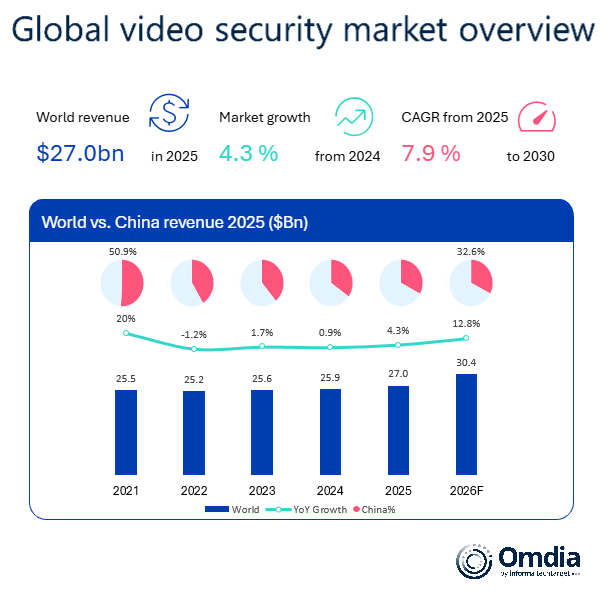
The Zhitong Finance App learned that according to Omdia's 2026 “Global Intelligent Video Security Market Report”, the global video surveillance market will grow 4.3% in 2025 to reach 27 billion US dollars. The market is undergoing a major transformation as demand for AI data centers continues to grow and regulatory frameworks evolve, and these factors are reshaping deployment strategies, storage economies, and business models across the security industry.
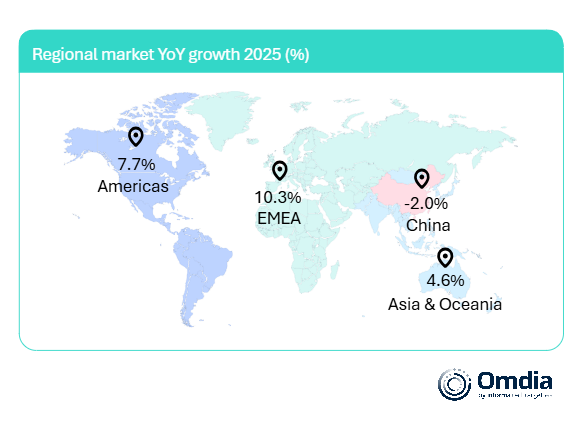
Market performance in 2025 showed significant regional differences. Strong growth in North America and Western Europe is mainly due to AI-enabled system upgrades, accelerated replacement cycles, and strict compliance requirements, including the US Defense Authorization Act (NDAA) and the European Union's Artificial Intelligence Act. Emerging markets have also experienced strong expansion, thanks to large-scale government infrastructure investments and rapid urbanization.
Hardware price increases will drive double-digit growth in 2026
Omdia predicts that market growth will rise to 12.8% in 2026 — mainly driven by rising core device prices rather than increased sales volume. The rapid expansion of large-scale AI data centers has triggered fierce competition in various industries for manufacturing capacity of memory chips, storage devices, and semiconductors. This imbalance between supply and demand is lengthening procurement delivery cycles and driving significant price increases for critical hardware components.
Three strategic changes profoundly transform the global video surveillance market
1. The share of software in market value is rapidly increasing
As customers move to outcome-driven solutions, software's share of total market value continues to grow. The monetization of AI-driven analytics, widespread adoption of video surveillance as a service (vSaaS), and the growing preference of enterprises for operational results over capital equipment are driving up software penetration. This trend is particularly evident in government and industrial applications as well as in developed markets.
2. Accelerating the convergence of cybersecurity and data protection regulations
The global regulatory framework is expanding from traditional product security standards to include mandatory cybersecurity agreements and data localization requirements. In 2025, the Indian market contracted 9.4% after implementing standardized testing and quality certification (STQC) requirements, indicating that compliance barriers could have a significant impact on market performance.
As more regulations are implemented, including Vietnam's QCVN 11:2026 technical standards and the EU's Cyber Resilience Act (CRA), manufacturers are under increasing pressure to integrate secure design principles throughout the product development cycle, or risk being excluded from the market and leaving inventory that can no longer be sold.
3. The Chinese market is shifting to high-quality development
After years of market contraction, China's video surveillance market has begun to stabilize, and manufacturers are adjusting their strategies. Leading manufacturers are no longer prioritizing market share and are putting more emphasis on profitability. This includes exiting low-margin market segments, reallocating resources to differentiated AI capabilities, and implementing stricter project selection criteria that focus on cash flow and accounts receivable management.
Tommy Zhu, senior chief analyst at Omdia, said: “The wave of price increases for core components is expected to continue until 2027. Businesses should re-evaluate their storage infrastructure strategies, prioritize open platforms, and explore hybrid cloud architectures. These measures help make the supply chain more resilient and manage total cost of ownership in the face of unbalanced hardware supply.”